
The Future of GEO: How AI Changes Brand Discovery in 2026 & Beyond

We have now officially entered the AI Discovery Era, a world where people no longer “search” with keywords. They simply ask AI questions in natural language. Instead of showing a list of links, AI provides a direct answer.
This shift changes everything for brands.
Generative Engine Optimization (GEO) is how brands stay visible in this new world.
It’s not a tool or a hack. It’s a survival strategy that helps AI understand your brand, trust your expertise, and include you in its answers.
The risk is real: as Zero-Click discovery grows, many brands that rely only on traditional SEO will disappear from the conversation entirely. If AI doesn’t mention you, recommend you, or cite you, users won’t find you at all.
The new goal is simple:
The future isn’t only about ranking #1. It’s about being the source an AI chooses to cite.
From 2026, brands win by becoming the trusted example AI pulls into its responses—not by fighting for search rankings, but by earning a place inside the answer itself.
What You Will Learn in This Blog:
How Brand Discovery Is Shifting: From Search Engines to Answer Engines
AI tools are changing how people discover brands. Instead of browsing multiple results, users now expect one fast, confident answer—generated directly by an “answer engine.”
Why the Search Paradigm Has Shifted?
Zero-click dominates
Most informational queries end without a click because AI provides the answer immediately. This reduces the value of ranking pages and increases the importance of being cited.
Generative answers replace result lists
AI combines information into one response. Only a few sources make it into that synthesis—often just one.
Entities > keywords
AI understands brands as entities, not keyword matches. Clear brand data, consistency, and authority matter more than traditional keyword targeting.
How Users Discover Brands in AI Search?
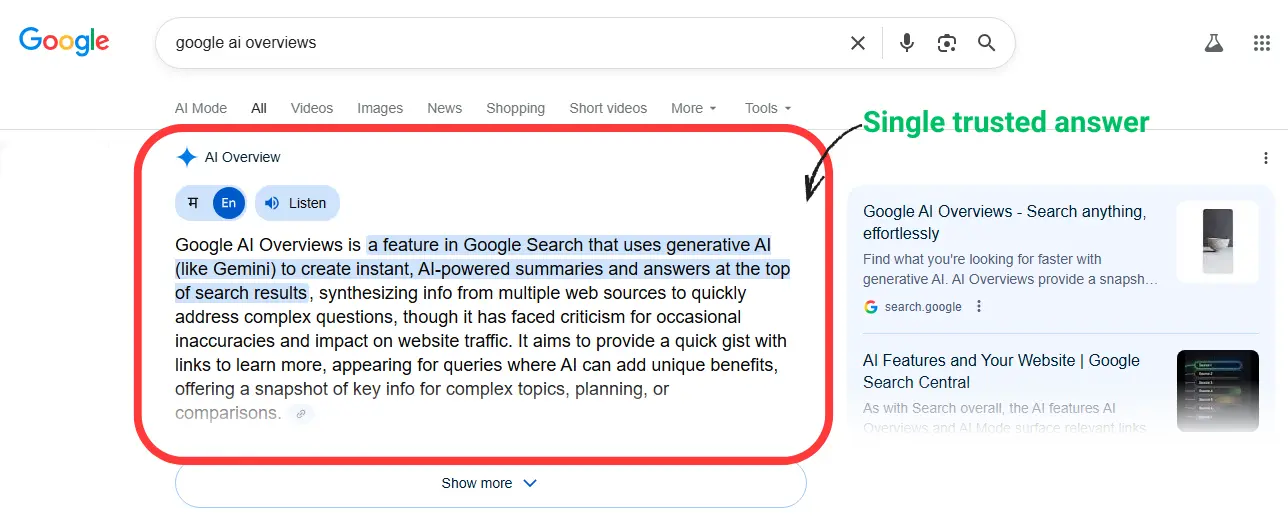
The “single trusted answer” effect
AI tends to recommend only one or two brands. If you’re not included, you’re invisible.
Conversational discovery
Users ask follow-up questions instead of opening new tabs. AI guides them through a decision path, which means brands appear only if they remain relevant across the conversation.
Citation behavior
AI cites sources it sees as authoritative, structured, and frequently referenced. Brands with clear datasets, expert content, and strong entity signals show up more often.
What Exactly Is Generative Engine Optimization (GEO)?
Generative Engine Optimization (GEO) is the discipline of making your brand visible, verifiable, and recommendable inside AI-generated answers.
In simple terms:
GEO ensures that ChatGPT, Perplexity, Gemini, and other AI systems can confidently use your brand as a source when generating responses. Instead of targeting “rankings,” GEO targets mentions, citations, and presence across generative engines.
The Core Mechanism: How GEO Really Works?
To understand GEO, imagine the difference between a Librarian and a Research Assistant.
Traditional SEO treats Google like a Librarian: you want to be the book placed on the top shelf.
GEO treats AI like a Research Assistant: you want to be the source the assistant quotes when they write a report for their boss.
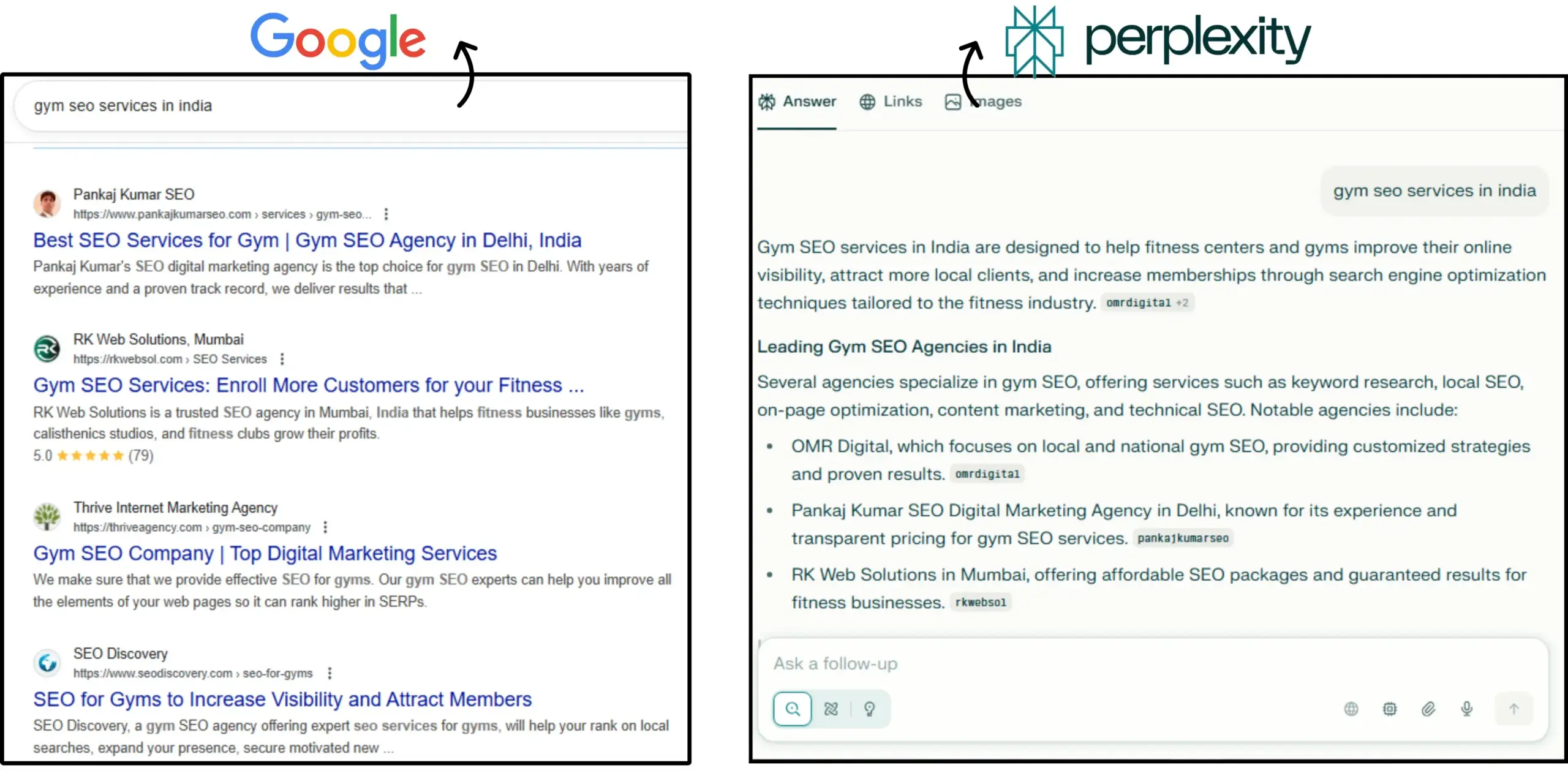
The AI doesn’t just list links; it reads, understands, and summarizes.
Here is the three-step process it uses:
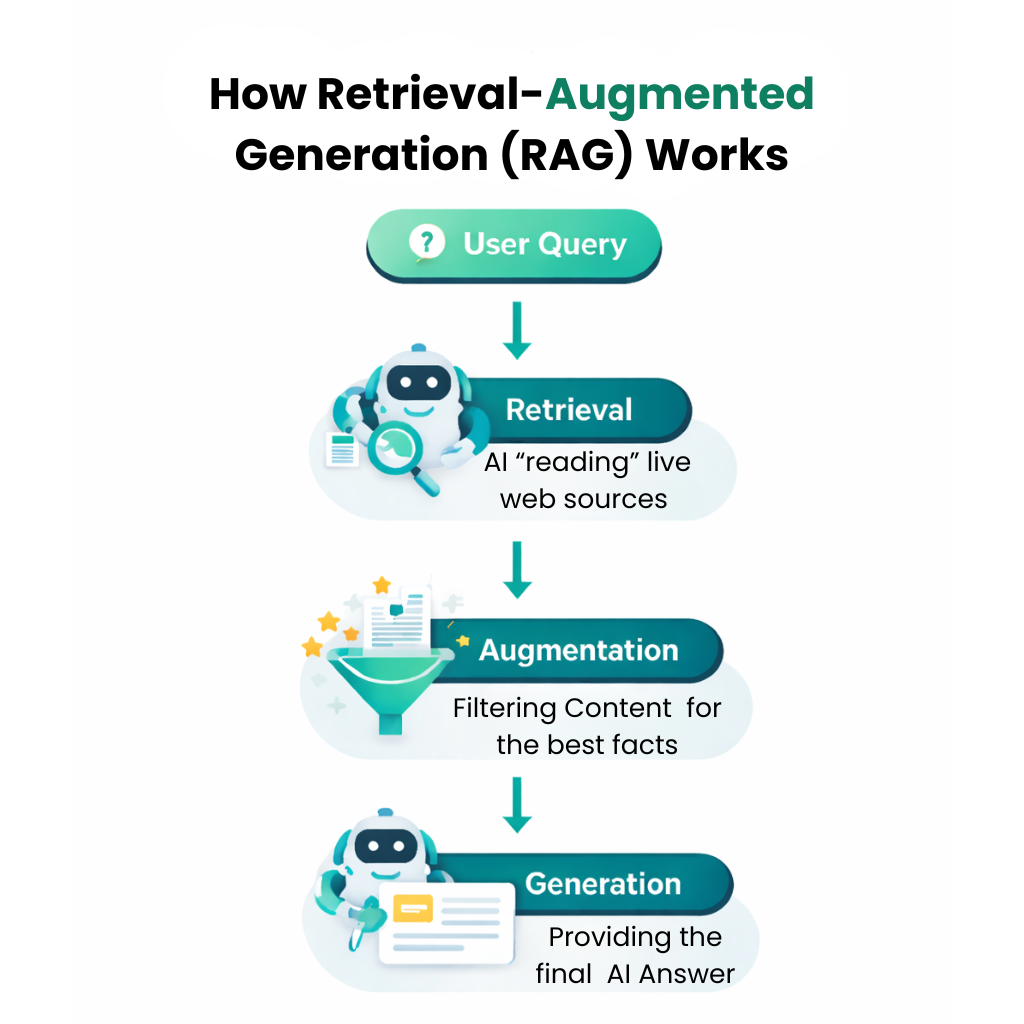
1. Retrieval-Augmented Generation (RAG): Explaining how AI fetches live data
Large Language Models (LLMs) are incredibly smart, but they have a flaw: their training data has a cut-off date. They don’t inherently know what happened today. To solve this, AI search engines use a process called Retrieval-Augmented Generation (RAG).
How this affects your brand:
In GEO, you aren’t just trying to rank; you are trying to be the most accessible page for the RAG system to read. If your site blocks crawlers, loads too slowly, or hides answers behind complex user interfaces, the AI simply won’t “open the book” to your page. It will skip you and fetch the data from a competitor who makes the information easier for the machine to digest.
2. The Importance of “Entities” over Keywords
In the old days, if you wanted to rank for “digital marketing agency,” you just wrote the word “digital marketing agency” fifty times. That is simple keyword matching.
Today, AI understands context using a technology called Natural Language Processing (NLP). NLP allows the computer to read text like a human does, looking for meaning rather than just matching letters.
Inside the NLP toolkit, there is a specific process called Named Entity Recognition (NER) (sometimes called entity extraction or entity chunking).
Entity Chunking groups words together to find meaning. It doesn’t read “New” and “York” as separate words; it chunks them into “New York” (Location).
NER categorizes them. It knows “Nike” is a Brand, “Marathon” is an Event, and “5K” is a Distance.
Why this matters:
You can’t just stuff keywords anymore. You need to structure your content so the NLP algorithms can easily perform entity extraction. You must clearly connect your brand to the topics you cover so the AI knows exactly who you are.
3. Quotability and Trust: Why LLMs Hate “Fluff.”
Here is a secret: AI models are terrified of being wrong.
When an AI writes an answer, it wants to be sure it isn’t lying (hallucinating). Therefore, it loves content that feels like a solid fact. It is looking for Quotability.
If your website is full of fluff like “We are passionate to help brands grow online with innovative marketing solutions,” the AI ignores it. It means nothing.
However, if you write: “Our agency increased organic traffic for clients by an average of 38% within 6 months using targeted SEO and content campaigns,” the AI loves you.
Now it has:
Numbers to grab (38% growth)
A specific outcome (organic traffic increase in 6 months)
Something it can cite
Proof of expertise
The Strategy:
To win in AI-driven search:
Stop writing vague marketing slogans.
Include measurable results, case study stats, or concrete outcomes.
Give AI content it can confidently quote.
In short: make your claims real, specific, and easy to reference.
GEO vs. SEO vs. AEO (Answer Engine Optimization)
While these terms are often used together, they require different strategies. Understanding the distinction is the key to mastering the 2026 AI search optimization landscape
| Feature | Traditional SEO | AEO (Answer Engine Optimization) | GEO (Generative Engine Optimization) |
|---|---|---|---|
| Primary Engine | Google Search, Bing (The “Ten Blue Links”) | Google Assistant, Siri, Alexa, Featured Snippets | ChatGPT, Perplexity, Gemini, Claude |
| The Goal | Ranking #1 to earn a click. | Winning “Position Zero” or the spoken answer. | Being cited, synthesized, and recommended. |
| User Intent | “I want to browse options.” | “I want a specific fact quickly.” | “I want a solution, plan, or comparison.” |
| Primary Signal | Backlinks & Keywords. | Schema Markup & Concise Answers. | Entity Authority, Context & Quotability. |
| Success Metric | Traffic & CTR. | Impressions & Voice Share. | Share of Model (SoM) & Brand Sentiment. |
Key Differences in How AI Evaluates Brands
Unlike traditional search engines that count links, AI models evaluate the “truthfulness” and “probability” of a brand based on four deep semantic layers.
1. Entity Strength (Who You Are)
AI doesn’t just read your website; it looks for your entry in the Knowledge Graph. It asks: Is this brand a defined, verifiable entity?
The Shift: You move from optimizing for “strings” (keywords) to optimizing for “things” (entities). If the AI cannot distinguish your brand name from a generic word, you will not rank.
2. Reputation Signals (How You Are Perceived)
Google counts a backlink as a vote. AI reads the context of that vote. It analyzes sentiment from reviews, forum discussions (Reddit/Quora), and news mentions to determine if your brand is associated with positive or negative outcomes.
The Shift: A high-authority link with negative sentiment (e.g., a complaint article on a news site) now hurts you, whereas in old SEO, the link equity might have helped.
3. Authority Networks (Who You Associate With)
AI maps relationships. It looks at “Co-occurrence”—which other entities appear alongside your brand?
The Shift: If your brand is frequently mentioned alongside industry leaders (e.g., appearing in a listicle with Salesforce and HubSpot), the AI learns to categorize you in that same tier of authority.
4. Multimodal Credibility (What Can Be Seen & Heard)
Text is no longer the only verification method. AI models verify claims by cross-referencing video content, audio transcripts, and images.
The Shift: A brand with a YouTube channel demonstrating a product feature is viewed as more “verified” than a brand with only a text claim about that feature.
6 Forecasts for the Future of GEO (2026 & Beyond)
The next evolution of online visibility will be shaped not by search engines, but by AI agents, multimodal systems, real-time data flows, and entity authority models.
These forecasts outline how GEO will transform from 2026 and what brands must prepare for now.
1. Rise of Agentic SEO – Optimizing for AI That Makes Buying Decisions
By 2026, AI agents (ChatGPT, Google, Apple) won’t just answer questions; instead, they’ll take actions like booking flights, purchasing software, comparing suppliers, scheduling appointments, negotiating renewals, and building shortlists.
This shift is already visible in travel, where companies like Google, OpenAI, Microsoft, and Expedia now offer AI agents that can plan and book trips end-to-end, as highlighted in a recent CNBC report on AI travel agents.
Experts call this the biggest transformation in online travel since the internet, as AI agents move from simple assistants to autonomous decision-makers.
To get chosen by an AI agent, brands must provide:
- Clear pricing, features, and eligibility
- Machine-readable specifications
- Structured decision criteria
- Strong trust signals (refunds, verified reviews, transparent documentation)
In this agentic world, visibility becomes transactional. AI must know not only who you are, but whether you’re a safe, optimal choice.
2. Multimodal Data Will Determine Visibility (Text + Audio + Video)
Generative AI is moving beyond text to understand videos, audio, images, and diagrams, and this shift is already underway. AI systems are actively analyzing multimedia content today, extracting insights from various sources to provide a richer understanding.
Companies like OpenAI, Microsoft, and Google have confirmed this trend, noting that AI search now supports multimodal queries and advising brands to support their pages with high-quality images and videos to perform well in AI-driven search.
AI systems can already:
- Extract insights from YouTube videos
- Summarize podcasts
- Parse webinar transcripts
- Understand product photos, diagrams, or feature tables
- Identify recurring voices, hosts, products, and brand themes
Blogs will no longer dominate visibility. Brands with rich multimodal libraries that provide deeper context for AI are already being favored in search and recommendations.
What Brands Should Do Now?
- Add transcripts to all media
- Attach structured metadata to videos and audio
- Produce authoritative explainer videos
- Maintain consistent visual and verbal identity across channels
Brands that provide structured, high-quality multimedia content will dominate in AI-driven visibility.
3. “Brand Presence Score” Might Replace Domain Authority
You cannot solely rely on Domain Authority in an AI-driven world. Instead, AI systems will judge brands based on a Brand Presence Score, basically, how clearly and consistently your brand shows up across the internet.
This score comes from things like:
- Entity clarity & consistency: whether your brand info is clear and consistent
- Cross-platform profile alignment: Are your brand profiles matching across platforms
- High-quality citations: being mentioned by trustworthy sources
- Presence in industry datasets: showing up in niche industry platforms
- Multimodal footprint: having strong video, audio, and written content
- Data accuracy: verified and accurate data across the web
- EEAT Signals: positive sentiment and trust signals
In simple terms, AI wants to know:
“Can I trust this brand enough to include it in my answer?”
The future version of “ranking” is no longer where you appear on Google; it’s how often AI sees you as a reliable choice.
4. Private Data Partnerships — Big Brands Will Pay to Be Inside LLMs
LLMs are increasingly using exclusive data partnerships to improve their responses.
This is already happening — for example, Reddit with Google, StackOverflow with OpenAI, and major publishers with Anthropic and Meta.
In the future, large brands may pay or negotiate to put their private data directly into AI systems, such as:
- product catalogs
- pricing feeds
- knowledge bases and documentation
- industry research
- customer reviews or support info
Being part of an AI’s training data becomes a major advantage.
Small businesses can stay competitive by making their information open and easy for AI to read, including:
- structured product data
- clear specs and documentation
- verified reviews
- strong schema markup
Making your information accessible helps AI understand and recommend your brand.
5. Entity-Based Optimization and Advanced Structured Data Become the New Technical SEO
Structured data is no longer optional; it is the backbone of AI-driven SEO. Brands must provide clear, machine-readable information so AI can understand how everything connects.
Ensure your brand content includes:
- Deep entity graphs
- Relationship-based structured data
- Product ontologies
- Machine-readable taxonomies
- Advanced schema for services, people, events
- API-fed Knowledge Panels
- Dataset schema tied to real-time updates
This goes beyond traditional SEO — it’s about giving AI clear, organized information it can trust.
Generative engines don’t just look at keywords anymore. They focus on how your information is connected and what it means.
6. Hyper-Personalization Changes Brand Exposure
AI answers are becoming fully personalized.
Two people searching for “best CRM tool” won’t see the same results anymore. Instead, AI will tailor recommendations based on things like their industry, budget, tools they already use, past behavior, team size, location, and personal preferences.
This creates a future where:
❌ There is no universal “top result.”
✔ Only individualized brand visibility.
To stay discoverable, brands need to appeal to many different types of users by:
- Publishing content optimized for different use cases
- Explaining who the product is best for
- Offering clear pricing and feature tiers
- Providing guides for different personas
- Building a wide semantic footprint (covering many related topics).
Which means, the more user types your brand fits, the more often AI will recommend you.
How to Optimize for the AI Era: A Practical GEO Framework
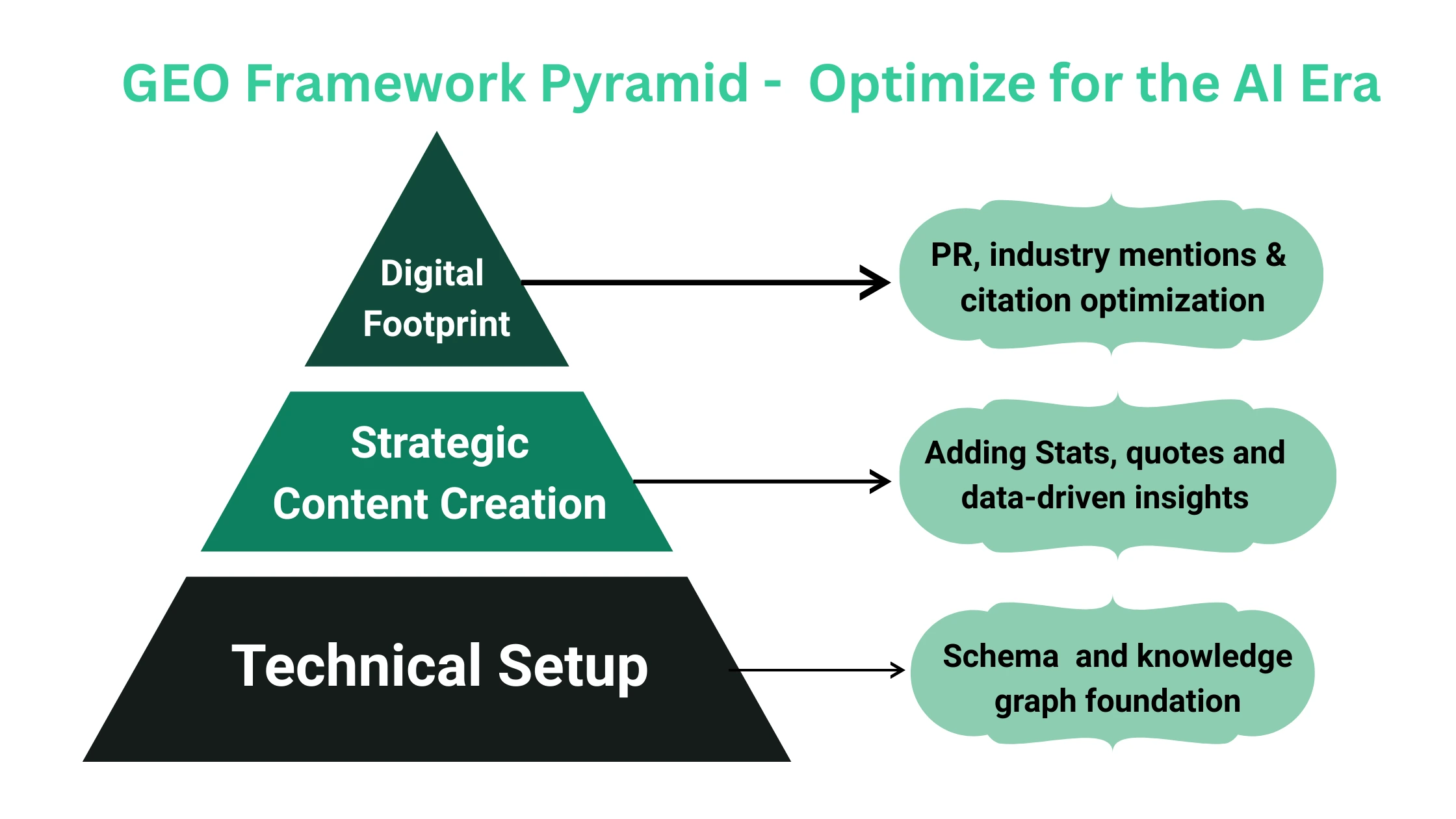
So the big question is:
How do you make sure you or your business shows up in these AI-generated answers?
That’s exactly what this framework is about.
Let’s break it down into three simple pillars that anyone can follow.
Pillar 1: Becoming an Entity (Your Technical Foundation)
Before AI can recommend you, it needs to recognize you.
Think of this pillar as setting up your “digital identity card,” so AI systems know you’re a real, credible entity.
Why does this matter? AI models don’t just look at keywords; they look at entities. An entity is anything that’s clearly defined and easy to verify, like:
- a business
- a person
- a product
- a location
If AI can’t confidently identify you as a real entity, it won’t include you in answers or recommendations.
Actionable Step #1: Use Schema.org (Organization, Person, SameAs)
Schema.org is a tool that lets you describe your business or personal brand in a way that machines can easily understand.
Here’s what to do:
- Add an Organization Schema if you run a business.
- Add Person Schema if you’re building your personal brand.
- Use SameAs to link all your verified profiles—LinkedIn, Crunchbase, social media, Wikidata, etc.
This helps AI systems say, “Okay, this is the same person/company across all platforms. I trust this.”
Actionable Step #2: Claim Your Knowledge Panel
If Google gives you a Knowledge Panel, claim it immediately.
This is one of the strongest trust signals you can send to both Google and AI models.
Inside your Knowledge Panel, make sure your:
- description
- social profiles
- website
- logo
- General information
All these are correct and consistent. Consistency is everything because AI models cross-check information across multiple sites.
Pillar 2: Writing Content That AI Can Actually Use
Once AI recognizes your brand as a real entity, the next step is making sure your content is easy for AI to read, understand, and reuse. This pillar is all about writing in a way that machines—and humans—can quickly grasp. Fluent content = content that’s easy for AI to read, extract, summarize, and quote.
Why does this matter? AI doesn’t think in full paragraphs; instead, it breaks content into “chunks” and patterns. The clearer your writing structure is, the more likely AI will pull your answers directly into its responses.
Actionable Step #1: Use the “Question → Answer → Evidence” Format
This is one of the easiest ways to make your content AI-friendly:
Question: Start with the exact question your audience might ask.
Example: “How can a digital marketing agency increase organic traffic?”
Answer: Give a simple, direct response.
Example: “By optimizing on-page SEO, creating targeted content, and building authoritative backlinks.”
Evidence: Back it up with numbers, stats, or examples.
Example: “Our agency increased organic traffic for clients by an average of 38% within 6 months using this approach.”
Actionable #2: Use Statistics and Unique Data to Earn Citations
AI tools often cite websites that contain:
- original stats
- unique insights
- proprietary data
- industry benchmarks
- expert explanations
If you publish content that includes numbers or original findings, your chances of being cited by AI models increase dramatically.
Examples of content that AI loves to cite:
- “Top industry trends for 2025”
- “Survey results from 300 marketers”
- “Average pricing breakdown of service X”
- “Case study showing a 42% improvement”
If your content includes unique data, you automatically stand out.
Pillar 3: Digital Footprint (Your Off-Page GEO)
Your digital footprint is everything that exists about you outside your website.
This is a huge part of AI optimization, because AI models rely heavily on trusted external sources to confirm if you’re real and authoritative.
Why does this matter? AI systems don’t take your word for it—they check what the rest of the internet says about you. If trustworthy websites mention you, list you, or link to you, AI will consider you credible.
Actionable Steps: Get PR and Mentions on High-Authority Sites
Focus on platforms that AI models already trust and use for training.
These include:
- Wikidata (extremely influential)
- Crunchbase (for businesses, founders, startups)
- Niche Industry publications
- Trusted news sites
Professional directories (eg, Google Business Profile)
Even one or two mentions from credible publications can dramatically improve your perceived authority in the AI world.
This also increases your chances of appearing in:
- “recommended companies” lists
- “top tools for X” summaries
- AI-driven buying guides
- expert roundups
Visualizing Success: GEO vs. SEO Metrics
Traditional SEO has always focused on rankings. If you were in “Position 1,” you were winning. But in the world of AI-driven search, things work very differently.
In GEO, visibility isn’t about your spot on a page. It’s about whether AI chooses your brand as a reliable source.
New Metrics to Watch
Because AI search works differently, we need new success metrics. Here are the key ones:
• Share of Model (SoM)
To measure SoM, you manually test how often AI tools mention your brand versus your competitors.
You do this by asking popular AI engines (like ChatGPT, Gemini, Perplexity, Claude, Bing AI) questions that your customers would normally ask — for example, “best [your service] companies,” “top [industry] providers,” or “who offers [your solution].”
Then you check how often your brand appears in the AI’s answers. Do this for 10–20 relevant prompts, track how many times your brand is included, do the same for your competitors, and calculate your percentage. If your brand shows up in 6 out of 20 AI answers, your SoM is 30%. The more often AI tools mention you, the stronger your Share of Model becomes.
• Brand Sentiment Score
A Brand Sentiment Score shows how positively or negatively people talk about your brand across the internet, based on reviews, social media posts, news mentions, and online discussions.
AI tools use this score to decide whether your brand is trustworthy enough to recommend in search results. While there isn’t one universal place to check this score yet, you can easily get it through tools like Semrush Brand Monitoring.
• Citation Frequency in AI Overviews
AI tools often reference sources when giving answers. This metric tells you how often your brand, website, or content is cited inside those AI-generated summaries.
These KPIs give a clearer picture of your brand’s true visibility in an AI-first world.
Challenges & Risks in the Future of GEO
Optimizing for AI search is powerful, but it comes with its own set of challenges. Since AI platforms don’t work like traditional search engines, the rules aren’t always clear, and they can change overnight.
1. The “Black Box” Problem (Lack of Standardized Metrics)
Unlike SEO, which has years of benchmarks and best practices, GEO is still the Wild West. There are no official “ranking factors” and no console to track your position.
The Risk: You can’t track position changes like you would with Google Search Console. You rarely know exactly why an AI included or excluded your brand.
The Fix: Strategies must rely on manual testing (SoM checks) and adaptability rather than rigid rule-following.
2. Extreme Volatility (Platform Dependency)
AI platforms can change their behavior instantly. A single update to OpenAI, Gemini, or Perplexity can alter how they cite sources, which publishers they trust, or how they interpret entities.
The Risk: A model update might improve your visibility… or make you disappear overnight.
The Fix: Never rely on just one AI engine. Diversify your presence across the web so you are visible to all models.
3. The “Over-Optimization” Trap
Because GEO rewards quotable content, some businesses try to “force” AI to cite them by stuffing pages with fake stats or repetitive phrases.
The Risk: AI systems are getting sophisticated at detecting manipulation. Trying too hard can damage your domain’s trust signals, getting you “shadow-banned” from answers.
The Fix: Focus on authentic data and helpful structure, not tricks.
4. Entity Confusion (The Silent Killer)
AI needs to clearly understand who you are. If your brand name is common, similar to another company, or inconsistently represented across the web, AI may get confused.
The Risk: Your info might be mixed with another business, leading to wrong citations or irrelevant facts being attached to your brand.
The Fix: Aggressive consistency. Ensure your NAP (Name, Address, Phone) and “SameAs” schema data are identical on every platform.
The Future of Brand Discovery: What Businesses Must Do Now
1. Invest in entity building
If you want AI systems to recognize and recommend your brand, you need to start thinking beyond keywords. Focus on building a strong entity, a clear, consistent identity that tells search engines and AI exactly who you are, what you offer, and why you matter. This includes accurate business details, consistent profiles across the web, and strong brand signals.
2. Strengthen your digital footprint
AI can only work with what it can find. Make sure your brand shows up everywhere your audience might look: on your website, social platforms, directories, review sites, and industry-specific platforms. The broader and more consistent your digital footprint is, the easier it becomes for AI tools to trust and surface your brand.
3. Create AI-friendly content
Traditional SEO content isn’t enough anymore. Write content that answers real questions clearly, provides structured information, and helps AI understand context. Think “explain it like I’m five” detail, mixed with authority. The goal is content that both humans and machines can easily interpret.
4. Diversify your visibility beyond Google
Google isn’t the only discovery platform anymore. AI assistants, chatbots, smart devices, and autonomous search engines are becoming the first place people look for answers. If you rely only on Google rankings, you’re already behind. Be present across multiple AI-driven ecosystems.
GEO will shape the winners and losers of the next decade
Those who embrace Generative Engine Optimization early will dominate AI discovery. Those who don’t will struggle to be found at all.
Get a free GEO audit from RK Web Solutions and see how visible your brand is in AI search.
FAQS
What’s the Difference Between GEO and Traditional SEO?
GEO, on the other hand, focuses on making your content eligible for AI-generated answers, summaries, and conversational results, not just SERPs.
Why Does Structured Data Matter for GEO?
Will Zero-Click Results Reduce Website Traffic?
How Does Voice Search Influence GEO?
GEO strategies must align with the kinds of questions people say out loud, not just what they type.
Which Industries Stand to Gain the Most from GEO?
How Does GEO Relate to E-E-A-T?
Does GEO Replace SEO?
SEO remains essential for traditional search results, while GEO prepares content for AI-first discovery. Both are needed for full visibility.
Why Is Content Freshness Important in GEO?
Regularly refreshing content signals reliability, which improves the likelihood of being surfaced in AI answers
What Are the Biggest Challenges in GEO?
Less traffic due to zero-click results
The need for ongoing content and entity updates
Rapid changes in how AI engines retrieve and display information
Keeping pace with these shifts is essential for staying visible in AI-driven ecosystems.
Explore Related Blog Posts
AIO
AI Optimization (AIO) - The Complete Guide for 2026 & BeyondSearch is undergoing the biggest transformation since Google launched in 1998. For the first time, people are no longer relying solely on search engines; they're turning to AI assistants like ChatGPT,...
AI Search Optimization
Mastering AI Search OptimizationClarifying AIO, GEO, AEO & AI SEOAI ☛How Search Has Changed and Why It Matters for Your Brand? ☛The Real Question Businesses Should Ask ☛AI isn’t killing SEO — it’s rewriting what SEO means ☛Key Differences Between AIO, AISO &...
Answer Engine Optimization (AEO)
The way people search for information has evolved beyond Google. Today, answers come from AI Overviews and Large Language Models (LLMs) like ChatGPT, Gemini, and Perplexity. This new search behavior demands more than keyword rankings — it calls for Answer Engine...