
PPC vs SEO: Which Delivers Faster ROI?
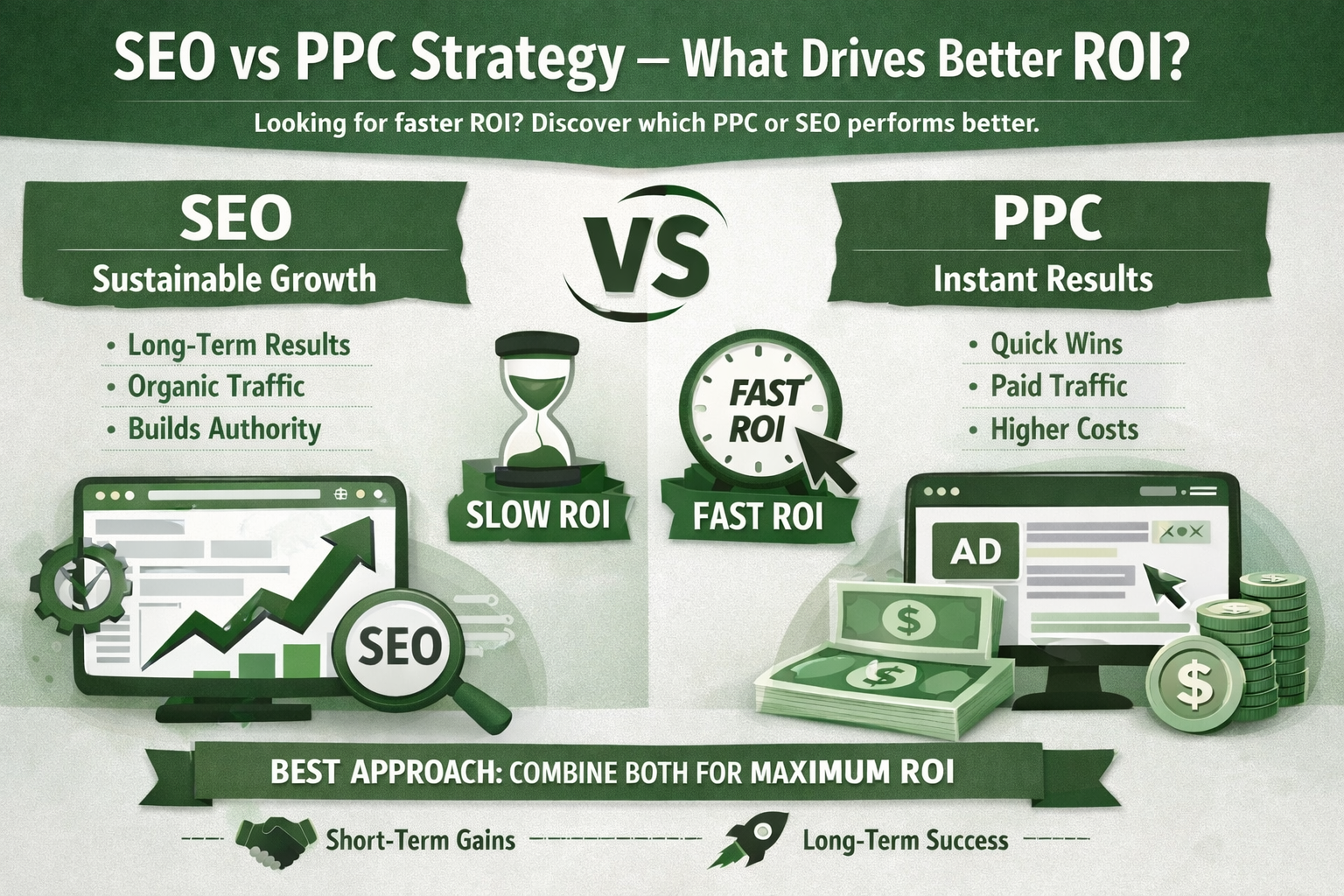
One question that nearly always arises when businesses plan their digital marketing expenditures is: Which offers a quicker return on investment, PPC or SEO? It’s crucial to understand PPC and SEO in detail, including how each channel works in practice, before making a decision. Pay-per-click (PPC) and search engine optimization (SEO) follow distinctly different paths to success, although both aim to enhance visibility and drive results.
PPC places advertisements in front of consumers who are prepared to act, focusing on immediate exposure. Although it can quickly generate leads and visitors, the results depend entirely on continuous ad spending. SEO adopts an alternative strategy. SEO creates organic visibility that increases gradually over time and continues to provide value even in the absence of ongoing investment by enhancing content quality, site structure, and search quality.
It’s about understanding how short-term gains and long-term efficiency are traded off. This guide breaks down search engine optimization vs. pay-per-click in terms of cost, speed, and stability. It also analyzes the ROI of PPC versus SEO. Additionally, you will discover when PPC makes sense, when SEO delivers better results, and how combining the two can drive steady, scalable growth.
What Is PPC? (Pay-Per-Click Definition)
Pay-per-click, or PPC is an online advertising model in which companies pay only when an ad is clicked. It is ideal for driving quick traffic, leads, and sales because it provides instant visibility on platforms like Google Ads . PPC is frequently used for campaigns where speed is essential, seasonal promotions, and new product launches.
Unlike SEO, results stop once you stop paying, so it works best when there is a flexible ad budget and urgency. When applied effectively, PPC can deliver fast ROI, especially for businesses focused on quick conversions and competitive keyword targeting.
Core Components of PPC
Campaign Strategy and Targeting: Identifies the right keywords and audience segments to reach users who are likely to convert.
Ad Copy and Creative Optimization: Enhances engagement by testing and refining messaging to maximize the click-through rate (CTR).
Landing Page Quality: Ensures that users are directed to a relevant, fast-loading, and conversion-focused landing page aligned with the ad.
Bidding and Budget Management: Allocates spending efficiently by using either manual or automated bidding strategies to optimize return on investment (ROI).
Performance Tracking and Optimization: Monitors analytics and continuously adjusts campaigns to achieve improved results.
What Is SEO? (Search Engine Optimization Meaning)
The process of improving a website to rank higher in unpaid search results is known as SEO (Search Engine Optimization). Unlike PPC, where you pay for each click, SEO builds long-term traffic by improving a website’s content, structure, and overall relevance. It focuses on gaining exposure naturally through consistent optimization efforts, helping companies build authority, trust, and long-term sustainable growth. Explore the SEO services methodology.
When it comes to long-term brand placement and informational, high-intent searches, SEO works best. The ROI continues to increase as the site gains authority and rankings stabilize, even though it takes longer to produce returns.
Core Components of SEO
On-Page SEO – This involves optimizing content, meta tags, keywords, and internal links to enhance relevance and improve search visibility.
Off-Page SEO – This focuses on building reputation through quality backlinks, social signals, and brand mentions to increase authority.
Technical SEO – This focuses on optimizing website structure, speed, and crawlability to enable search engines to index content effectively.
Local SEO – This optimizes online profiles and geo-targeted content to increase visibility in local searches and “near me” results.
Difference Between SEO and PPC
| Factor | SEO (Search Engine Optimization) | PPC (Pay-Per-Click Advertising) |
| Cost Structure | No cost-per-click, but requires investment in content and optimization. | Charges per click; visibility ends when the ad budget stops. |
| Speed of Results | Slow initial results; builds gradually over time. | Instant visibility and faster conversions. |
| ROI Timeline | Long-term compounding returns. | Short-term ROI while ads are active. |
| Budget Dependency | Less dependent on the ongoing budget once established. | Fully reliant on continuous ad spend |
| Traffic Source | Organic traffic from search engine results. | Paid traffic from sponsored listings. |
| Credibility & Trust | Higher trust due to organic placement | Lower trust than organic results, but still effective |
| Best For | Brand building, long-term growth, and high-intent informational searches. | Product launches, time-sensitive offers, and quick lead generation. |
| Scalability | Scalability improves over time with content expansion. | Easily scalable with higher budget allocation |
| Competition Handling | Competes based on authority and relevance. | Competes with bids and ad quality score. |
How AI Improves PPC Performance
AI-powered search engines prioritize authoritative, well-structured, and educational content. Highlighted snippets and AI Overviews are examples of AI-powered search results that are more likely to display websites that use entity-based SEO, schema markup, topical depth, and succinct answers to user inquiries.
SEO is independent of ongoing advertising expenditures, unlike PPC. Even though it takes time, ROI increases gradually as the website gains credibility and stays at the top of search results. In summary, AI promotes SEO by rewarding high-quality, authoritative content over time. To consistently build this credibility and achieve stronger organic rankings, businesses can follow a structured roadmap such as this step-by-step SEO process.
AI Impact Comparison: PPC vs SEO ROI
| Factor | PPC Performance | SEO Performance |
| Speed & Performance | AI accelerates bidding and targeting, resulting in faster results and conversions. | Minimal or no change in visibility during this period. |
| Cost Effectiveness | Higher CPC due to increased competition may make ROI dependent on ongoing optimization. | Slow and gradual progress as search engines begin indexing the content. |
| Targeting & Intent | AI identifies high-intent audiences in real time to improve ad relevance. | Initial ranking improvements start becoming visible. |
| Scalability & Longevity | Scales instantly with budget, but performance ends if spending stops. | Visibility and traffic continue to grow organically, offering compounding returns. |
ROI Timeline Comparison
Short-Term ROI – PPC (Immediate Returns)
PPC delivers immediate visibility; as soon as a campaign is launched, ads begin appearing. Companies can start getting website traffic, inquiries, or sales in a matter of hours or days. For brands looking for quick results, new product launches, or time-sensitive promotions, PPC is a great option. However, it is best suited for short-term growth goals, as performance declines once ad spending stops.
Long-Term ROI – SEO (Gradual, Sustainable Growth)
Since SEO relies on steadily improving search visibility, domain authority, and content relevance, it usually takes longer to generate benefits. Rankings start increasing over the course of weeks or months. Once established, SEO continues to drive traffic without additional cost per visit, making it a more sustainable approach that delivers compounding returns and stronger long-term ROI.
Mini Timeline: Days vs Months
| Timeline | PPC Performance | SEO Performance |
| Day 1–7 | Traffic starts nearly immediately after the ads go live. | Minimal or no change in visibility during this period. |
| Weeks 2–4 | Results continue steadily as long as the budget is maintained. | Slow and gradual progress as search engines begin indexing the content. |
| Months 2–4 | ROI depends heavily on ad spending and keyword competition. | Initial ranking improvements start becoming visible. |
| 6+ Months | Performance stops as soon as the advertising investment is paused. | Visibility and traffic continue to grow organically, offering compounding returns |
PPC vs SEO Cost & Budget Strategy
When deciding between PPC and SEO, strategic budget planning is essential, especially if you want to see results fast without compromising long-term growth. The manner in which you invest in them and the length of time returns continue to provide value vary greatly, even though both channels have the potential to deliver positive ROI.
PPC (Pay-Per-Click)
PPC requires continuous ad spend to maintain visibility. Ads remain visible only while you are actively investing, and performance drops sharply once spending is paused. This makes PPC ideal for businesses seeking fast results, promotional campaigns, or rapid growth.
SEO (Search Engine Optimization)
SEO requires an initial investment in website optimization, technological improvements, and ongoing maintenance. It continues to draw organic traffic without any ongoing per-click expense, even though it may take longer to demonstrate quantifiable results. SEO becomes more affordable and delivers long-term, sustainable growth as ranks rise and performance improves over time.
Ideal Budget Split Models
The ideal ratio of PPC to SEO will depend on your company’s objectives, stage of development, and anticipated rate of return. The three frequently successful budget allocation approaches listed below are based on various strategic goals.
70% PPC / 30% SEO – Best for fast performance and new businesses
Perfect for new ventures, product introductions, or businesses venturing into cutthroat markets. While the SEO investment lays the groundwork for future visibility, a larger PPC allocation helps generate quick traffic and leads.
50% PPC / 50% SEO – Best for steady and balanced growth
A suitable model for companies seeking both short-term results and long-term expansion. This strategy uses PPC to improve current conversions and SEO to increase long-term visibility.
30% PPC / 70% SEO – Best for long-term ROI and established brands
Recommended for companies that have a well-known brand or steady demand. Businesses can reduce their reliance on paid advertising, increase profitability, and eventually build sustainable organic traffic by prioritizing SEO.
Where PPC & SEO Fit in the Buyer Journey
Understanding how users move through the buyer journey helps in choosing the right channel at the right time. PPC and SEO work best when strategically aligned with different stages of intent.
TOFU – Top of Funnel (Awareness)
Best Strategy: SEO
- Users are researching and gathering information.
- They are not yet ready to buy but are looking for solutions.
- Use SEO-driven content such as: Informative blogs, Guides and tutorials,FAQs, & Educational landing page.
Example searches: What is PPC vs. SEO? How to increase website visibility? and Best strategies for traffic growth.
MOFU – Middle of Funnel (Consideration)
Best Strategy: SEO + PPC
- Users are comparing options and evaluating providers.
- Trust and relevance are important at this stage.
- Use SEO content like comparison articles, case studies, and industry insights and PPC remarketing ads to re-engage users and lead them toward action.
Example searches: PPC vs SEO ROI, Best marketing strategy for growth and Is SEO or PPC better for startups?
BOFU – Bottom of Funnel (Decision)
Best Strategy: PPC
- Users are ready to take action or make a purchase.
- Focus on conversion-optimized ads and landing pages.
- Use: PPC ads with strong CTAs (e.g., Get a Quote, Start Now, Book Consultation) & High-intent landing pages focused on results and benefits.
Example searches: Hire PPC agency Mumbai, SEO services pricing, Run PPC ads today
When PPC Succeeds (Speed, Launches, Critical KPIs)
PPC is the best strategy when getting results right away is important. It is very helpful for:
- Introducing fresh goods or services
- Offering transient deals or promotions based on events
- Companies in need of rapid leads or sales
- Markets with intense competition, where organic ranking could take some time.
- campaigns with a short-term performance focus
Businesses that want instant visibility in search results and have the resources to sustain ongoing ad investment are best suited for PPC.
When SEO Wins (High CPC, Authority Building)
When long-term success, brand credibility, and cost control are the priority, SEO offers greater value than PPC. It is particularly effective in the following situations:
- When advertising costs are high, and PPC becomes less cost-effective.
- Businesses that want to strengthen trust and position themselves as industry experts
- Strategies where users typically research before contacting a provider or making a decision.
- Brands focused on improving visibility over time and maintaining consistent organic traffic.
SEO works best for businesses that focus on long-term growth, use informative or educational content to engage their audience, and aim to generate leads organically instead of relying solely on paid advertising.
Best Hybrid Strategy
The best strategy is frequently to combine PPC and SEO. While SEO creates long-term, sustainable growth, PPC offers instant visibility and speedy results. This strategy, especially useful in competitive markets, lets brands maintain performance without relying solely on marketing. Launching with PPC for immediate traction, strengthening SEO over time, and using PPC retargeting to convert users as organic results improve is a workable strategy. Review common local SEO mistakes and how to fix them.
Real-World Scenarios
Your business strategy, the competition, and the speed at which you anticipate results will all influence how you prioritize PPC or SEO.
Local Business – PPC First
Local businesses targeting nearby customers often see better results by starting with PPC. While SEO gradually builds local authority, advertising provides instant visibility for location-based searches like “digital marketing agency near me, helping generate leads more quickly. Once it gains traction, SEO can be used to increase Google Business Profile visibility, reviews, and map ranking.
E-commerce – Hybrid Strategy
A combination of PPC and SEO works best for online retailers. While SEO focuses on long-term content strategy, organic visibility, and product category optimization, PPC helps promote best-selling or seasonal products quickly. Even in very competitive niches, this combination increases customer acquisition and conversions.
SaaS / B2B – SEO Authority with PPC Lead Boost
Before conversion, businesses in the SaaS and B2B industries frequently need to establish trust. PPC promotes lead magnets, demos, or free consultations to high-intent audiences, while SEO establishes authority through case studies, educational material, and industry knowledge. While SEO develops long-term positioning, PPC improves lead generation.
Hidden Costs, Risks & Practical Do / Don’t
Understanding the risks and knowing what to avoid can help improve ROI and prevent wasted budget.
PPC – What to Do / What NOT to Do
What to Do
- Continuously test ad variations and creatives to improve engagement.
- Use automated bidding strategies to optimise performance efficiently.
- To avoid overexposure and lessen ad fatigue, implement frequency limitations.
What NOT to Do
- Rely exclusively on manual bidding without monitoring performance.
- Ignore ad fatigue or rising CPC trends.
- Run campaigns without refining targeting or analyzing behavior.
SEO – What to Do / What NOT to Do
What to Do
- To guarantee crawlability and performance, start with robust technical SEO.
- Build topical authority by producing excellent, relevant content.
- Optimize AI-based search experiences with entity-based optimization and structured content.
What NOT to Do
- Anticipate instant ranking gains.
- Rely only on backlinks without enhancing the caliber of your content
- Ignore structured data, schema usage, or entity integration
- Neglect regular updates and optimisation efforts
Decision-Making Checklist
Determine whether PPC, SEO, or a hybrid approach best suits your present marketing goals by using this checklist.
1. Timeline Urgency
PPC performs best when a flexible budget is available, as it relies on ongoing ad spending. SEO is the most sustainable choice if you have limited funds or want a model that is more economical over time. Combining PPC and SEO can be advantageous for businesses with limited budgets.
2. Budget Flexibility
PPC performs best when a flexible budget is available, as it relies on ongoing ad spend. SEO is the more sustainable choice if you have limited funds or want a long-term, cost-effective approach. Combining PPC and SEO can be advantageous for companies with manageable budgets.
3. Domain Authority
Low-domain-authority websites may struggle to rank naturally initially, but they can utilize PPC to temporarily boost visibility. However, to take advantage of long-term compounding benefits, websites with significant authority should prioritize SEO.
4. Market Competition
While SEO efforts intensify, PPC can offer quick traction in fiercely competitive industries. In industries with limited competition, SEO is often more cost-effective and successful over time.
5. Short-Term Sales vs Long-Term Growth
- If your focus is on instant conversions and performance-driven campaigns, → PPC-led strategy
- If your goal is to build authority, improve organic visibility, and achieve long-term ROI, → SEO-led strategy is.
- If both short-term wins and sustainable growth are important, → Hybrid approach.
Conclusion
The decision between PPC and SEO ultimately comes down to your company’s objectives, deadlines, and financial resources. PPC is the better choice if you need quick ROI and instant visibility, as it uses targeted ads to deliver results quickly. If your focus is on long-term growth, authority building, and sustainable traffic, SEO offers better value over time without ongoing ad spend.
The best course of action for most organizations is a hybrid strategy that uses PPC to deliver immediate results while developing SEO to sustain steady organic performance. You may maximize ROI, gradually lessen reliance on sponsored ads, and develop a scalable growth model by coordinating both channels with your objectives and customer journey.
Contact Us and Get ROI Advice
Frequently Asked Questions (FAQs)
1. Which one generates faster ROI: PPC or SEO?
PPC delivers results and visibility right away once the campaign starts. SEO offers greater sustainability over time, but it takes longer to demonstrate results. PPC is superior if speed is the top concern; SEO is superior for long-term ROI.
2. Can PPC and SEO be used together effectively?
Yes. Combining both strategies often delivers the best outcome. PPC helps capture quick results, while SEO builds lasting authority and organic visibility. Using them together provides growth in both the short- and long-term.
3. How long does SEO take compared to PPC?
While SEO usually takes three to six months to get traction, PPC can produce results in a matter of hours or days. SEO gives compounding results without continuous advertising expenditure, but it increases gradually.
4. Does PPC cost more than SEO in the long run?
PPC requires ongoing investment, and expenses may rise as competition intensifies. Since SEO doesn’t charge per click but does require initial optimization, it becomes more economical in the long run.
5. How should I decide whether to use PPC, SEO, or both?
Consider factors such as the level of competition, financial resources, urgency, and expansion goals. When you want both quick and long-term results, a hybrid plan is the best option. PPC is great for short-term performance, while SEO is better for long-term visibility.
Need Help with Small Business SEO?
Related Topics
From Credibility to SEO: 7 Benefits of Having a Wikipedia Page
In today's digital age, having a strong online presence is essential for any business or brand. With millions of websites and social media platforms available, it can be challenging to stand out from the crowd. However, one platform that can help you establish...
A Step-by-Step Guide to Creating an Entry over Wikipedia
Wikipedia is a popular online encyclopedia that allows anyone to create and edit articles on a wide range of topics. Creating an entry on Wikipedia can be a great way to share your knowledge with the world and contribute to a global community of knowledge-sharing....