
Google Ads vs Meta Ads (Facebook Ads): Which Is Better?
Choosing between Meta Ads (Facebook Ads) and Google Ads primarily depends on your marketing objectives, such as whether you want to reach consumers actively seeking answers or spark interest among prospective clients.
By targeting consumers who are already searching for specific goods or services, Google Ads enables intent-based advertising. Meta Ads, including Facebook and Instagram advertising, aim to increase awareness by showing ads to people based on their interests, demographics, and online behavior.
Creating a successful advertising plan requires an understanding of how both platforms operate. This guide helps you choose the platform that best fits your business goals by providing data-driven insights and emerging advertising trends.
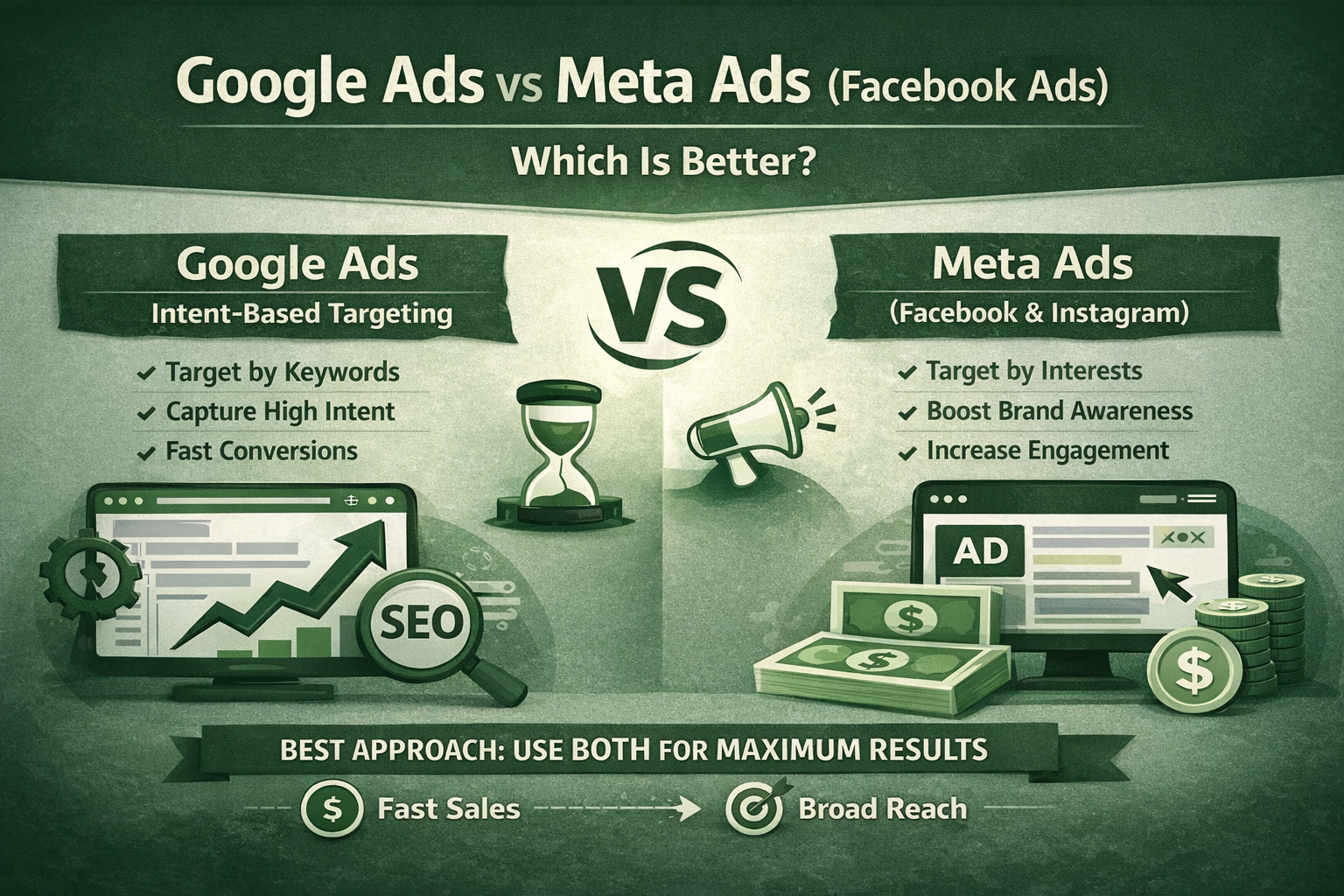
Key Differences Between Google Ads and Meta Ads
| Aspect | Google Ads | Meta Ads (Facebook/Instagram) |
| User Intent & Purpose | Focuses on those who are actively looking for the best goods or services to meet current demand. | Reaches consumers according to their online habits and interests to generate new demand and raise brand awareness. |
| Targeting Method | Keywords and search query-based. | Interest, demographic, and behavior-driven. |
| Platforms & Ad Formats | Appears on Google Search, YouTube, Display Network & Shopping, mainly in text, banner, and video ads. | Runs on Facebook, Instagram & Messenger images, videos, carousels, Stories & Reels. |
| Cost & ROI Timeline | Typically works on a CPC (cost per click) basis, delivering quicker results due to high intent. | Often uses CPM (cost per 1,000 impressions) or CPC; tends to show ROI over a longer engagement cycle. |
| Best For | Lead generation, direct conversions, high-intent traffic. | Brand awareness, audience expansion, engagement, and remarketing. |
Pros & Cons of Google Ads and Meta Ads
Selecting between Google Ads and Meta Ads depends on more than just platform characteristics; it also depends on your campaign objectives and your target audience’s interests. Understanding each platform’s strengths and potential weaknesses is important before selecting where to make additional investments. The practical breakdown is provided below.
Google Ads: Pros & Cons
Pros
- This method is ideal for faster conversions, direct sales, and lead generation because it reaches consumers actively seeking solutions.
- Offers clear results and strong performance at scale, particularly when consumers are ready to act.
- Gives access to several networks, including Google Search, YouTube, and Shopping Ads, as well as successful keyword targeting.
Cons
- Usually has a higher cost per click, especially in industries with intense competition.
- To maximize return on investment, landing pages must be well-developed and well-designed for conversion. Learn why website design is important.
- Less successful in advertising novel or unknown goods that consumers haven’t yet started looking for.
Meta Ads (Facebook Ads): Pros & Cons
Pros
- Useful for raising awareness and sparking interest among people who might not be actively seeking your goods or services.
- Enables careful targeting based on hobbies, habits, and behavior, making it ideal for reaching a wider audience.
- Supports engaging visual formats, including films, stories, reels, and carousel ads, that are excellent for remarketing and storytelling. Learn more about our Meta Ads management services, including Facebook marketing and Instagram marketing solutions.
Cons
- Conversion durations are usually longer and often require several user interactions before engagement.
- Campaign success largely relies on the strength of the visuals and messaging, and performance may decline over time if ad creatives are not refreshed consistently.
- Changes in platform algorithms and privacy policies may affect it.
Which Delivers Better Results: Google Ads or Meta Ads?
The platform that delivers better results largely depends on your advertising objective and how close your audience is to making a buying decision. Google Ads is more effective at generating quick conversions because it targets users actively searching for a product or service.
Facebook Ads, on the other hand, are ideal for increasing visibility and interest, particularly among audiences that may not be actively searching yet but are likely to interact based on their preferences and behavior. To help you grasp the differences, consider this quick performance comparison:
Google Ads – Performs Better When:
- You want to focus on people who have an urgent desire to buy or ask questions.
- The objectives are direct sales or lead generation.
- You’re looking for quick, measurable results.
- You must use search-based targeting to capitalize on current demand.
Enhance performance with a results-focused performance marketing strategy.
Facebook Ads – Performs Better When:
- You wish to connect with others based on their hobbies, habits, or lifestyle.
- The goal is to increase audience size and brand exposure.
- You are advertising new goods or educational content.
- You aim to acquire new customers or increase customer engagement.
Facebook Ads help introduce your business to new people and generate interest, whereas Google Ads help convert consumers who already know what they want. For most companies, using both together often yields stronger, more balanced results.
When to Use Google Ads & Meta Ads
The decision between Google Ads and Facebook Ads primarily depends on your goals and your target audience’s level of readiness. Knowing that each platform caters to a distinct point of the purchasing process can help you allocate your advertising budget more wisely.
When Google Ads Works Best
Choose Google Ads if you want to reach those who are already searching for something specific
- Perfect when people are actively trying to find a solution.
- Works well for direct sales, leads, and inquiries.
- Ideal for goods or services that are already in demand.
- Helps achieve fast results with performance-focused campaigns.
- Frequently utilized by sectors including e-commerce, tourism, healthcare, professional services, and finance.
Example: when someone searches for “best SEO agency near me” on Google, this is the ideal time to appear through Google Ads.
Retargeting is more effective when your website is well-maintained and optimized.
When Facebook Ads Are Better
If your goal is to increase visibility or spark interest among users who may not yet be searching. Choose Facebook Ads
- Good for increasing exposure and growing your audience.
- Reaching people according to their interests, way of life, or behavior.
- Useful for retargeting previous website visitors or social media followers.
- Great for visual promotions, storytelling, and engagement-driven campaigns.
- Perfect for companies launching new goods, promotions, or instructional materials.
Example: Show a promotional video to people who are interested in digital marketing tools, even if they haven’t actively searched for them yet.
Cost, ROI & Conversion Efficiency
It’s important to consider factors beyond ad pricing when evaluating cost and performance. Because they target visitors who are actively looking, Google Ads usually have a higher cost per click, which often leads to quicker, more valuable conversions. Because of this, it works well for efforts that target lead generation or direct sales.
Facebook advertisements usually offer a lower cost-per-impression and a wider reach, making them perfect for audience-building and awareness campaigns. Users may need multiple interactions before acting, though, and may not convert immediately.
Can You Use Google Ads and Facebook Ads Together?
Yes, it is frequently more efficient to use both systems together than to use just one. In the customer journey, each has a distinct job to do. Facebook advertisements help draw in viewers and generate interest, particularly among those who aren’t currently actively searching. Google Ads may turn users into buyers after their interest has grown and they begin looking for answers. From awareness to conversion, our consistent approach guarantees constant visibility.
Benefits of combining both platforms:
- Create interest on Facebook and use Google to convert that interest into intent.
- Continue to be present throughout the entire purchasing process
- Retargeting active users will increase conversion rates.
- Increase overall ROI by using complementary marketing techniques.
Businesses using Facebook Ads to generate interest and Google Ads to capture demand often achieve more consistent, scalable results.
Which Platform Should You Use Based on Your Goals?
However, you aim to increase visibility, introduce your brand or product, or target people based on their interests and behavior. In that case,The platform you choose for your advertising campaign should clearly reflect its objectives. Google Ads is a better choice if your goal is to generate quick conversions or customer inquiries from those already looking for a solution.
Facebook Ads (also known as Meta Ads) are often more effective, especially during the awareness and engagement stages.
Platform Selection Guide
| Goal | Recommended Platform |
| Generate quick leads or direct sales. | Google Ads |
| Increase brand visibility and reach. | Meta Ads |
| Target users actively searching. | Google Ads |
| Launch or introduce a new product. | Meta Ads |
| Retarget past users of the website. | Meta Ads |
| Capture high-intent traffic. | Google Ads |
| Promote deals that are urgent or time-sensitive. | Google Ads |
| Increase the demand for the audience. | Meta Ads |
Conclusion
Google Ads is better suited for campaigns aimed at capturing existing demand and generating measurable action. At the same time, Meta Ads is more effective for building awareness, expanding audience reach, and influencing customers earlier in their decision process.
The most effective strategy is to use both Meta Ads to build awareness and engagement and Google Ads to convert that interest into measurable results.
Want help deciding how to balance Google Ads and Meta Ads for maximum ROI?
Book a Call with Our Experts
Frequently Asked Questions (FAQs)
1. Are Facebook Ads cheaper than Google Ads?
Facebook ads usually cost less per impression while reaching a wider audience. However, Google Ads often generates higher-quality leads because clients are actively seeking answers. Therefore, even if Facebook may appear more cost-effective, Google might provide superior value if the goal is conversions.
2. Do I need a website to run Google Ads or Facebook Ads?
The Facebook Ads required website is for Google Ads, specifically search ads that send people to a landing page. There are a few exceptions, though, such as call-only or local service advertisements.
Facebook ads, such as message-based campaigns, WhatsApp ads, and lead-generation ads with short forms, let you run campaigns without a website. Having a website still enhances trust and conversion tracking. Learn why a business needs a website and how to develop a website for your business here.
3. How should I split my advertising budget between Google Ads and Facebook Ads?
Allocating 30–40% of the budget to Facebook Ads for awareness, engagement, or retargeting, and 60–70% to Google Ads for conversion-focused ads, is often a successful strategy. Campaign performance and corporate priorities can be used to modify the split.
4. Which platform works better for remarketing campaigns?
Facebook ads often perform well for remarketing because of their visual ad layouts and accurate behavior-based targeting. Facebook is generally more successful at re-engaging individuals who have previously expressed interest, but Google Ads can also be successful, particularly through Display and YouTube remarketing.
5. How long does it take to see results from Google Ads vs. Facebook Ads?
Google Ads can deliver results quickly, sometimes within days, because it targets users who are already searching for a solution. Facebook Ads usually take longer, as users may need multiple interactions before responding. Expect awareness and engagement first, followed by conversions over time.
6. Which is better for e-commerce: Google Ads or Facebook Ads?
When employing shopping or search ads, Google Ads is the best option for consumers who are prepared to make a purchase. Facebook Ads work incredibly well for retargeting customers who have abandoned their carts, showing images, and product discovery. The most effective approach is frequently a combination of Google to convert interest and Facebook to generate it.
7. Which platform is more suitable for B2B advertising?
Because decision-makers frequently look for service providers or solutions directly, Google Ads usually performs better for business-to-business transactions. Facebook Ads are often a secondary channel, although they can help with B2B branding and remarketing. Google Ads are typically more effective for lead creation. You can also explore LinkedIn marketing.
Need Help with Small Business SEO?
Related Topics
All You Need to Know While Creating a Wikipedia Page
Wikipedia is a powerful and reliable source of information, but it is also an incredibly complex system. If you ever find yourself in need of a Wikipedia page, you may suddenly find yourself in a whole world of confusion. Navigating the ins and outs of Wikipedia isn't...
Why Notability is Essential to Get a Wikipedia Page
If you want to get a Wikipedia page, you may be wondering about the criteria and why notability is essential. After all, there are millions of entities out there, so what makes it notable enough to have a Wikipedia page? To create a successful Wikipedia page, you need...
How to Create a Wikipedia Page For Your Company
Wikipedia is one of the most popular online encyclopedias that is visited by millions of users every day. According to SimilarWeb's data, Wikipedia dominates its category and stands tall at the 9th position globally in terms of total internet traffic. It is not...