
AI Optimization (AIO) – The Complete Guide for 2026 & Beyond

Search is undergoing the biggest transformation since Google launched in 1998.
For the first time, people are no longer relying solely on search engines; they’re turning to AI assistants like ChatGPT, Google’s AI mode, and other generative systems that summarize the internet for them.
This shift has created a new reality:
- SEO alone is not enough.
- AI engines increasingly decide which content gets visibility.
- Brands must optimize not just for ranking, but for interpretation, extraction, and citation.
And that’s exactly where AI Optimization (AIO) comes in.
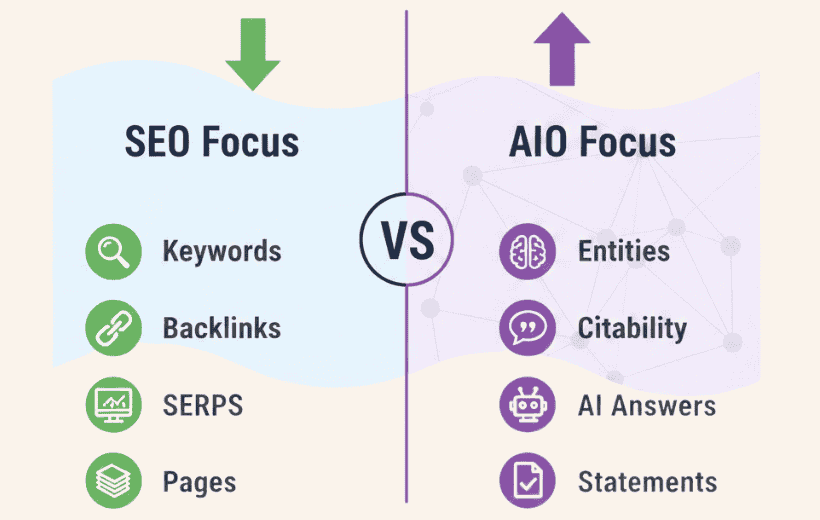
SEO optimizes for search engines; AIO optimizes for AI-driven discovery.
🔹 In short:
AIO is the evolution of SEO for an AI-driven world.
TL;DR
- AIO prepares your content so AI systems can interpret, extract, and cite it accurately.
- AIO ≠ SEO; SEO ranks pages; AIO gets statements selected in AI answers, summaries, and citations.
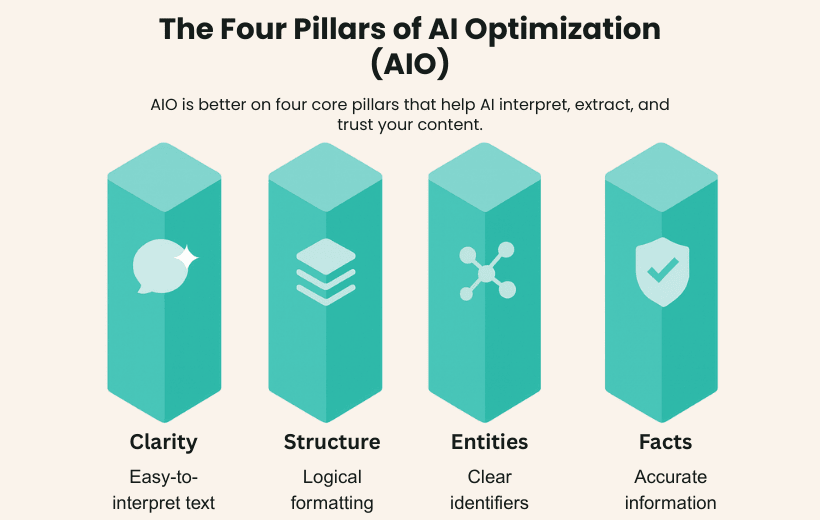
- AIO has four core pillars: clarity, structure, entity precision, and factual grounding.
- AI engines now rank statements, not pages: meaning extractability is more important than keyword density.
- To win in AI Search, your content must be: structured, entity-clear, machine-readable, and verifiably factual.
- Goal of AIO: make your content AI-ready, extractable, and citation-worthy across ChatGPT, Google AI Overviews, Perplexity, Gemini, and generative engines.
What You Will Learn in This Guide:
| ☛What AIO actually is |
| ☛Why AIO matters now |
| ☛How AIO differs from SEO |
| ☛How AEO and GEO fit into AIO |
| ☛How to make your content AI-ready |
This guide will give you the complete blueprint to stay visible in the era of AI-powered search.
What Is AI Optimization (AIO)?
AI Optimization (AIO) is a practice of structuring, formatting, and enriching your webpage content so AI systems can accurately interpret, extract, and cite it as a reliable source.
Modern AI systems such as Google AI Overview, ChatGPT Search, Perplexity, Gemini, and Bing Copilot evaluate content semantically rather than solely by keywords.
For your content to appear in AI-generated answers, these systems must be able to:
- interpret your content accurately
- extract the primary information
- generate answers or summaries
- cite your website as the source
AIO builds content that AI can easily interpret using four essential components: Clarity, Structure, Entities, and Factual Consistency.
⚙️ AIO Rule:
“The clearer the sentence, the higher the citation probability.”
AIO ≠ AISO ≠ AEO ≠ AI SEO – Clearing the Confusion
Marketers, SEOs, and brands are seeing new AI-related terms everywhere, yet most explanations online are incomplete, confusing, or even contradictory.
Here is the simplest, most accurate way to understand the ecosystem:
- AIO (AI Optimization): The parent discipline that focuses on optimizing content for all AI systems, including search engines, answer engines, generative engines, voice assistants, and multimodal AI, so that it can be understood, interpreted, summarized, and cited.
- AISO (AI Search Optimization): A subset of AIO focused specifically on AI search engines such as ChatGPT Search, Perplexity, Gemini, and Google AI Overviews. Its goal is to make your content discoverable, extractable, and rankable within AI Search results.
- AEO (Answer Engine Optimization): A subset of AIO focused on being selected as the direct and factual answer to the user queries. A parallel discipline, GEO (Generative Engine Optimization), focuses on being cited inside AI-generated summaries and narratives.
- AI SEO (AI Search Engine Optimization): Optimization for Google Search, SERPs, Featured Snippets, and AI Overviews. It enhances visibility through on-page SEO, technical SEO, semantic relevance, and E-E-A-T signals, helping Google interpret and surface your content across both traditional and AI-driven results.
| Factor | AIO | AEO | AISO | AI SEO |
|---|---|---|---|---|
| Definition | AIO is the parent discipline that optimizes content for all AI systems so it can be understood, interpreted, summarized, extracted, and cited. | AEO is a subset of AIO focused on making content the direct, factual, and authoritative answer to user queries. | AISO is a subset of AIO focused on optimizing content specifically for AI search engines such as ChatGPT, Perplexity, and Gemini. | AI SEO is optimization for Google Search & SERPs, adapted for AI-driven ranking signals, Featured Snippets, and AI Overviews. |
| Focused On | All AI systems: search engines, answer engines, generative engines, voice assistants, multimodal AI. | Answer engines and factual question–answer retrieval systems. | AI search engines: ChatGPT Search, Perplexity, Gemini, Google AI Overviews. | Google search systems, SERPs, AI Overviews, Featured Snippets. |
| Targets | AI interpretation, semantic clarity, structure, factual accuracy, and entities. | Being chosen as the “best factual answer.” | Discoverability, extractability, and rankability in AI search results. | On-page SEO, technical SEO, semantic signals, E-E-A-T. |
| Primary Goal | Make content AI-readable and AI-citable across all platforms. | Make content the AI-selected direct answer. | Ensure AI search engines can find, understand, and surface your content. | Improve search rankings and visibility in SERPs & AI-enhanced Google results. |
| Outcome | Content is understood and reused by all AI systems. | Content is selected as the direct answer; GEO enables citation in generative summaries. | Content appears in AI Search results with high extraction accuracy. | Higher rankings, featured snippets, AI Overviews visibility, and organic traffic. |
| Example | Structuring content with clear entities, definitions, and factual consistency. | Your article is chosen as the direct factual answer to a user query. | Your content appears in ChatGPT Search or Perplexity with correct citations. | Your page ranks #1 in Google and appears inside AI Overviews. |
Why AIO Exists
AI systems do not think in keywords or follow traditional SEO patterns. They interpret meaning, structure, and relationships.
To work well with AI, content must be:
- clear, not keyword-stuffed
- entity-defined, not vague or ambiguous
- factual, not padded with unnecessary text
- structured, using tables, lists, and definitions
- contextually unambiguous, so AI avoids misinterpretation
SEO optimizes for search engines; AIO optimizes for AI systems.
Key Insight:
“AI engines don’t read your content; they interpret it.”
Speed Tip: “A definition at the start of any section boosts both SEO and AIO.”
Why AIO Matters in 2026
Search and discovery have changed more in the last two years than in the previous two decades.
In 2026, AI is becoming the primary gateway to information, not the traditional search engines.
Brands that ignore AIO will see their search visibility shift from appearing in SERPs to being absent from AI-generated answers.
AIO matters because it aligns your content with how AI systems read, interpret, and distribute information today.
1. AIO Drives Visibility Across AI Search Systems
AI-driven platforms now play a major role in how users consume information:
- Google AI Overviews summarize content and selectively cite sources.
- ChatGPT Search retrieves responses from structured and factual pages.
- Perplexity blends sources and highlights the most credible citations.
- Gemini favors well-structured, entity-rich content for AI summaries.
- Bing Copilot extracts clean facts and steps directly from pages.
These systems depend on clarity, structure, entities, and factual consistency.
AIO increases the likelihood that your content will be:
- visible (selected for inclusion)
- extractable (parsed correctly)
- usable (included in answers)
- cite-worthy (cited as the source)
Why it matters: Traditional SEO helps you rank, but AIO enables you to get selected, extracted, and cited, which now drives most visibility in AI-driven results.
2. AIO Strengthens Your Entity Presence Across the Web
AI engines rely on entities, not just keywords.
Clear entities allow AI systems to understand:
- who you are
- what you offer
- how your content relates to other entities
Why it matters: AIO aligns your content with knowledge graphs and entity recognition, increasing your chances of appearing in summaries, comparisons, and explanations.
3. AIO Aligns Your Content With AI-Driven Discovery
Search is no longer a typed query followed by a list of ten blue links.
Users now rely on:
- conversational queries
- AI-generated summaries
- voice responses
- contextual recommendations
- generative browsers
These interfaces require structured, factual, unambiguous content.
Why it matters: AIO ensures your content is readable and usable across all AI-powered discovery channels, not just Google Search.
4. AIO Is About Optimizing Your Content for AI Models
AIO does not train AI models. It optimizes your content for AI models, so they can:
- parse your content
- understand entities
- extract relationships
- identify factual statements
- evaluate trustworthiness
5. AIO Helps Content Pass the AI Processing Pipeline
Every AI system follows a similar processing pipeline:
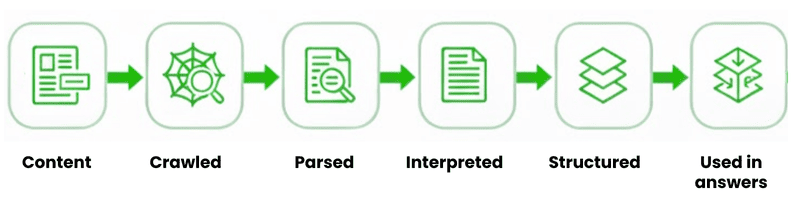
- Crawling: clear headings, schema, consistent formatting
- Parsing: lists, tables, definitions, clean sentence boundaries
- Interpretation: explicit context, entity clarity
- Structuring: predictable patterns AI can convert into data
- Answer selection: factual, concise statements AI can cite
If your content fails at any stage, AI ignores it.
Why it matters: AIO ensures your content moves through the entire pipeline without friction.
6. AIO Prepares Content for Voice, Assistants, and Generative Interfaces
Users increasingly ask, not search.
And they expect answers, not 10 blue links.
AI assistants, voice systems, generative browsers, and multimodal agents depend on:
- structured explanations
- step-by-step instructions
- definitions
- factual statements
- clean entities
Quick Action:
Open Perplexity or ChatGPT and ask a question your business should answer.
Check:
- Does your site appear as a citation or source?
- If not, note which type of content is being cited (structured, factual, table-based, FAQs).
List 3 pages you need to rewrite with AIO in mind.
Why Brands Must Adapt With AIO (Not Just SEO)
Search journeys now begin with AI assistants, not Google SERPs.
➠ Google is shifting from SERPs → AI Overviews.
➠ Bing is shifting from Search → Copilot Mode.
➠ ChatGPT Search and Perplexity are replacing the traditional “10 blue links” experience

Brands relying only on SEO will gradually lose:
- visibility
- citations
- traffic
- relevance
AIO is the only optimization framework aligned with the future of information discovery.
Without it, brands will become progressively invisible in AI-powered ecosystems.
Visibility Insight: “Being ranked is optional. Being extractable is mandatory.”
How AIO Differs From Traditional SEO
SEO optimizes for search engines.
AIO optimizes content for how AI reads, interprets, validates, and cites information.
SEO vs AIO: Direct Comparison Table
AIO is not a replacement for SEO; it is the evolution of SEO.
SEO builds visibility. AIO builds AI-level authority, extractability, and citability.
The Core Pillars of AIO
Every AI engine (search, answer, generative, or multimodal) relies on four foundational signals to determine whether your content is usable and citation-worthy.
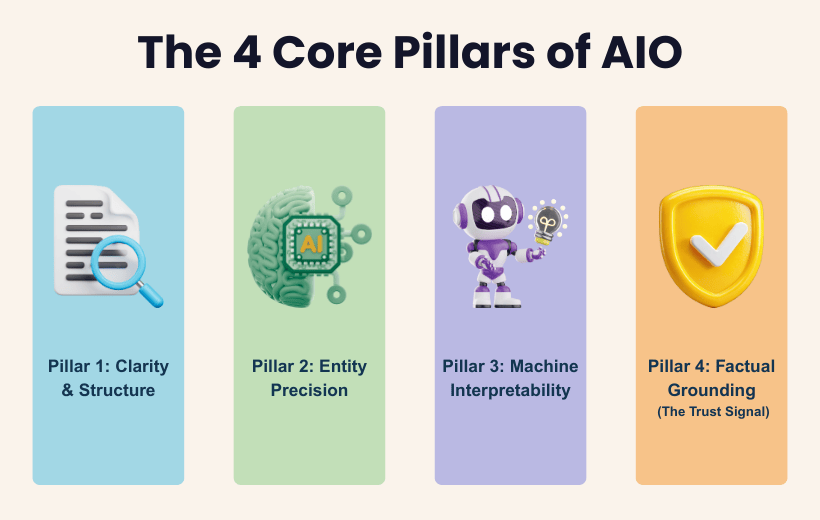
Below are the four core pillars that define AIO.
Pillar 1: Clarity & Structure
AI engines cannot guess meaning; they rely on visible structure.
Clarity & Structure include:
- Short, complete, unambiguous sentences
- Clear definitions at the start of sections
- Lists, tables, and steps for easier parsing
- Headings used as semantic markers
- Predictable formatting patterns
Why this matters:
AI extracts information using pattern-recognition models.
The more structured your content is, the easier it is to convert into data.
AI prefers content that is:
- explicit, not implied
- organized, not conversational
- structured, not flowing narratives
This pillar heavily influences your extractability score, a core factor in AI answer selection.
Pillar 2: Entity Precision
AI does not understand content through keywords.
AI understands content through entities, the things, people, concepts, brands, places, and actions.
Entity Precision requires:
- Defining each entity clearly
- Avoiding ambiguous terminology
- Consistent naming
- Disambiguating similar entities (e.g., AIO vs AISO)
- Linking related concepts together
- Aligning content with known knowledge graphs
Why this matters:
AI cannot generate accurate answers without knowing:
- who or what the content refers to
- how entities relate to one another
- which meaning of a term is intended
Entity precision transforms content from keyword-aware to context-aware, dramatically increasing interpretability and citation probability.
Pillar 3: Machine Readability & Interpretability
Content must be easy for both humans and machines to parse, segment, and structure.
Machine readability means:
- Clear parsing without friction
- Identifiable conceptual boundaries
- Understand relationships between sentences
- Extract facts and steps in the correct order
Machine readability means:
- Simple, clean sentence structure
- Consistent formatting and spacing
- Clear cause–and–effect statements (“X leads to Y”)
- Semantic markers (“means,” “because,” “therefore”)
- Clean HTML structure
- Schema markups
- LLMs.txt or AI directives when applicable
Why this matters:
If your content is not machine-readable, AI will:
- skip it
- misclassify it
- extract incorrect meaning
- replace it with another source
Machine interpretability determines whether AI includes or ignores your content.
Pillar 4: Factual Grounding (The Trust Signal)
AI engines prioritize content they can verify.
AI models trust content that is:
- verifiable
- up-to-date
- consistent across your site
- backed by evidence
- supported with external references
Factual grounding requires:
- Unambiguous facts
- Avoiding speculative writing
- Maintaining consistency across pages
- Including statistics, definitions, and authoritative references
- Updating content regularly
Why this matters:
AI systems treat factual inconsistency as a trust issue.
If your information contradicts public data, known facts, or established entities, AI systems may down-rank, avoid, or refuse to cite your content.
Factual grounding is the foundation of AI trust, which directly impacts how often your content appears in:
- Google AI Overviews
- ChatGPT answers
- Perplexity citations
- Gemini summaries
Quick Action:
Audit one page for the 4 pillars:
- Clarity & Structure → Do you have clear headings, lists, and definitions?
- Entity Precision → Are entities unambiguous and consistently named?
- Machine Readability → Are there short sentences, clean HTML, no giant blocks?
- Factual Grounding → Are there verifiable facts, dates, stats, and consistent claims?
Mark one weak pillar and plan an update.
Why These Pillars Matter Together
Each pillar influences a different part of the AI processing pipeline:
| Pillar | AI Pipeline Stage Improved | Outcome |
|---|---|---|
| Clarity & Structure | Parsing | More extractable content |
| Entity Precision | Interpretation & context | More accurate answers |
| Machine Readability | Structuring | Higher selection probability |
| Factual Grounding | Trust & Citation | More citations in AI answers |
If one pillar is weak, AI engines may misinterpret or skip your content entirely.
When all four are strong, your content becomes:
✔ AI-friendly
✔ Citation-ready
✔ Visible
✔ Future-proof
These are the foundations of effective AIO.
Remember:
“Ambiguity is the enemy of AI.”
The AI Search & Discovery Ecosystem
Information discovery no longer happens in one place. It now spans three distinct layers: traditional search engines, answer engines, and generative engines.
Each layer interprets content differently, and AIO improves visibility across all of them.
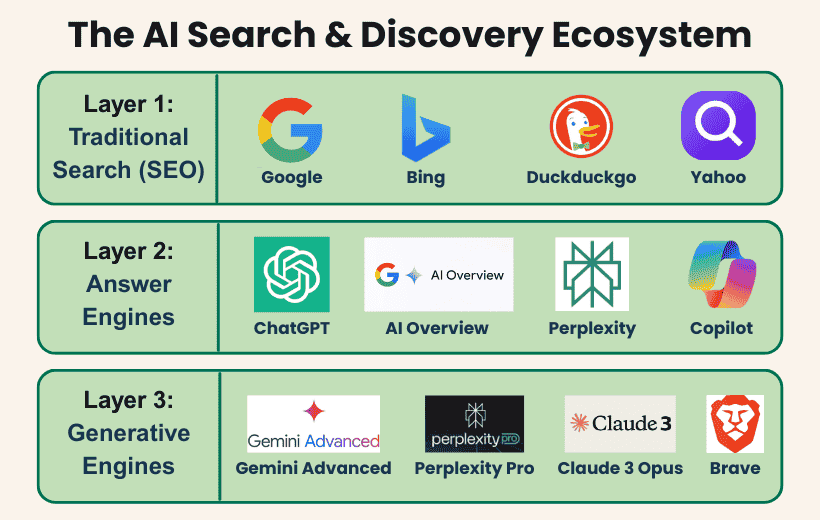
Understanding how these layers work is essential for building AI- and citation-ready content.
Layer 1: Traditional Search (SEO)
This is the classic search environment built around:
- Bing
- DuckDuckGo
These systems rely on:
- keyword matching
- semantic analysis
- ranking algorithms
- backlinks
- SERP layouts
How AIO fits here:
Even in traditional search, AIO improves how Google reads and interprets content by strengthening:
- structured snippets
- definition boxes
- entity signals
- schema-based enhanced results
Google’s shift from classic SERPs → AI-enhanced results → AI Overviews and AI Mode means that even “traditional SEO” is becoming AI-mediated.
Layer 2: Answer Engines
Answer engines do not present lists of links.
They generate direct, factual answers by extracting them from multiple sources.
Examples include:
- ChatGPT (Search + Answers)
- Google AI Overview
- Perplexity Search
- Bing AI / Copilot
These engines evaluate content based on:
- structure (lists, definitions, steps)
- factual clarity
- entity clarity & completeness
- extractability
- citability strength
Where AISO fits:
AISO (AI Search Optimization) focuses on how AI search engines:
- select the most reliable source
- extract the cleanest factual segment
- cite the most trustworthy page
AISO ensures your content meets the standards required for all three.
Where AEO fits:
AEO focuses on being the direct, authoritative answer that answer engines display.
Layer 3: Generative Engines
Generative engines create long-form, synthesized summaries that blend insights from many sources.
Examples include:
- Gemini Advanced
- Perplexity Pro (generative mode)
- Claude 3 Opus (within Projects)
- AI browsers such as Arc and Brave
These engines:
- aggregate multiple trusted sources
- evaluate factual consistency
- prefer structured, unambiguous content
- blend extracted facts into narrative summaries
Where GEO fits:
GEO (Generative Engine Optimization) helps your content appear:
- in generative summaries
- within comparisons
- as part of multi-source explanations
- in step-by-step synthesized answers
AISO’s extended role:
Generative engines behave like AI search engines. They must still:
- select the clearest statements
- extract clean data
- verify entity consistency
- trust the factual grounding
Highly structured, entity-rich, verifiable content is far more likely to appear in generative narratives.
How to Make Your Content AI-Ready and AIO-Optimized
AIO-optimized content helps AI systems interpret, extract, and cite information accurately and without ambiguity.
These five elements form the practical foundation for making your content AI-ready.
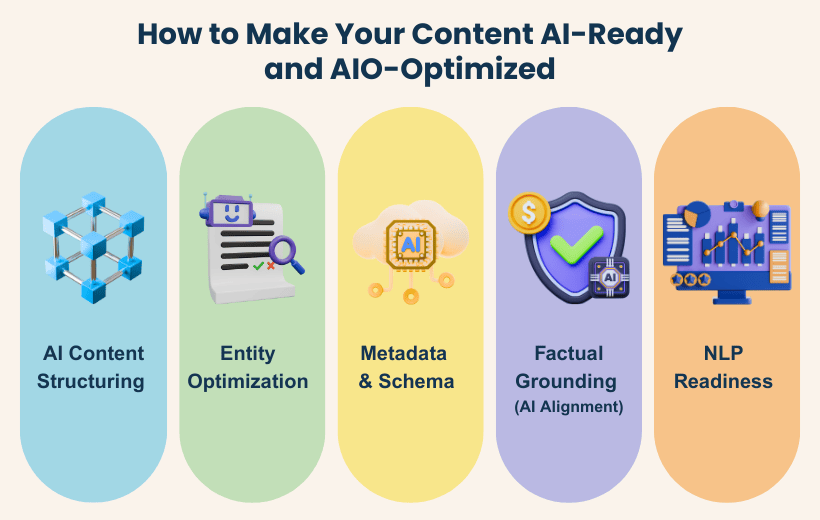
1. Content Structuring for AI
AI engines extract information through patterns, not narrative flow.
Your structure directly determines how extractable your content is.
Use:
- Definitions at the top of each section (AI reads definitions first)
- Lists, tables, and steps instead of long paragraphs
- Short, semantically clear sentences that separate ideas cleanly
This makes your content easier for AI to parse, segment, and convert into structured data.
2. Entity Optimization
AI models understand content through entities, not keywords.
Ensure:
- Key terms are clearly defined, so AI knows exactly what each concept refers to
- Ambiguous entities are disambiguated (“Apple Inc.” vs “apple fruit”, AIO vs AISO)
- Terminology is consistent across pages, so AI does not confuse multiple meanings
Strong entity clarity improves AI interpretation, context resolution, and answer accuracy.
3. Metadata & Schema
Schema markup provides AI with explicit context, relationships, and meaning.
Include:
- FAQ, Article, Breadcrumb, and Organization schema to define the structure
- Product/Service schema for commercial or informational pages
- LLMs.txt or ai.txt directives to guide AI crawler behavior (where supported)
Schema improves machine readability, entity mapping, and citation probability.
4. Factual Grounding (AI Alignment)
AI systems prefer content that is verifiable, consistent, and trustworthy.
Use:
- Clear, unambiguous factual statements
- Reliable citations or references where relevant
- Regular content updates to maintain freshness and alignment with public data
Factual grounding strengthens AI trust signals and increases the likelihood of selection and citation.
5. NLP Readiness
Your writing must be structured and clear enough for NLP models to parse without errors.
Ensure:
- Short sentences with clear meaning boundaries
- Explicit relationships between entities (“X leads to Y,” “A refers to B,” “C depends on D”)
- Use of Logical connectors such as “because,” “therefore,” “means,” “refers to”
This helps AI models understand context, relationships, and intent.
Quick Action:
Choose one key page and implement at least 3 of the 5 steps:
- Add a definition at the top.
- Convert one paragraph into a list or table.
- Clarify 2–3 entities (brand names, tools, locations).
- Add or update schema (Article/FAQ/Product).
- Shorten long sentences into 2–3 factual ones.
➤ Read the Full Guide: How to Make Your Content Fully AIO-Optimized
Real-World Use Cases of AIO Across Platforms
AIO is not theoretical; it already shapes how content is selected, interpreted, and cited across every major AI interface.
Below are the core environments where AIO directly increases visibility, accuracy, and citation frequency.
AIO for AI Assistants
AI assistants (ChatGPT, Gemini, Copilot, Claude) provide instant answers, not search results pages.
AIO improves their ability to:
- Understand definitions, steps, comparisons, and structured explanations
- Extract clean factual statements without distortion
- Select your content as the authoritative answer
When users ask questions, AI assistants select content with clear entities, structured formats, and factual grounding.
AIO for AI Chatbots
AI Chatbots (website support bots, customer service automations) embedded in websites or apps depend on structured, machine-readable content to:
- Respond accurately using internal knowledge
- Reduce hallucinations
- Provide consistent, correct answers
AIO ensures your documentation becomes a dependable source for customer-facing AI systems.
AIO for Voice Search
Voice interfaces (Siri, Google Assistant, Alexa, In-Car Voice AI) rely heavily on short, unambiguous, factual statements, because they must produce:
- One clear answer
- Zero ambiguity
- Concise, verifiable statements
AIO improves voice search compatibility through structured definitions and concise response formats.
AIO for AI Browsers
AI browsers (Arc, Brave AI, Opera AI, Perplexity Browser Mode) summarize pages, compare information, and generate recommendations.
AIO helps AI browsers:
- Extract structured data consistently
- Evaluate factual correctness
- Prioritize entity-rich and schema-supported content
Structured, machine-readable pages consistently outperform long narrative pages.
AIO for Enterprise AI Agents
Enterprise AI tools (internal copilots, workflow automations, knowledge agents) pull data from company documentation.
AIO ensures:
- Clean knowledge ingestion
- Accurate task instructions
- Clear mapping of relationships between concepts
This reduces operational errors and prevents AI misinterpretation in business-critical contexts.
AIO for Generative Tools
Generative engines create long-form outputs (summaries, reports, comparisons, evaluations) by blending information from multiple sources.
AIO increases your representation within generative outputs by ensuring your content is:
- Extractable
- Factually consistent with public data
- Entity-rich and structurally predictable
This is essential for appearing in generative summaries, comparisons, and synthesized explanations.
AIO for AI-Powered Search Engines
AI search engines (ChatGPT Search, Perplexity, Gemini Search) no longer “rank pages.” They select, extract, and cite specific factual segments.
AIO improves:
- Selection probability (clarity + structure + entity precision)
- Extractability of definitions, lists, steps, and data
- Citation strength (trust, factual grounding, consistency)
Your content earns visibility when AI systems can use it as data rather than treating it only as indexed content.
Why These Use Cases Matter
Nearly every modern discovery interface, assistant, browser, chatbot, voice tool, or enterprise agent uses AI interpretation rather than SEO ranking signals.
AIO ensures your content becomes:
✔ usable
✔ extractable
✔ contextually accurate
✔ citation-ready
across all of these platforms.
How AI Search Engines Choose What to Cite
AI search engines do not “rank pages” the way traditional Google SERPs do. They rank statements, then evaluate:
- how clear the statement is
- how accurate it appears
- how trustworthy its source looks
If both the statement and the source pass that test, they become cite-worthy.
Behind the scenes, most AI search systems apply a similar logic. You can think of it as an AIO citation score built from eight core signals.
These are the 8 AIO rules AI engines use when deciding which content to select, extract, and cite.
1. Entity Completeness
Entity completeness means a statement clearly specifies:
- who or what it refers to
- the entity’s definition, role, or purpose
- how that entity relates to other entities
If the entity is vague (“it,” “they,” “this tool”) or incomplete, AI engines are less likely to cite it.
Why this matters: The clearer your entities, the easier it is for AI to understand exactly what you’re describing and reuse it without confusion.
2. Structured Formatting
Structured formatting means your information appears in predictable, machine-friendly patterns, such as:
- bullet lists
- tables
- definition blocks
- step-by-step instructions
Structured text is far easier for AI to parse, segment, and convert into data than long narrative paragraphs.
Why this matters: AI search engines prefer content they can slice into clean, reusable pieces. Structure boosts extractability.
3. Clear Definitions
AI engines look for explicit meaning, not implied meaning.
Statements that start with clear definition patterns, such as:
- “AIO means…”
- “AISO refers to…”
- “GEO is the practice of…”
score higher in extractability, contextual accuracy, and answer ranking.
Why this matters: Definition-style sentences are ideal answer candidates for AI search, answer engines, and featured definitions.
4. Trusted Sources
AI evaluates trust at both the page and domain level using signals like:
- factual consistency with other sources
- domain relevance and topical authority
- internal consistency across your own pages
- external indicators such as brand reputation, citations, and authoritative mentions
If your content appears stable, consistent, and relevant, AI is far more likely to cite it.
Why this matters: AIO is not just on-page formatting. Your broader reputation and consistency across the web also influence citation probability.
5. Schema & Metadata
Schema markup and metadata provide machine-readable context that helps AI interpret:
- what the page represents (Article, FAQ, Product, HowTo, etc.)
- which entities appear and how they relate
- which blocks are definitions, FAQs, lists, or steps
A strong schema dramatically improves AI clarity, classification, and citation confidence by providing models with structured meaning.
Why this matters: Schema turns a raw HTML page into structured data that AI engines can trust and reuse more easily.
6. Freshness
AI engines prefer up-to-date content, especially in:
- legal
- technical
- medical
- financial
- fast-changing industry topics
Freshness helps AI avoid outdated facts and reduces the risk of citing obsolete information.
Why this matters: Regular updates signal that your content is maintained, which increases its likelihood of being selected as a current, reliable answer.
7. Low Ambiguity
Ambiguous or vague statements force AI to:
- guess
- hallucinate
- or ignore the content entirely
Clear, literal, and precise wording consistently outperforms broad or interpretive writing.
Why this matters: When AI is unsure, it skips you and cites a clearer competitor. AIO writing reduces ambiguity, so your statements remain safe to reuse.
8. Citability Strength
Citability strength is the final decision factor.
AI systems evaluate whether a statement is:
- short
- factual
- self-contained
- verifiable
- contextually complete without surrounding text
The stronger the statement, the more likely it is to be selected as a direct answer, included in a summary, or cited as a factual reference.
Why this matters: Think in terms of “copy-pastable answers.” If AI can safely lift one sentence from your page and it still makes sense, your citability score goes up.
✦ The Key Shift: AI Ranks Statements, Not Pages
Traditional SEO ranks web pages.
AI search engines rank individual statements inside those pages.
This shift changes everything about how visibility is earned.
AI now evaluates micro-units of knowledge rather than whole articles. As a result:
- A single sentence can earn a citation even if the page does not rank in Google.
- Poor formatting or ambiguity can cause you to lose citations even if your page ranks well organically.
- AI visibility now comes from extractable micro-insights, not long-form narrative paragraphs.
- Pages need multiple clear, structured, factual statements to maximize citation potential.
AIO prepares your content for this new evaluation system by ensuring every key statement is:
- clear
- structured
- entity-complete
- factual
- machine-readable
This “statement-first” model is now the foundation of modern AI citation and long-term visibility across AI search systems, answer engines, and generative interfaces.
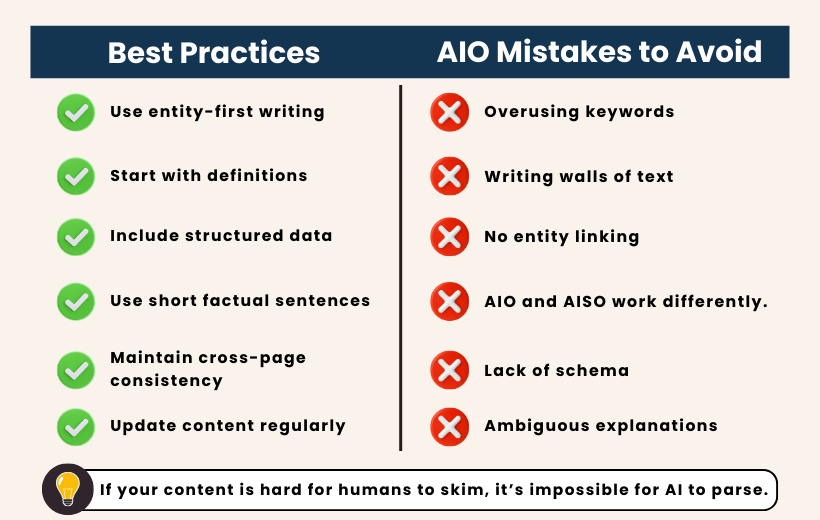
AIO Best Practices (and Mistakes to Avoid)
AIO requires writing and structuring content so AI systems can parse, interpret, extract, and cite it with high accuracy and minimal ambiguity.
| DO | DON’T |
|---|---|
| Use entities | Use vague references |
| Use structure | Use walls of text |
| Add schema | Ignore metadata |
| Short factual statements | Long narrative explanations |
Below are the essential practices and the critical mistakes to avoid when optimizing content for AI engines.
Best Practices
✔ Use entity-first writing
Write with clear entities, not vague references.
AI engines rely on entities to understand context, relationships, intent, and meaning.
✔ Start with definitions
Begin sections with explicit definitions or explanations.
AI systems prioritize content that establishes explicit meaning at the beginning of a section.
✔ Include structured data
Use schema markup (FAQ, Article, Breadcrumb, Organization, Product/Service).
Structured data gives AI a machine-readable map of your content, including relationships and contextual meaning.
✔ Use short factual sentences
Concise, direct statements are easier for AI to extract, segment, rank as answers, and cite.
✔ Maintain cross-page consistency
Consistent terminology and factual alignment help AI build trust across your site. Avoid redefining concepts inconsistently or introducing multiple interpretations of the same entity.
✔ Update content regularly
AI engines prefer fresh, updated information, especially in fast-changing topics.
AIO Mistakes to Avoid
❌ Overusing keywords
Keyword stuffing weakens clarity, introduces ambiguity, and reduces AI interpretability.
AIO focuses on entities and structure, not keyword density.
❌ Writing walls of text
Dense paragraphs reduce extractability, obscure relationships between ideas, and increase ambiguity.
AI engines prefer segmented, structured, machine-readable content.
❌ No entity linking
Failing to define or distinguish entities leads to misclassification, misinterpretation, or skipped content.
Example:
✖︎ “AIO and AISO work differently.”
✔ “AIO (AI Optimization) covers all AI-driven systems. AISO (AI Search Optimization) focuses specifically on AI search engines.”
❌ Lack of schema
Without a schema, AI engines lose essential context and struggle to classify your content.
Schema improves classification, interpretation, entity mapping, and citation confidence.
❌ Ambiguous explanations
Vague or implied meaning forces AI to guess.
AI rewards explicit, literal statements that clearly convey purpose, meaning, relationships, and factual boundaries.
Examples of AIO-Optimized Content
Practical examples illustrate AIO more clearly than theory.
Below are real writing scenarios transformed using core AIO principles: clarity, structure, entity precision, machine readability, and factual grounding.
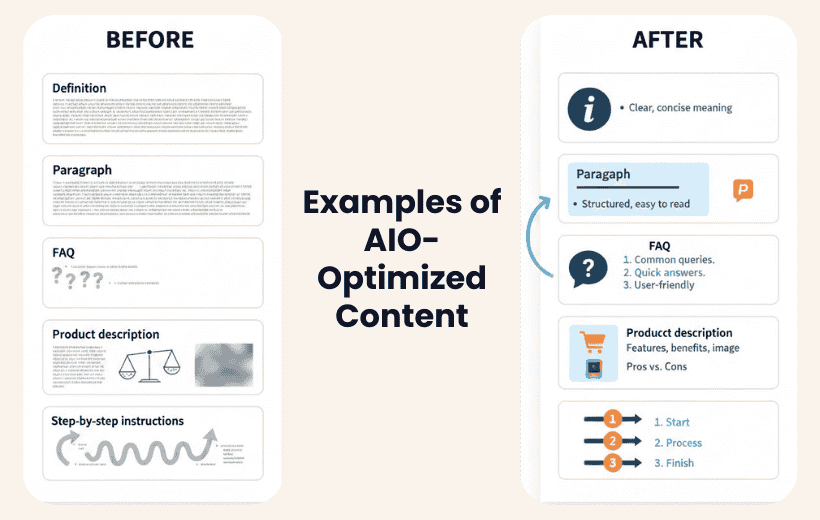
1. Optimized Definition
❌ BEFORE (Non-AIO Definition)
AI Optimization is basically improving your content so it ranks better and AI tools can use it.
✔ AFTER (AIO-Optimized Definition)
AI Optimization (AIO) refers to the practice of structuring, formatting, and aligning content so AI systems can interpret, extract, and cite it accurately.
AIO ensures the content is entity-clear, machine-readable, and factually grounded, increasing its likelihood of being selected, extracted, and cited by AI systems.
2. Optimized Paragraph
❌ BEFORE (Unstructured Paragraph)
Google, ChatGPT, and Perplexity are all changing how people search. They don’t just show results; they generate answers by drawing on information from many sources. So content needs to be written in a way that these AI tools can understand and pick up easily.
✔ AFTER (AIO-Optimized Paragraph)
Modern AI systems, including Google AI Overview, ChatGPT Search, and Perplexity, generate direct answers instead of listing results.
To appear inside these answers, the content must be:
- structured (lists, definitions, steps)
- entity-precise (clear terminology)
- fact-aligned (verifiable statements)
AI engines rely on these signals to determine whether a statement is extractable, accurate, and citation-worthy.
3. Optimized FAQ
❌ BEFORE (Weak FAQ)
Q: What is AEO?
A: AEO helps your website show up when someone asks a question online.
✔ AFTER (AIO-Optimized FAQ)
Q: What is Answer Engine Optimization (AEO)?
A: Answer Engine Optimization (AEO) is the subset of AIO focused on helping content appear as direct answers inside AI systems such as ChatGPT, Google AI Overview, Bing AI, and Perplexity.
AEO ensures content is structured, factually clear, and entity-complete, making it easier for AI engines to extract and display a single authoritative response.
4. Optimized Product / Service Description
❌ BEFORE (Generic Description)
Our digital marketing service helps businesses grow online with SEO, content, and social media strategies.
✔ AFTER (AIO-Optimized Product/Service Description)
Digital Marketing Service
Our Digital Marketing Service helps businesses improve visibility across search engines and AI-powered discovery systems.
The service includes:
- SEO optimization for Google Search and Featured Snippets
- AIO optimization for AI search engines such as ChatGPT Search and Perplexity
- Content structuring for entity clarity, schema markup, and AI extractability
This service helps brands gain visibility in SERPs, AI answers, and generative summaries across modern discovery platforms.
5. Optimized Comparison Segment
❌ BEFORE
SEO is traditional, and AIO is new, but both help you get visibility.
✔ AFTER
SEO improves visibility in search engines using ranking systems based on keywords, backlinks, and page-level factors.
AIO improves visibility in AI engines by optimizing content for interpretation, structured extraction, and citation.
SEO influences rankings. AIO influences which statements AI systems select, extract, and cite across search, answer, and generative engines.
6. Optimized Step-by-Step Instructions
❌ BEFORE
To optimize your page, make sure it is clear and includes all important details.
✔ AFTER (AIO-Structured Instruction)
How to AIO-Optimize a Page (Step-by-Step):
- Start with a definition that clearly introduces the topic.
- List key concepts using bullet points or tables.
- Define all entities (people, concepts, tools, brands) and use consistent terminology throughout the page.
- Add schema markup, such as FAQ or Article schema.
- Use short, factual sentences that are easy for AI engines to parse.
- Update content regularly to maintain freshness and trust signals.
Is Your Brand AI Ready?
Find out whether AI systems will cite or skip your content.
Get your AI Readiness Score in minutes.
✓ Covers ChatGPT, Claude, Gemini & Perplexity
✓ No Technical Skills Required
FAQs
What is AIO?
AIO (AI Optimization) is the discipline of preparing content so AI systems can interpret, extract, and cite it accurately.
A simple analogy:
AIO is to AI what SEO was to search engines. It ensures that AI systems understand your content the way humans do.
SEO helped Google understand webpages.
AIO helps AI models understand information inside webpages.
AIO ensures AI systems can interpret your content accurately, extract key statements, and cite them as trusted sources.
Who Needs AIO?
AIO is essential for:
- Brands that want visibility in Google AI Overviews
- Businesses targeting ChatGPT Search, Perplexity, Gemini, and Bing Copilot
- Publishers and educators competing in AI-driven discovery
- E-commerce websites that rely on product/service citations
- Any organization that wants its expertise included in AI answers, summaries, or recommendations
In short, AIO is essential for any brand that wants visibility in a world where users ask AI rather than search Google.
Is AIO the same as AEO or AISO?
No. These terms represent different layers of AI visibility:
- AIO = parent discipline for all AI systems
- AISO = subset focused on AI search engines (ChatGPT Search, Perplexity, Gemini AI Search, Google AI Overviews)
- AEO = subset focused on direct factual answers chosen by AI
AIO is the umbrella discipline; AEO and AISO are specialized branches within it.
Does AIO replace SEO?
No. AIO does not replace SEO — it evolves it.
SEO is still essential for:
- Ranking in traditional SERPs
- E-E-A-T consistency
- Organic traffic
AIO adds new layers for: AI extraction, AI citation, entity interpretation, generative summaries, and machine readability.
SEO = visibility in search engines.
AIO = visibility in AI engines.
Both support organic visibility.
How many people use AI now?
Usage of AI systems has grown faster than any previous technology:
- ChatGPT has crossed 300M+ monthly users
- Perplexity is one of the fastest-growing AI search tools
- Over 1 billion users now interact with Google AI Overviews
- Voice assistants like Siri, Alexa, and Google Assistant power daily queries by millions
- AI browsers (Arc, Brave AI) are rapidly replacing traditional navigation
This shift proves one thing: AI, not search engines, is becoming the first place people go for answers.
How do I implement AIO on my website?
Implement AIO using five foundational steps:
1. Structure your content for AI:
- Start with definitions
- Use lists, tables, and steps
- Keep sentences short and explicit
2. Optimize entities, not keywords:
- Define key terms
- Remove ambiguity
- Ensure entity consistency across your site
3. Add schema and metadata:
- Article, FAQ, Breadcrumb, Organization, Product/Service schema
- Add LLMs.txt or ai.txt where applicable
4. Ensure factual grounding:
- Use verifiable statements
- Keep data updated
- Maintain cross-page consistency
5. Improve machine readability:
- Clean HTML structure
- Use semantic markers “means,” “refers to,” “because,” “therefore”)
- Make content easy for AI to parse and segment
Related Posts
Why Some Brands Don’t Appear in “Top 10 Lists” but Still Win in AI-Driven Search
TL;DR Not appearing in “Top 10” lists does not mean a brand lacks visibility in AI-driven search. AI systems do not rank companies based on curated lists or popularity. They select sources based on clarity, consistency, and how well content explains a topic. Brands...
The Future of GEO: How AI Changes Brand Discovery in 2026 & Beyond
The Future of GEO: How AI Changes Brand Discovery in 2026 & BeyondWe have now officially entered the AI Discovery Era, a world where people no longer “search” with keywords. They simply ask AI questions in natural language. Instead of showing a list of links, AI...
Ranking Factors for AI Search Engines (2025 Study)
Ranking Factors for AI Search Engines (2025 Study)AI search engines are transforming the way content is searched, evaluated, and cited. AI search changes how information is consumed, but it still relies on the foundations of traditional SEO. While core SEO signals...