
What Is Generative Engine Optimization (GEO)? Explained Simply

If you have noticed that Google now answers queries directly, Google AI Overview summarizes content instantly, and users often do not click through the websites, you are already seeing Generative Engine Optimization (GEO) in action.
GEO is not replacing SEO. It is expanding it. For years, we focused on ranking for the “10 blue links.” But in 2026, the goal has changed.
This guide explains what GEO is, why it matters in the future, and how you can optimize content so it is not just ranked but selected and referenced within AI-generated answers.
Key Takeaways
- Generative Engine Optimization (GEO) focuses on making content understandable, trusted, and reusable by AI-driven search and answer systems.
- GEO does not replace SEO. SEO helps content get discovered, while GEO helps content get selected and cited by AI.
- AI-powered platforms prioritize clarity, structure, entities, and topical authority over keyword density alone.
- Visibility in AI-generated answers matters as much as, or more than, traditional rankings in the zero-click search era.
- A hybrid SEO + GEO approach ensures content performs across organic search results, LLMs, and generative tools.
- Well-structured, answer-focused, and expertise-driven content is more likely to be reused by AI systems.
What Is Generative Engine Optimization (GEO)?
Generative Engine Optimization (GEO) is the practice of optimizing content so it can be understood, trusted, extracted, and referenced by AI-powered search and answer systems.
These systems include:
- Google AI Overviews
- ChatGPT
- Perplexity
- Bing Copilot
Other generative search engines and LLM-based tools
Instead of ranking for ten blue links, these platforms generate responses. GEO ensures your content becomes part of those responses.
In simple terms:
- SEO helps your content get found
- GEO helps your content get used
- If SEO is about visibility, GEO is about credibility and clarity.
Why GEO Matters for Brands in 2026?
This matters because AI often replaces traditional search clicks, making visibility within AI-generated answers more important than ranking position alone.
Today, it’s not enough to appear on page one. Brands must be part of the information AI uses to answer user questions.
Users want fast, direct answers.
AI systems are now the middle layer between your content and the user. If your content is not AI-friendly, it may never be seen, even if it ranks.
Surviving the “Zero-Click” Search Era
Many searches now end without a click. AI Overviews summarize information directly on the results page.
This means:
- Traffic is no longer the only metric
- Being cited and referenced matters more
- Brands that appear in AI answers gain authority and recall
If an AI provides a 200-word answer to a user, that user might never visit a website.
GEO ensures that even if they don’t click, they see your brand cited as the authority. If they do want to dive deeper, your link is the one they click.
The Shift from Keywords to “Conversations”
AI systems do not think in keywords. They understand:
- Questions
- Context
- Entities Relationships
- User intent
GEO aligns content with how people ask questions and how AI interprets them, not just keyword density. It focuses on conversational, long-tail, and precise queries that AI engines are designed to solve.
Why You Need Both SEO and GEO?
You might be wondering: “Does this mean I should stop doing SEO?” Absolutely not. Think of them as two sides of the same coin.
This is one of the most misunderstood topics right now. You do not choose between SEO and GEO. You use both.
To understand why SEO and GEO work best together, it helps to look at how they differ in purpose and function. While they often overlap in practice, each plays a distinct role in how content is discovered, interpreted, and reused across search and AI systems.
How GEO Differs from SEO?
While SEO and GEO are closely related, they serve different purposes in how content is discovered and used by SEs and AIs.
In practice, SEO helps content get indexed and discovered, while Generative Engine Optimization helps that same content get understood, trusted, and reused by AI systems.
The Hybrid Strategy: Ranking on Google while Sourcing in AI
A hybrid SEO + GEO strategy ensures your content performs well in traditional search results while also being selected and cited by AI-powered systems.
Here’s how the hybrid approach works in practice:
SEO ensures discoverability
SEO helps your pages get crawled, indexed, and ranked on Google through keyword targeting, internal linking, and technical optimization.
GEO ensures AI selection and reuse
GEO focuses on making content easy for AI systems to understand, extract, and reference when generating answers in AI Overviews and conversational search.
Structured content supports both systems
Clear headings, lists, tables, and summaries help search engines rank content and help AI systems identify reusable information.
Authority signals reinforce trust across platforms
Consistent expertise, clear authorship, and topical depth support selection by both ranking and generative systems.
One piece of Content serves multiple visibility layers
The same page can rank in organic results, appear in Google AI Overviews, and be cited in generative answers across platforms.
In short, a hybrid strategy allows content to rank on Google, answer user questions directly, and remain visible even when clicks decrease.
How does GEO Work?
GEO aligns content with how AI-powered systems analyze, extract, and reuse information when generating answers for users.
Instead of focusing only on rankings, GEO focuses on how content is understood and trusted by AI models.
How AI Understands Content
AI systems analyze content based on meaning, context, and structural clarity.
They analyze:
- Language patterns and clarity
- Depth of topic coverage
- Consistency across sections
- Contextual relationships between concepts and entities
Content that is fragmented, vague, or indirect is harder for AI systems to interpret and is less likely to be selected for AI-generated answers.
Content Must Be Easy to Extract
For content to be used in AI, it must be easy to isolate and reuse.
AI systems look for:
- Direct answers to specific questions
- Short, factual explanations
- Clear definitions, summaries, and lists
If an answer cannot be extracted cleanly from a page, AI systems are unlikely to include it in generated responses.
Authority Drives AI Trust
Once content is understandable and extractable, authority becomes a key factor in AI selection and reuse.
This includes:
- Demonstrated subject-matter expertise
- Consistent publishing on a focused topic
- Websites with clear topical authority
This does not mean only large brands are favored. In many cases, specialized and focused expertise is more valuable than broad coverage.
Clear Entities Improve Recognition
Entities help AI systems understand exactly what your content is about.
Entities can include:
- Concepts such as Generative Engine Optimization and Search Engine Optimization
- Platforms like Google AI Overviews
- Brands, tools, or organizations
When entities are clearly defined and used consistently, AI systems can more accurately interpret and connect your content to relevant queries.
Structured Formats Improve AI Readability
Well-structured content is easier for AI systems to analyze and reuse.
Formats that improve AI readability include:
- Clear headings and subheadings
- Bullet points and numbered lists
- Tables and FAQ sections
Structured content helps AI systems identify key information, extract precise answers, and match content to user intent more effectively.
GEO Works Best With SEO & AEO
Generative Engine Optimization does not replace SEO or AEO. It works alongside them.
- SEO supports crawling, indexing, and rankings
- AEO structures content as direct answers
- GEO helps AI systems understand, trust, and reuse content
Together, SEO, AEO, and GEO create a unified approach that improves visibility across traditional search results and AI-generated answers.
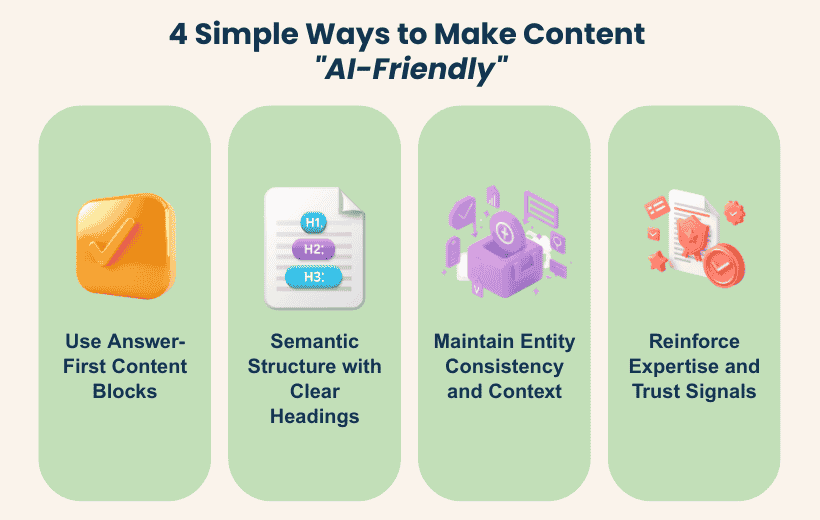
4 Simple Ways to Make Content “AI-Friendly”
Use Answer-First Content Blocks
AI systems prioritize clear, self-contained answers. Begin important sections with a direct response to the core question before adding explanation or context.
Placing the most precise answer early improves extraction accuracy for AI-generated summaries and conversational responses.
Apply Semantic Structure with Clear Headings
Use H2 and H3 headings to define topic boundaries clearly. These headings act as semantic signals that help AI systems understand how concepts are organized and related.
Short paragraphs, bullet lists, and tables further improve machine readability and content extraction.
Maintain Entity Consistency and Context
Clearly define key terms and entities when they first appear, and use consistent language throughout the page.
Consistent entity usage helps AI systems correctly associate concepts, platforms, and terminology, reducing ambiguity and improving relevance for generative answers.
Reinforce Expertise and Trust Signals
AI systems assess trust based on content accuracy, topical depth, and consistency. Support explanations with precise language, factual detail, and clear authorship where possible.
Content that demonstrates subject understanding and reliability is more likely to be selected, cited, and reused by AI-driven search platforms.
Conclusion
By focusing on GEO, you are future-proofing your brand. You are ensuring that even when users don’t click, they still learn from you. You are transforming your website from a collection of pages into a trusted knowledge source for the world’s most powerful AI engines.
As AI systems increasingly generate answers directly, content must be easy to understand, accurate, and supported by credible signals such as clear authorship and topical depth. GEO helps ensure content meets these expectations so it can be interpreted, trusted, and reused by AI-driven platforms.
In simple terms, SEO enables discovery, while Generative Engine Optimization determines whether content is trusted and reused by AI systems. Together, they keep content visible and relevant as search continues to evolve.
How AI-Ready Is Your Website? Use Our AI+Search Visibility Checker
See how well your website is understood, trusted, and surfaced by AI-driven search engines and generative results. Identify what to improve and where to focus next.
Frequently Asked Questions (FAQs)
What is Generative Engine Optimization?
What is GEO used for?
In practice, GEO is used to improve visibility in AI-driven search results, increase the likelihood of being cited by AI tools, and ensure content remains relevant as search shifts toward generative and zero-click experiences.
Is GEO replacing SEO?
How do you optimize content for Generative Engine Optimization?
Optimizing for GEO focuses on creating content that is easy for AI systems to interpret, extract, and trust.
This involves:
- Providing clear, direct answers to specific user questions
- Structuring content with descriptive headings and logical sections
- Using consistent terminology and clearly defined entities
- Covering topics with enough depth to demonstrate subject expertise
- Keeping content accurate, current, and aligned with user intent
What are the benefits of GEO?
Key benefits of Generative Engine Optimization include:
- Greater visibility in AI-generated search results
- Higher likelihood of being cited by AI-driven systems
- Improved clarity and intent alignment for both users and machines
- Stronger trust signals across AI-powered search platforms
- Long-term relevance as search continues to evolve
Pramod Ram
Head of SEO, AIO, and Founder, RK Web SolutionsFounder of RK Web Solutions, specializing in SEO, AIO, AEO, GEO, and AI-first search strategies. With 14+ years of experience, he helps brands build visibility in the AI-driven search ecosystem, moving beyond traditional rankings to become a trusted source for AI-generated answers.
Related Posts
Why Some Brands Don’t Appear in “Top 10 Lists” but Still Win in AI-Driven Search
TL;DR Not appearing in “Top 10” lists does not mean a brand lacks visibility in AI-driven search. AI systems do not rank companies based on curated lists or popularity. They select sources based on clarity, consistency, and how well content explains a topic. Brands...
The Future of GEO: How AI Changes Brand Discovery in 2026 & Beyond
The Future of GEO: How AI Changes Brand Discovery in 2026 & BeyondWe have now officially entered the AI Discovery Era, a world where people no longer “search” with keywords. They simply ask AI questions in natural language. Instead of showing a list of links, AI...
Ranking Factors for AI Search Engines (2025 Study)
Ranking Factors for AI Search Engines (2025 Study)AI search engines are transforming the way content is searched, evaluated, and cited. AI search changes how information is consumed, but it still relies on the foundations of traditional SEO. While core SEO signals...