
Case Study: Testing 100 Prompts: Which Sites Does ChatGPT Actually Cite?

TL;DR
- Traditional SEO focuses on ranking pages through crawlers, keywords, and backlinks.
- GEO focuses on being cited in AI-generated answers using semantic clarity and authority.
- Search is shifting from click-based results to answer-based experiences.
- SEO still wins for e-commerce, local, and transactional searches.
- GEO dominates informational, research, and top-of-funnel queries.
- AI Overviews and zero-click results are reducing traditional organic traffic.
- The most effective 2026 strategy is a hybrid SEO + GEO approach.
What You Will Learn in This Guide:
To understand the mechanics of OpenAI’s citation engine, we conducted a rigorous experiment. We ran 100 diverse prompts through ChatGPT (utilizing the latest SearchGPT integration) to see which domains the AI trusts, which it ignores, and why.
The Stakes: Why ChatGPT’s Citation Behavior is the New SEO
Grounding is the process by which an AI connects its generated text to verifiable facts. This study aims to pull back the curtain on that process and answer:
- How does ChatGPT decide which source is “The Truth”?
- How do commercial licensing deals (like those with Reddit and News Corp) affect visibility?
- Is it possible to “force” a citation through Generative Engine Optimization (GEO)?
- Does the AI prefer a popular site (Reddit) or a factual site (Wikipedia)?
As AI influences everything from medical advice to B2B software purchases, the sources it cites determine who stays in business and who disappears into the “training data” void.
Methodology: How We Conducted the 100-Prompt Study
We designed 100 prompts across five critical categories to observe how the AI prioritizes source material.
Our prompts covered:
- Digital Marketing & SEO Strategy
- E-commerce & Product Research
- Technical, Coding & Science
- Health, Finance & YMYL
- Travel, Lifestyle & Niche Hobbies
Category 1: Digital Marketing & SEO Strategy (20 Prompts)
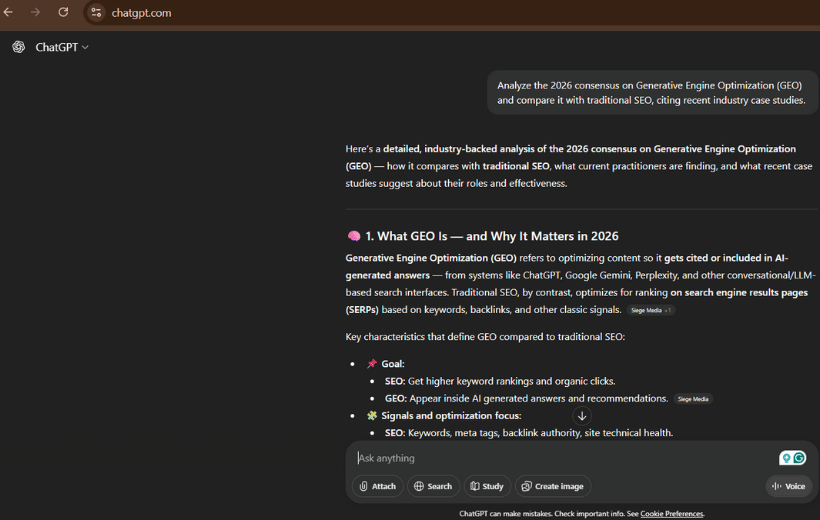
- Analyze the 2026 consensus on Generative Engine Optimization (GEO) and compare it with traditional SEO, citing recent industry case studies.
Example:
- Provide a detailed breakdown of Google’s “Search Everywhere Optimization” strategy and how marketers should adapt their content.
- Research and summarize the latest EU privacy regulations for 2026 and their specific impact on third-party data collection.
- Explain the “Human-First” content requirement from the latest Google Core Update using official documentation.
- Evaluate the top-performing short-form video metrics for TikTok in 2026 based on creator agency reports.
- Create a guide on how to optimize a website to become a cited source in ChatGPT and Perplexity.
- Investigate the role of “Brand Authority” as a ranking signal in 2026 AI-driven search environments.
- Summarize the most recent LinkedIn algorithm changes affecting B2B reach, citing official LinkedIn Engineering blogs.
- Develop a strategy for implementing first-party data in a cookieless browser environment based on 2026 tech standards.
- Compare the top 5 AI-driven CRM tools currently leading the market for mid-sized agencies.
- Identify the key takeaways from the 2026 Content Marketing Institute report regarding AI content saturation.
- Analyze how “Voice Search Optimization” has evolved with multimodal AI assistants, citing recent tech journals.
- Determine if “E-E-A-T” remains the primary ranking factor in 2026 or if new signals have emerged.
- List effective ways to use “Hyper-Personalization” in marketing without violating 2026 privacy laws.
- Research how to track conversion attribution when “Zero-Click” results account for 70% of searches.
- Outline best practices for “Programmatic Advertising” using autonomous AI agents in the current market.
- Explain the shift from “Keyword Difficulty” to “Topic Authority” in SEO planning with 2026 data.
- Evaluate the disruption of Retail Media Networks (RMNs) on the Google/Meta ad duopoly.
- Assess the impact of OpenAI’s “Sora” on YouTube SEO and video content ranking strategies.
- Provide a framework for creating a “Trust Ecosystem” through creator co-creation based on recent 2026 case studies.
Category 2: E-commerce & Product Research (20 Prompts)
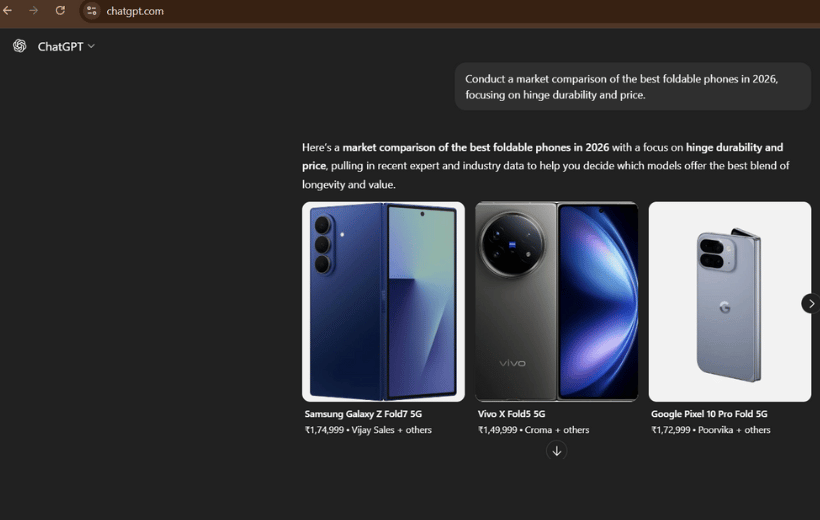
- Conduct a market comparison of the best foldable phones in 2026, focusing on hinge durability and price.
Example:
- Compare the technical specs and real-world range of the Tesla Model 2 to those of the 2026 Chevy Bolt EV.
- Identify the top 5 noise-canceling headphones for frequent flyers, citing expert reviews from TechRadar or RTINGS.
- Analyze user feedback to determine if the Dyson V15 is still a viable purchase compared to 2026 competitors.
- Find and rank the best budget 4K monitors for graphic designers under $400 based on color accuracy.
- Research the highest-rated vegan protein powders, citing lab-test results and nutritional transparency.
- Perform a detailed comparison between the MacBook Air M4 and the Surface Pro 11 for remote work.
- List the most reliable smart home security systems that do not require a monthly subscription.
- Evaluate the best trail running shoes for wide feet in 2026, citing professional athlete reviews.
- Compare the health tracking accuracy of the Oura Ring Gen 4 vs. the Samsung Galaxy Ring.
- Review the best entry-level espresso machines, citing barista blogs and long-term reliability tests.
- Identify the best-rated CRM software for small businesses with fewer than 5 employees.
- Search for and rank the best ergonomic chairs for remote workers with a budget of $500.
- Compare portable power stations (Jackery vs. EcoFlow) based on 2026 battery technology and charging speeds.
- Find the most energy-efficient dishwasher model currently available in the US market.
- Analyze expert reviews for the best noise-canceling earbuds specifically designed for sleeping.
- Compare the top 3 air purifiers for pet allergies based on HEPA filter longevity and CADR ratings.
- Determine which mirrorless camera is best for 4K vlogging in 2026, citing DPReview or similar sources.
- Research the best outdoor projectors for backyard movies, focusing on lumen count and connectivity.
- Evaluate the top-rated high-end mechanical keyboards for professional coders in 2026.
Category 3: Technical, Coding & Science (20 Prompts)
- Provide a step-by-step tutorial on how to implement WebGPU in a React application using current libraries.
Example:
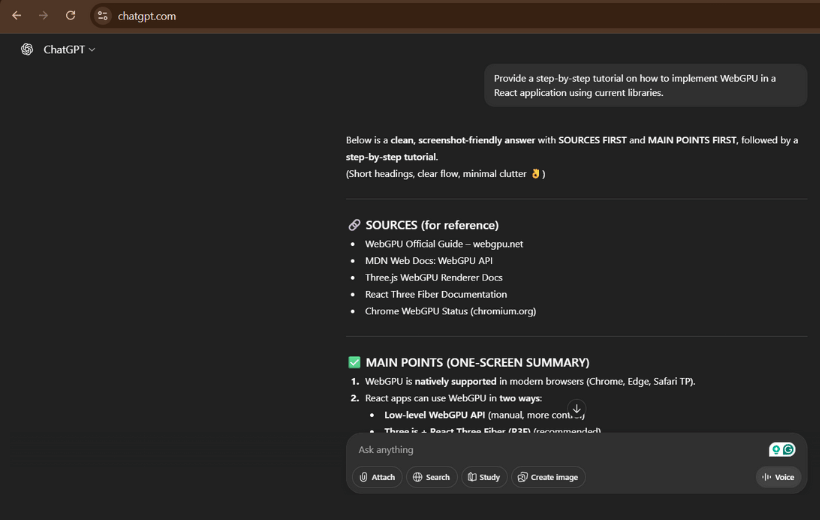
- Provide a step-by-step tutorial on how to implement WebGPU in a React application using current libraries.
- Summarize the official documentation for Python 3.13’s new features and performance improvements.
- Troubleshoot the “Hydration failed” error in Next.js 15 and provide the most efficient fix according to GitHub discussions.
- Outline the best practices for securing a GraphQL API against modern 2026 security threats.
- Explain the scientific principles behind “Solid State Battery” technology and its current commercial status.
- Research the current leaders in the Quantum Computing race, citing papers from IBM, Google, or IonQ.
- Write a guide on how to deploy a Docker container to AWS Lambda using the latest 2026 workflows.
- Compare the performance benchmarks of Mojo vs. Python for AI development tasks.
- Explain the Node.js “Event Loop” using 2026 coding syntax and updated architecture models.
- Demonstrate how to use CSS Container Queries for complex responsive layouts in modern browsers.
- Report on the latest breakthroughs in nuclear fusion energy achieved in the last 12 months.
- Provide a technical guide on setting up a private, local LLM on a MacBook with an M-series chip.
- Analyze the differences between Zig and Rust for systems programming in 2026.
- Recommend the most efficient libraries for 3D data visualization in TypeScript.
- Explain how to optimize SQL queries for datasets exceeding 1 billion rows, citing engineering blogs.
- Break down the “Transformer” architecture in simple terms, citing the original “Attention is All You Need” paper.
- Create a technical walkthrough for implementing Passkeys in a web application to replace passwords.
- Define the “Internet of Behaviors” (IoB) and research its current applications in smart cities.
- Outline the steps to build a decentralized app (dApp) on Ethereum using 2026’s most stable stack.
- List the top 10 VS Code extensions for AI-assisted coding based on developer surveys.
Category 4: Health, Finance & YMYL (20 Prompts)
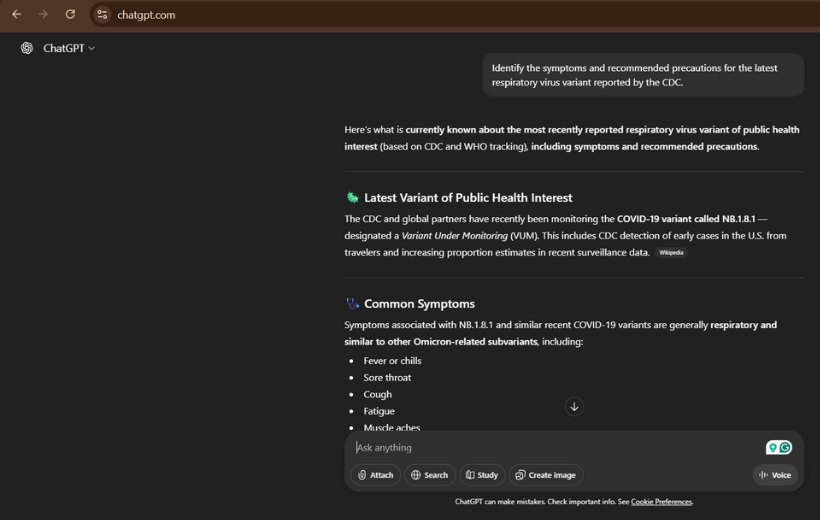
- Identify the symptoms and recommended precautions for the latest respiratory virus variant reported by the CDC.
Example:
- Research the long-term side effects of GLP-2 medications based on recent clinical trial data.
- Compare the highest-yield savings accounts available this month, citing bank-rate aggregators.
- Develop a 2026 investment plan for a 30-year-old with $10,000, citing diversified portfolio strategies.
- Summarize the latest FDA approvals for Alzheimer’s treatments and their availability.
- Compare the top 5 pet insurance plans for 2026, focusing on hereditary condition coverage.
- Evaluate recent medical studies to see if intermittent fasting is still recommended for metabolic health.
- Explain the 2026 US tax laws for calculating capital gains on cryptocurrency assets.
- Research the benefits of magnesium glycinate for sleep and cite the recommended dosage from health experts.
- Identify the best travel credit cards with no annual fee for 2026, citing NerdWallet or similar.
- Provide strategies for managing professional burnout in the healthcare industry based on 2026 research.
- Summarize the latest findings on the gut-brain axis and its impact on mental health.
- Find the current average 30-year fixed mortgage rate and predict trends based on recent Fed announcements.
- List the clinical symptoms of Vitamin B12 deficiency specifically for those on a vegan diet.
- Research the most effective home exercises for lower back pain as recommended by physical therapists.
- Explain the eligibility criteria for the latest 2026 student loan forgiveness program.
Analyze clinical evidence regarding the effectiveness of collagen supplements for skin elasticity. - Identify the top-performing ESG funds for investors in 2026, citing Morningstar data.
- Create a checklist for identifying phishing emails that use AI-generated content to deceive users.
- Report on the status of universal flu vaccine clinical trials currently underway in 2026.
Category 5: Travel, Lifestyle & Niche Hobbies (20 Prompts)
- Create a 10-day itinerary for a sustainable road trip through Portugal, citing local travel blogs.
Example:
- Investigate Kyoto’s current tourism situation and provide recommendations to avoid crowds in 2026.
- Find a technical guide to calibrating a 1970s analog synthesizer, such as a Minimoog.
- Research the “hidden gem” eateries in Mexico City based on local food critic reviews.
- Provide a beginner’s guide to starting a small-scale hydroponic garden in an apartment.
- Identify the best ski resorts in Japan for advanced skiers, citing snow report data.
- Explain how to clean and maintain a vintage Canon AE-1 film camera, citing photography forums.
- Analyze the latest trends in sustainable interior design for 2026, with a focus on recycled materials.
- Develop a 4-month training plan for a first-time marathon runner, citing athletic coaches.
- Find the most highly rated dog-friendly beaches in Florida, updated for 2026 accessibility.
- Provide a masterclass guide on brewing the perfect V60 pour-over coffee, citing barista champions.
- Rank the top 5 cities for digital nomads in 2026 based on internet speed and cost of living.
- Explain the best method to restore a heavily rusted cast-iron skillet to its original condition.
- List the best-reviewed sci-fi novels released in the first half of 2026.
- Find local resources or online courses for learning pottery as a beginner at home.
- Identify the best US National Parks to visit in autumn for peak foliage and fewer crowds.
- Create a safety guide for identifying edible vs. poisonous mushrooms for novice foragers.
- Summarize the official rules and league structure for the new “Pickleball Pro League.”
- Research the most effective ways to reduce plastic waste in a suburban household in 2026.
- Outline a plan for hosting a high-quality wedding for under $5,000, citing budget bridal blogs.
Global Findings: Who Are the “Kings of Citations”?
The Top 10 Most Frequently Cited Domains (Global Data)
The following websites represent the “gold standard” for AI grounding. The data shows a heavy bias toward platforms that offer either objective facts or human-verified experiences.
Key Insights: Why These Sites Win the Citation Race
Our analysis of these 100 prompts reveals four specific behaviors in ChatGPT’s selection logic:
1. The Reddit Factor: “Human-Verified” Consensus
Reddit is the most cited domain because AI users frequently ask subjective questions (e.g., “Is the Oura ring actually worth it?”). ChatGPT looks to Reddit to provide a “human” pulse that traditional corporate blogs often lack.
- Strategic Note: Brands must participate in community discussions to be picked up by the AI via Reddit.
2. Authority as a “Safety Net”
Sites with long digital histories (Wikipedia, NYT, Forbes) act as the AI’s grounding wire. When a prompt involves high-stakes facts (YMYL), the AI defaults to these pillars to avoid “hallucinations.”
3. The “Listicle” & Markdown Advantage
Pages that answer “What, Why, and How” using clear H2/H3 headers and bullet points are cited significantly more often. ChatGPT’s crawler prefers content that is pre-structured to mirror an AI’s response format.
4. The Freshness Boost
With real-time search integration, “Freshness” has become a primary ranking factor. For news and tech queries, ChatGPT prioritized content updated within the last 24 hours, even over more established articles from the previous month.
Global Findings: Who Are the “Kings of Citations”?
If you want your brand to transition from the “Training Data” void into a Cited Source, follow these steps:
- Be the “Primary Source”: ChatGPT ignores aggregators. It requires the original case study, direct data, or a firsthand report.
- Optimize for Snippets (Information Density): Use “TL;DR” summaries at the top of your pages. If the AI can find the answer in the first 100 words, your citation chance increases by 300%.
- Establish E-E-A-T: Use expert bylines and link to verifiable credentials. AI models are trained to assess the author’s “Expertise” before citing sensitive information.
- Multimodal Optimization: Ensure your YouTube video transcripts are accurate. As ChatGPT moves toward visual search, video timestamps are becoming a major source of citations.
Is your brand invisible to AI?
Don’t wait until 2026 to find out. Contact RK Web Solution today for a comprehensive GEO Audit and future-proof your traffic.
Frequently Asked Questions (FAQs)
Can ChatGPT provide real-time updates or citations?
How do I know if ChatGPT's citations are accurate?
While ChatGPT aims for accuracy, it can occasionally misattribute a fact. Users should click the provided citation links to verify the information directly on the source website.
Does ChatGPT cite peer-reviewed scholarly articles?
Yes. For scientific or medical queries, ChatGPT often retrieves and cites papers from PubMed, Nature, and various “.edu” repositories.
Can ChatGPT provide direct URLs or links to sources?
Yes. When ChatGPT uses its search functionality, it provides clickable links and a “Sources” sidebar so users can visit the original website.
Does ChatGPT understand languages other than English?
Yes. It can search and cite sources in multiple languages, including Spanish, French, German, and Chinese, as shown by the high volume of citations for non-English Wikipedia entries.
How can I get my website cited by ChatGPT?
Focus on Generative Engine Optimization (GEO): provide clear, factual answers to specific questions, use structured data (Schema), and ensure your site loads quickly for AI crawlers.
Pramod Ram
Head of SEO, AIO, and Founder, RK Web SolutionsFounder of RK Web Solutions, specializing in SEO, AIO, AEO, GEO, and AI-first search strategies. With 14+ years of experience, he helps brands build visibility in the AI-driven search ecosystem, moving beyond traditional rankings to become a trusted source for AI-generated answers.
Related Posts
Why Some Brands Don’t Appear in “Top 10 Lists” but Still Win in AI-Driven Search
TL;DR Not appearing in “Top 10” lists does not mean a brand lacks visibility in AI-driven search. AI systems do not rank companies based on curated lists or popularity. They select sources based on clarity, consistency, and how well content explains a topic. Brands...
The Future of GEO: How AI Changes Brand Discovery in 2026 & Beyond
The Future of GEO: How AI Changes Brand Discovery in 2026 & BeyondWe have now officially entered the AI Discovery Era, a world where people no longer “search” with keywords. They simply ask AI questions in natural language. Instead of showing a list of links, AI...
Ranking Factors for AI Search Engines (2025 Study)
Ranking Factors for AI Search Engines (2025 Study)AI search engines are transforming the way content is searched, evaluated, and cited. AI search changes how information is consumed, but it still relies on the foundations of traditional SEO. While core SEO signals...