
Ranking Factors for AI Search Engines (2025 Study)

AI search engines are transforming the way content is searched, evaluated, and cited.
AI search changes how information is consumed, but it still relies on the foundations of traditional SEO. While core SEO signals remain important, generative models also look for clarity and structure to validate content for citation.
This guide breaks down the real ranking factors behind AI search visibility, based on hands-on analysis and citation testing.
TL;DR
- AI search engines often cite pages that rank well in traditional search, but top ranking alone does not guarantee citation.
- Clear structure with headings, bullet points, and tables improves AI readability.
- Direct answers and summaries help AI quickly extract relevant information.
- Structured data and schema make content machine-readable and citation-ready.
- Well-defined entities reduce ambiguity and enhance context for AI responses.
- SEO ensures discovery, while clarity, structure, and machine-readability drive citation suitability.
Why Ranking in AI Search Is Not the Same as SEO
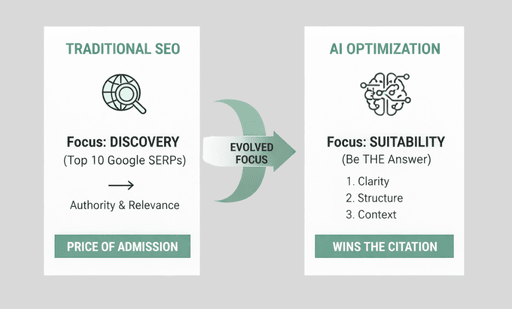
Let’s be clear: SEO is not dead. In fact, our recent study confirms that SEO is the price of admission for AI visibility.
Our analysis revealed that the vast majority of AI citations were pulled from pages already ranking on the first page of Google SERPs. If the AI cannot find you via traditional ranking signals (like authority and relevance), it generally won’t cite you.
However, ranking #1 does not guarantee a citation.
The difference exists because AI systems prioritize:
- Clarity of explanation over ranking position
- Structure that supports summarization and extraction
- Context that reduces ambiguity when generating answers
This is where SEO has evolved. Traditional optimization focuses on Discovery (getting into the top 10). AI optimization focuses on Suitability (getting chosen as the answer).
This is where AI Optimization (AIO) comes into play.
SEO helps content get discovered, Answer Engine Optimization (AEO) helps it become the answer, and Generative Engine Optimization (GEO) helps it remain usable across generative AI systems that summarize, compare, and cite information.
In short, Strong SEO gets you into the candidate pool, but strong AI optimization wins you the citation. The two are not competing strategies; they are two halves of the new standard.
The Experiment: How We Analyzed AI Citability
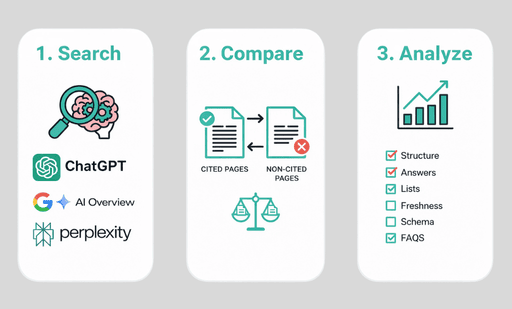
To understand how AI-powered systems select sources, we conducted a structured analysis of AI-generated answers across multiple platforms.
Rather than focusing only on Google rankings, the experiment examined which pages were cited and how they differed from other relevant results. The analysis compared cited pages with non-cited pages appearing for the same queries.
This approach helped identify consistent signals influencing AI citation behavior.
What We Searched & Where
To examine how AI systems select sources, we tested a diverse set of queries designed to reflect real user intent. The queries spanned several types:
- Informational – providing definitions, explanations, or insights
- Commercial – comparing products, services, or solutions
- Transactional – focused on purchasing decisions or actionable steps
These queries were run across AI-driven platforms to capture differences in citation behavior:
Each query was reviewed multiple times to account for variations in AI responses. The aim was to identify which pages were cited and to observe consistent patterns in AI content selection.
What We Measured (Analysis)
For every cited and non-cited page, we systematically evaluated content and structural attributes to identify factors influencing AI citations. By calculating the percentage of pages with each feature, we identified patterns that make a page more likely to be cited.
Key factors measured included:
- Content Structure – clarity of headings and subheadings
- Direct Answer / Summaries – presence of concise answers to user queries
- Bullet Points and Comparison Content – use of lists or structured sections
- Table Usage – presence of tables for comparison or clarity
- Freshness / Updated Content – whether the content was recently updated
- Author Bio – visibility of author or expertise information
- FAQs – inclusion of frequently asked questions
- Schema / Structured Data – machine-readable elements like JSON-LD
- Entity Clarity – especially for commercial queries, clear mention of key entities
- Price / Features Info – for transactional queries, presence of pricing and feature details
The Results: AI Cited vs. Non-AI Cited Pages
Based on findings from December 2025.
Summary
Cited pages consistently feature clear structure, direct answers, tables, bullet points, and schema, making them easier for AI systems to interpret and reference. Freshness, FAQs, and well-defined entities further increase citation likelihood. Non-cited pages often lack these elements, showing that AI citations prioritize clarity, structure, and suitability for machine reading over ranking alone.
The 5 Core Ranking Factors of AI Systems (Based on the Data)
1. Semantic Density & Information Gain
This factor aligns with AEO (Answer Engine Optimization), where content that delivers clear, complete answers with high information value is more likely to be selected. AI systems favor pages that explain the topic fully without unnecessary filler.
What the Data Shows:
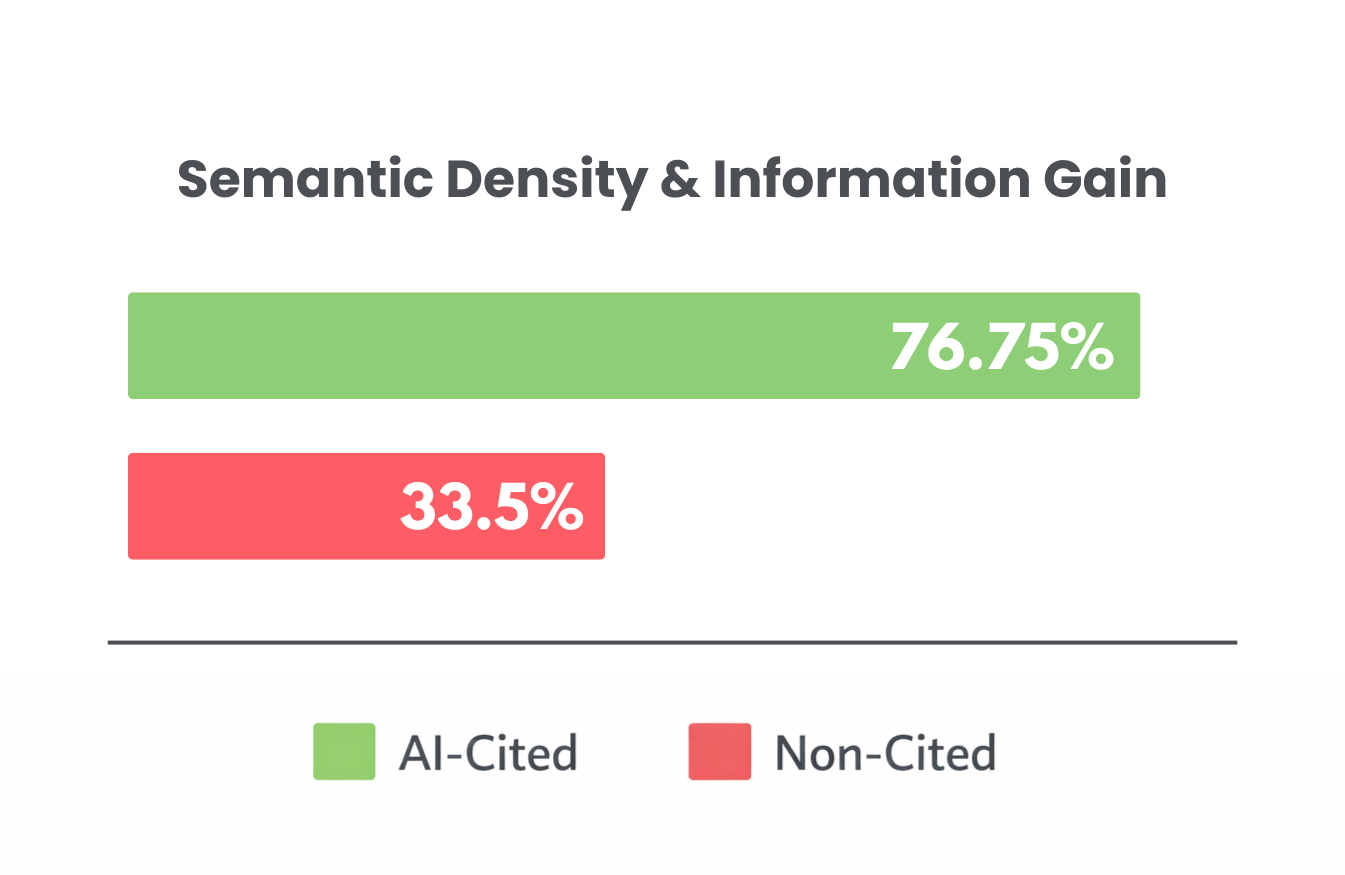
Pages cited by AI systems showed a 76.75% average presence of semantic density signals, compared to 33.5% for non-cited pages.
This indicates that AI-cited content consistently delivers higher information value through concise, well-structured explanations that maximize information gain for both users and AI systems.
2. LLM Readability & Structural Clarity
Content that is well-organized, clearly structured, and easy for machines to parse improves AI readability. This includes logical headings, subheadings, and a flow that makes it simple for AI to extract and summarize information.
What the Data Shows:
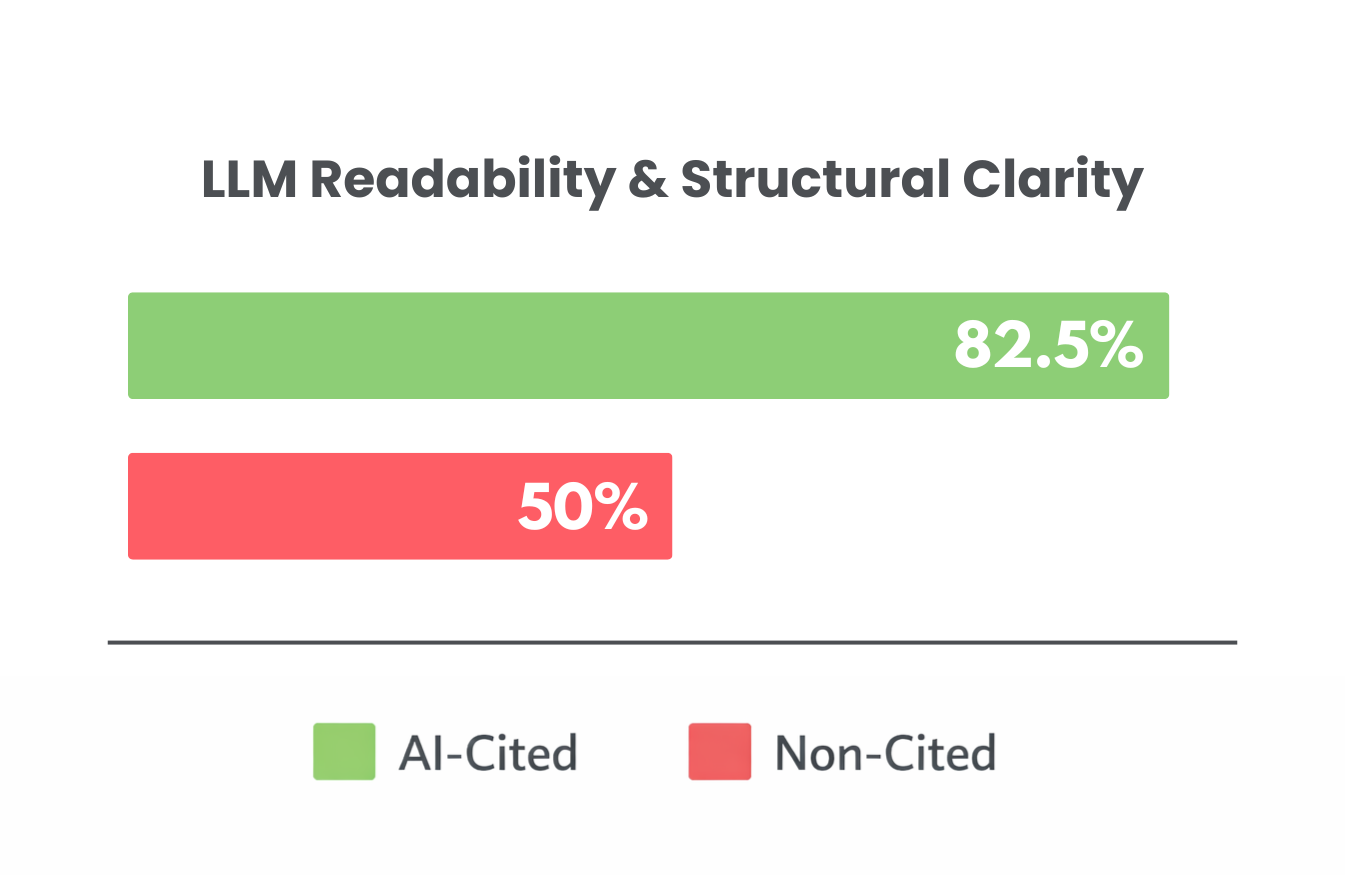
Content cited by AI demonstrated a higher overall level of readability and structural clarity, with a composite presence of 82.5%, compared to 50% on non-cited pages.
This shows that AI systems favor pages with clearly segmented information that is easy to process at the structural level, beyond basic formatting alone.
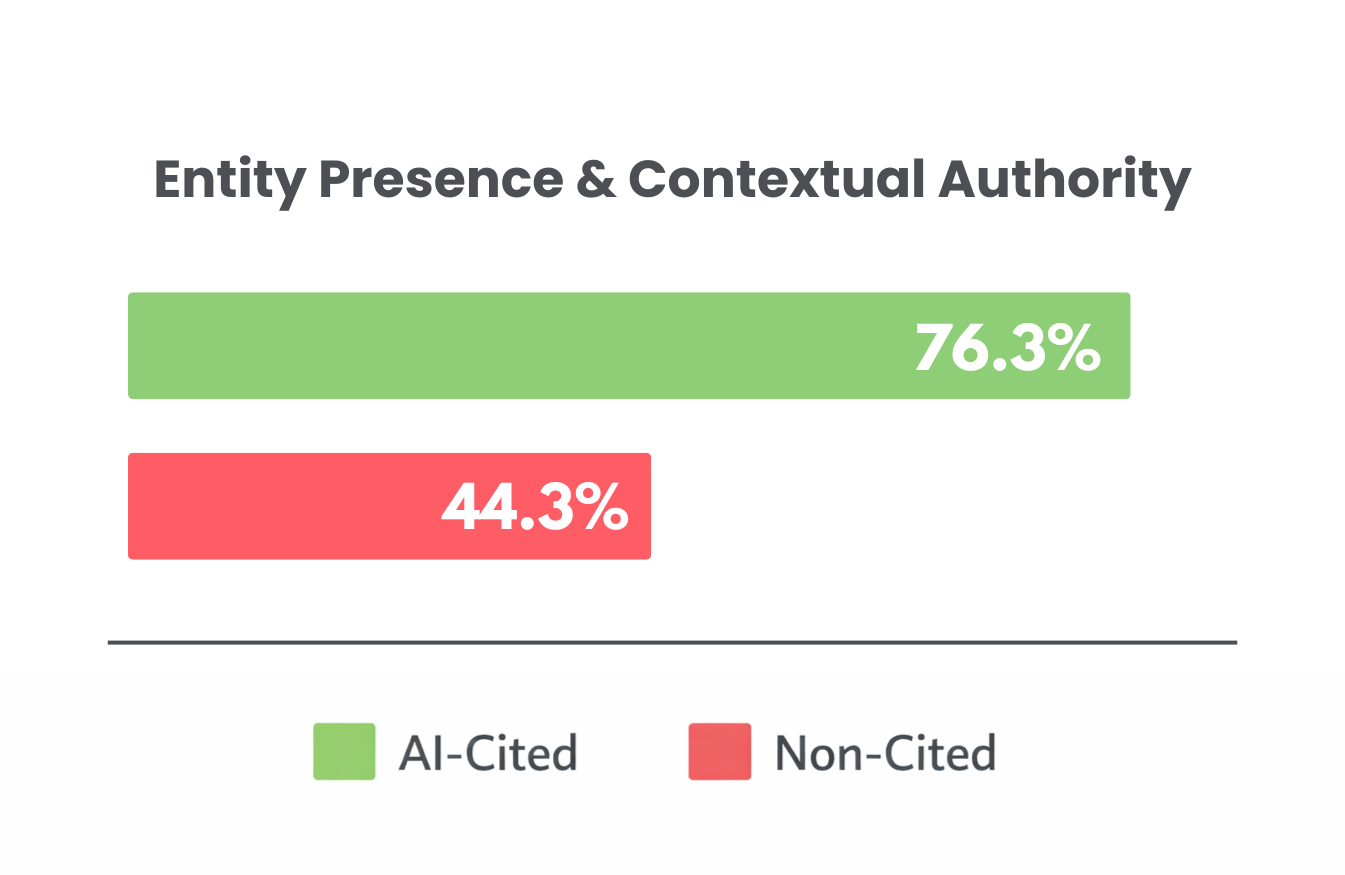
3. Entity Presence & Contextual Authority
Clearly identifying key entities such as products, brands, or concepts, and presenting them in context, signals authority to AI. Well-defined entities help AI understand the topic and reduce ambiguity.
What the Data Shows:
Entity-related signals appeared on 76.3% of AI-cited pages, versus 44.3% of non-cited pages.
This confirms that AI systems are more likely to cite content that clearly defines and contextualizes key entities, helping reduce ambiguity and strengthen topical understanding.
4. Structured Data & Machine Interpretability
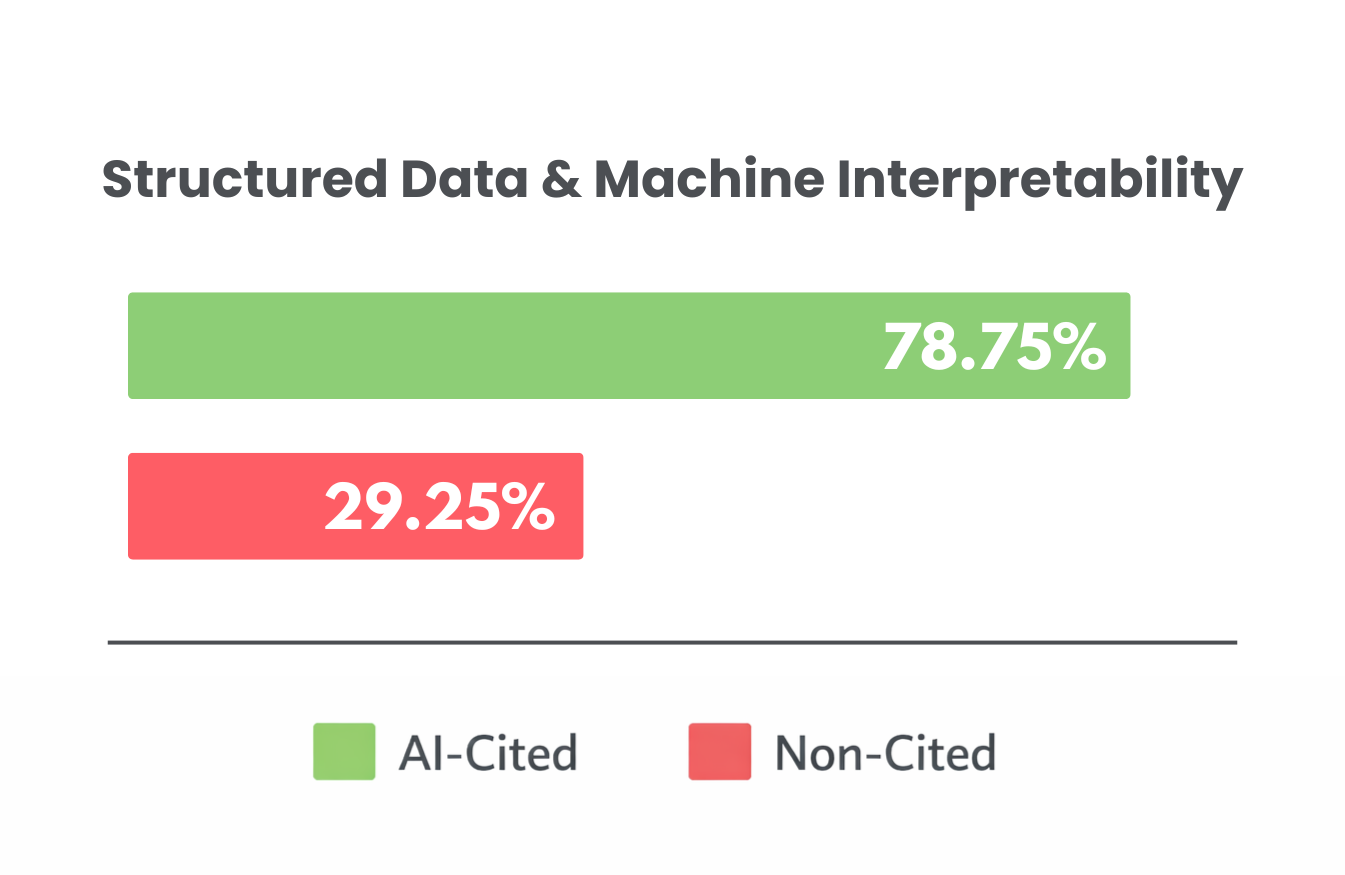
Machine-readable elements such as schema, JSON-LD, and tables make content easier for generative AI systems to extract and reuse. This aligns with GEO, where structured formats improve interpretation, verification, and citation suitability.
What the Data Shows:
This factor showed the strongest separation between cited and non-cited content.
78.75% of AI-cited pages demonstrated strong machine-interpretability signals, compared to only 29.25% of non-cited pages.
This highlights the importance of structuring content so that AI systems can easily parse, interpret, and reuse it.
5. User Experience (UX)
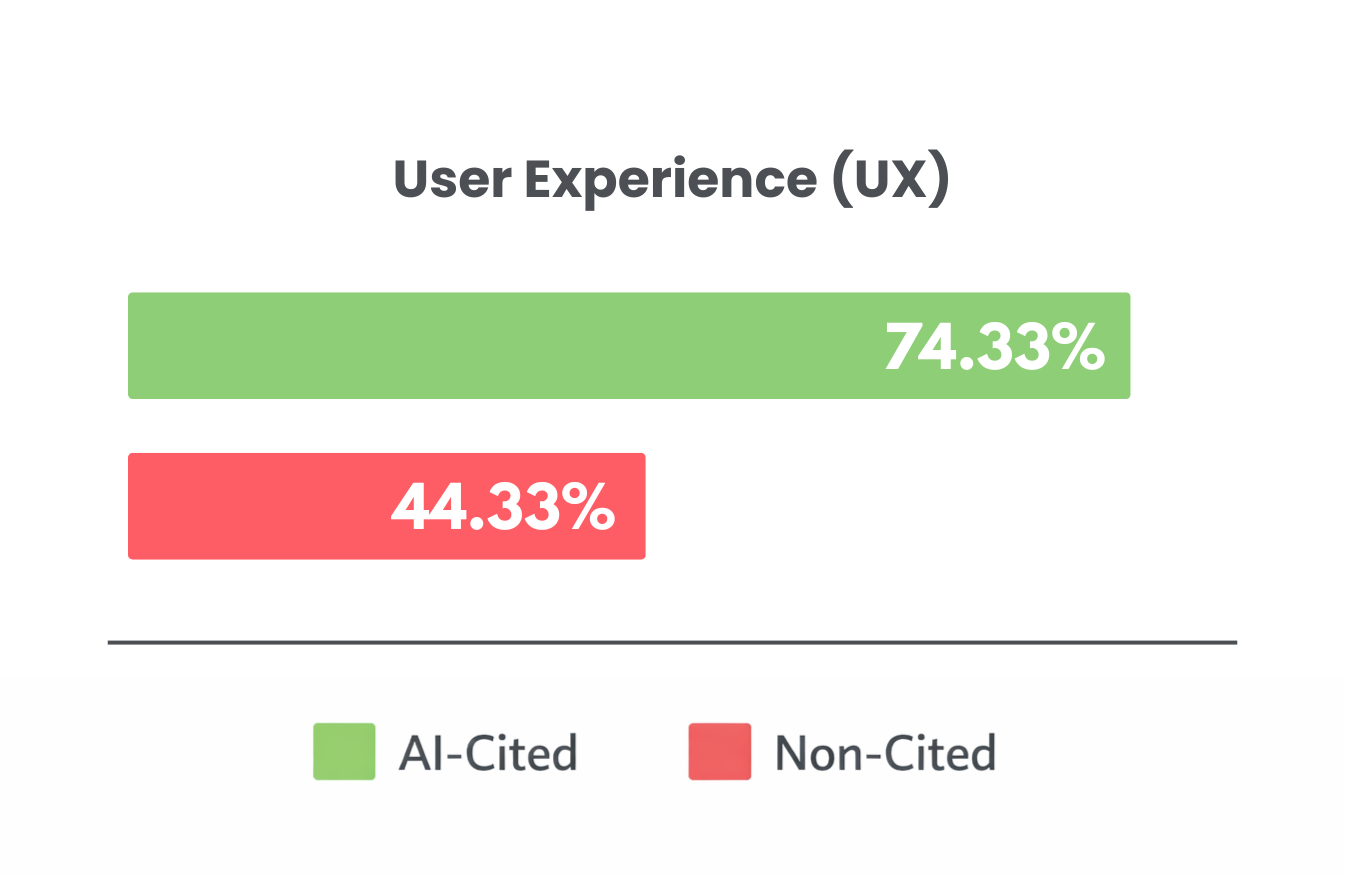
Pages that are clear, easy to navigate, and accessible enhance both human and AI interaction. A good user experience ensures that key information is easy to find, making the page more suitable for AI citation.
What the Data Shows:
UX-related signals were present on 74.33% of AI-cited pages, compared to 44.33% on non-cited pages.
While UX alone does not dominate AI citation behavior, the data shows that clear, accessible, and up-to-date content significantly improves a page’s likelihood of being selected as a source.
| Core AI Ranking Factor | Signals Included | AI-Cited Pages (Avg %) | Non-AI-Cited (Avg %) |
|---|---|---|---|
| 1. Semantic Density & Information Gain | Direct Answers FAQs Bullet Points Tables | 76.75% | 33.5% |
| 2. LLM Readability & Structural Clarity | Headings Bullet Points Tables Direct Answers | 82.5% | 50% |
| 3. Entity Presence & Contextual Authority | Entity Clarity Author Bio Price/Features | 76.3% | 44.3% |
| 4. Structured Data & Machine Interpretability | Schema FAQs Tables Entity Clarity | 78.75% | 29.25% |
| 5. User Experience (UX) | Freshness Clear Structure FAQs | 74.33% | 44.33% |
Based on findings from December 2025.
Page Formats That Appear More Often in AI Search
AI search engines tend to favor pages that present information in clear, structured, and easily interpretable formats. Certain page layouts make it easier for AI systems to extract and reference content:
- Articles with Summaries or Direct Answers: Concise explanations help AI quickly understand the topic.
- Bullet Points and Lists: Structured lists improve readability and facilitate efficient information parsing.
- Tables and Comparison Charts: Tables organize information in a way that AI can easily interpret relationships or differences.
- FAQ Sections: Frequently asked questions highlight key subtopics and support content extraction.
- Schema & Structured Data: Machine-readable elements, such as schema markup, enhance content interpretability.
- Updated and Authoritative Content: Clear authorship and fresh information increase trust and usability.
In essence, AI prefers pages that combine clarity, structure, and extractability, making them easier to reference in responses.
Is Your Site Ready for AI? Use Our AI Readiness Checker
Ensure your site is AI-ready. Check how your content performs for AI search and discover quick improvements.
Frequently Asked Questions (FAQs)
How to rank in AI search?
What are the ranking factors of ChatGPT?
Can we rank AI content?
If I get cited by AI, will I actually get any clicks?
Why is my competitor showing up in the AI answer, and I'm not?
Does having a YouTube channel help my website rank in AI?
Pramod Ram
Head of SEO, AIO, and Founder, RK Web SolutionsFounder of RK Web Solutions, specializing in SEO, AIO, AEO, GEO, and AI-first search strategies. With 14+ years of experience, he helps brands build visibility in the AI-driven search ecosystem, moving beyond traditional rankings to become a trusted source for AI-generated answers.
Related Posts
Why Some Brands Don’t Appear in “Top 10 Lists” but Still Win in AI-Driven Search
TL;DR Not appearing in “Top 10” lists does not mean a brand lacks visibility in AI-driven search. AI systems do not rank companies based on curated lists or popularity. They select sources based on clarity, consistency, and how well content explains a topic. Brands...
The Future of GEO: How AI Changes Brand Discovery in 2026 & Beyond
The Future of GEO: How AI Changes Brand Discovery in 2026 & BeyondWe have now officially entered the AI Discovery Era, a world where people no longer “search” with keywords. They simply ask AI questions in natural language. Instead of showing a list of links, AI...
Organic Search and AI Visibility
Organic Search and AI VisibilityHow To Rank And Be Cited In 2026? The complete framework for visibility across Google rankings, AI Overviews, and Answer Engines. ☛What is Organic Search and AI Visibility? ☛Search Engines vs. AI: Where Should You Focus Your Efforts?...