
Perplexity SEO Framework: How to Build Content That AI Cites

The old SEO game was simple: get people to click your link. But that era is fading.
Today, it’s not about winning clicks—it’s about earning citations from AI.
People now rely on answers from LLMs (Large language models) like ChatGPT, Gemini & perplexity.
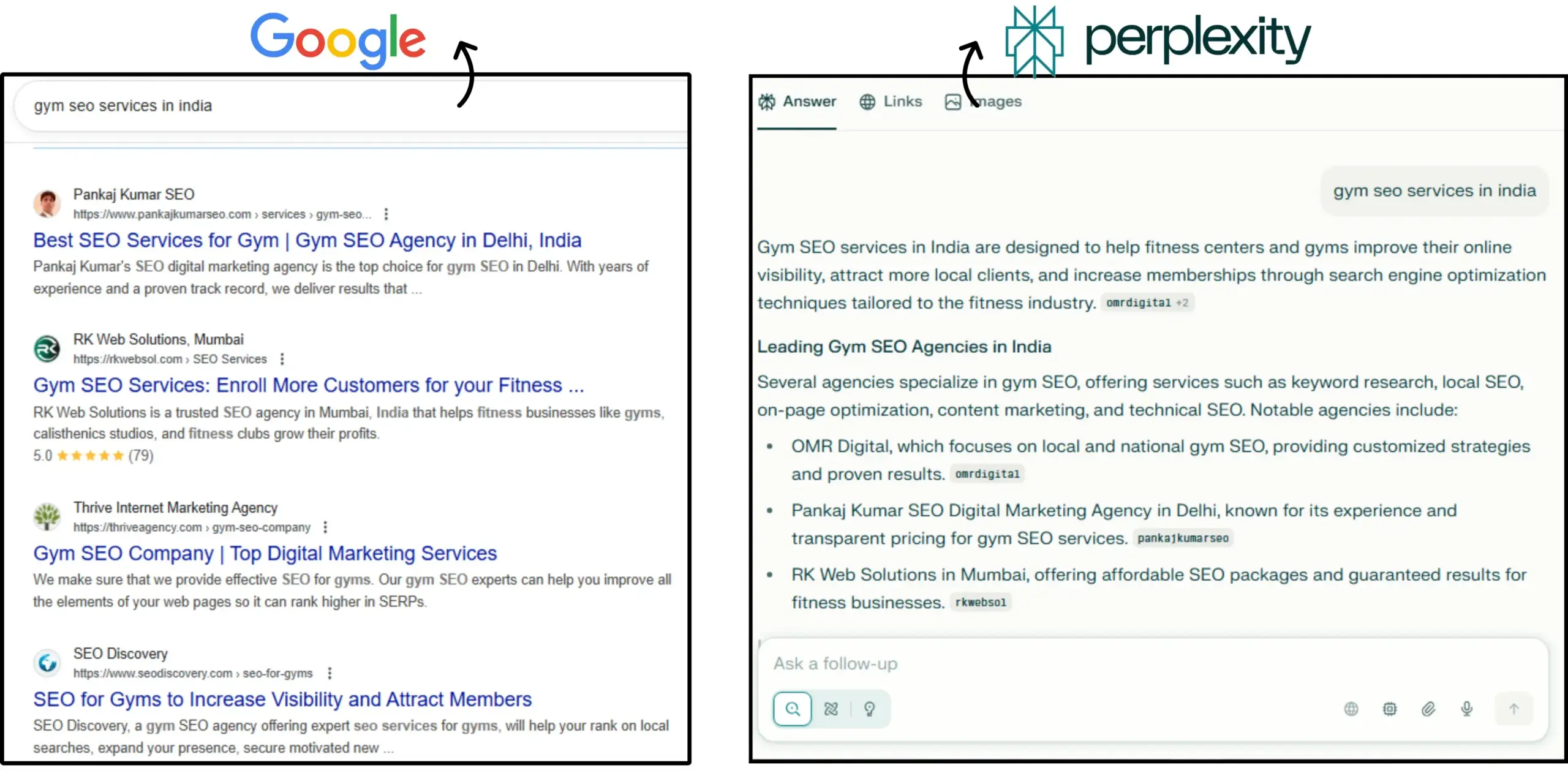
AI Systems like Perplexity have changed the rules. Instead of acting like Google and showing a long list of links, it works like an Answer Engine.
It reads the web, understands it, and delivers one clear, confident answer. And if your content is the best, Perplexity will quote you.
And that shift is massive. To succeed in this new landscape, your content must be structured less like a marketing page and more like a source that is clear, factual, scannable, and rich in grounded expertise.
Your goal is no longer to attract a click.
Now your goal is to become the page that the AI chooses to quote.
What You Will Learn in This Guide:
This guide will show you how to get discovered, cited, and trusted by Perplexity and AI-powered search engines.
Why You Should Add Perplexity to Your SEO and AEO Strategy?
AI search isn’t a “future trend”; it’s already changing how people find and trust information. Ignoring it now means falling behind.
Adding Perplexity SEO optimization to your SEO and AEO strategy gives you a major edge.
Here’s why:
1. High-Intent Referral Traffic
Users on Perplexity aren’t casually browsing; in fact, they’re asking direct, specific questions.
When Perplexity cites your page, the people who click through are already in a high-intent mindset. They aren’t window-shopping. They’re looking for clear answers, solutions, or products.
2. Instant Brand Authority
Being cited by a popular AI tool serves as a built-in trust signal. If Perplexity calls your content a reliable source, users automatically see your brand as an expert. AI citations can work like digital word-of-mouth, boosting credibility before the user even reaches your site.
3. Strategic Diversification
Relying on Google alone is risky, especially with Google’s SGE (Search Generative Experience) diminishing traditional organic visibility. Adding Perplexity SEO to your Google AI Overview strategy helps protect your organic traffic diversification. If one platform changes, you’re not left scrambling.
4. Optimized for the Next Era of Search
Perplexity rewards content that is clear, structured, factual, and easy for AI models to interpret.
By optimizing for Perplexity now, you prepare for a world where answer engines sit at the center of search behavior.
What Makes Perplexity AI Different from Traditional Search
Traditional search engines like Google rely on indexing. They crawl the web, store pages in a database, match your query to those pages, and then show you a ranked list of links. You do the work of clicking and interpreting those pages.
Perplexity works differently from a traditional search engine.
It uses an LLM-powered Retrieval-Augmented Generation (RAG) system, which means it doesn’t just find web pages. It reads them, understands the content, and synthesizes everything into one clear, direct answer for the user.
The Technical Flow: Google vs. Perplexity
Here’s the simplified technical flow of how these systems work:
- Crawls and stores webpages in an index
- Matches queries to keywords
- Ranks pages based on signals
- Shows a list of links
This is document retrieval.
Perplexity
- Fetches relevant data in real time
- Sends it through an LLM
- The LLM reads, interprets, and compares the information
- Produces a clean answer
- Adds citations showing where each fact came from
This is retrieval + reasoning + synthesis.
In simple terms:
→ Google gives you links.
→ Perplexity gives you the answer, backed by citations.
Comparison Table: Traditional Search vs. Perplexity AI
The table below shows a simple comparison between Traditional search and Peplexity AI
| Feature | Traditional Search Google) | Perplexity AI |
| How It Works | Indexes pages and ranks links | Reads pages and synthesizes answers |
| User Experience | User clicks through results to find info | User gets a clean, direct answer |
| Data Freshness | Depends on indexed content | Browses the live web in real time |
| Goal | Provide Links as search results | Provide the best answer |
Overall, Perplexity shifts search from browsing links to getting instant answers. This new model rewards clear, trustworthy content, making it a key part of modern SEO and AEO.
How Do You Get Featured in Perplexity AI Results?
Getting cited by Perplexity AI isn’t about tricking the algorithm; it’s about creating content that an AI can easily understand, trust, and use to answer real questions. Below is a simple, actionable breakdown of the most important Perplexity ranking factors.
1. Focus on Continuous SEO Efforts
If you want Perplexity to cite your content, a traditional SEO strategy is essential.
PerplexityBot (the crawler Perplexity uses) needs fast, clean, and accessible pages. If it can’t crawl your site, it can’t cite your site.
Key tips:
- Improve website speed and ensure it passes essential Core Web Vitals.
- Regularly check Google Search Console for crawl errors.
- Use clean code and simple URL structures.
- Ensure all pages are fully mobile-friendly.
- Keep your robots.txt file open to PerplexityBot.
- Ensure your sitemap is up-to-date and accessible.
2. Grow Multi-Channel Authority Across the Web
Most people think “authority” means backlinks, DR scores, or who has the biggest website.
But Perplexity doesn’t work like Google.
Perplexity pulls reputation signals from hundreds of micro-sources, including:
- Reddit discussions
- YouTube video reviews transcripts
- Niche community forums
- Product documentation
- Small expert blogs
- Industry directories
- Q&A platforms
- Social media citations
Example: Query “Best laptops for coding in India.”
When I searched for the “best laptops for coding in India” on Perplexity, it didn’t just pull top results from big tech sites.
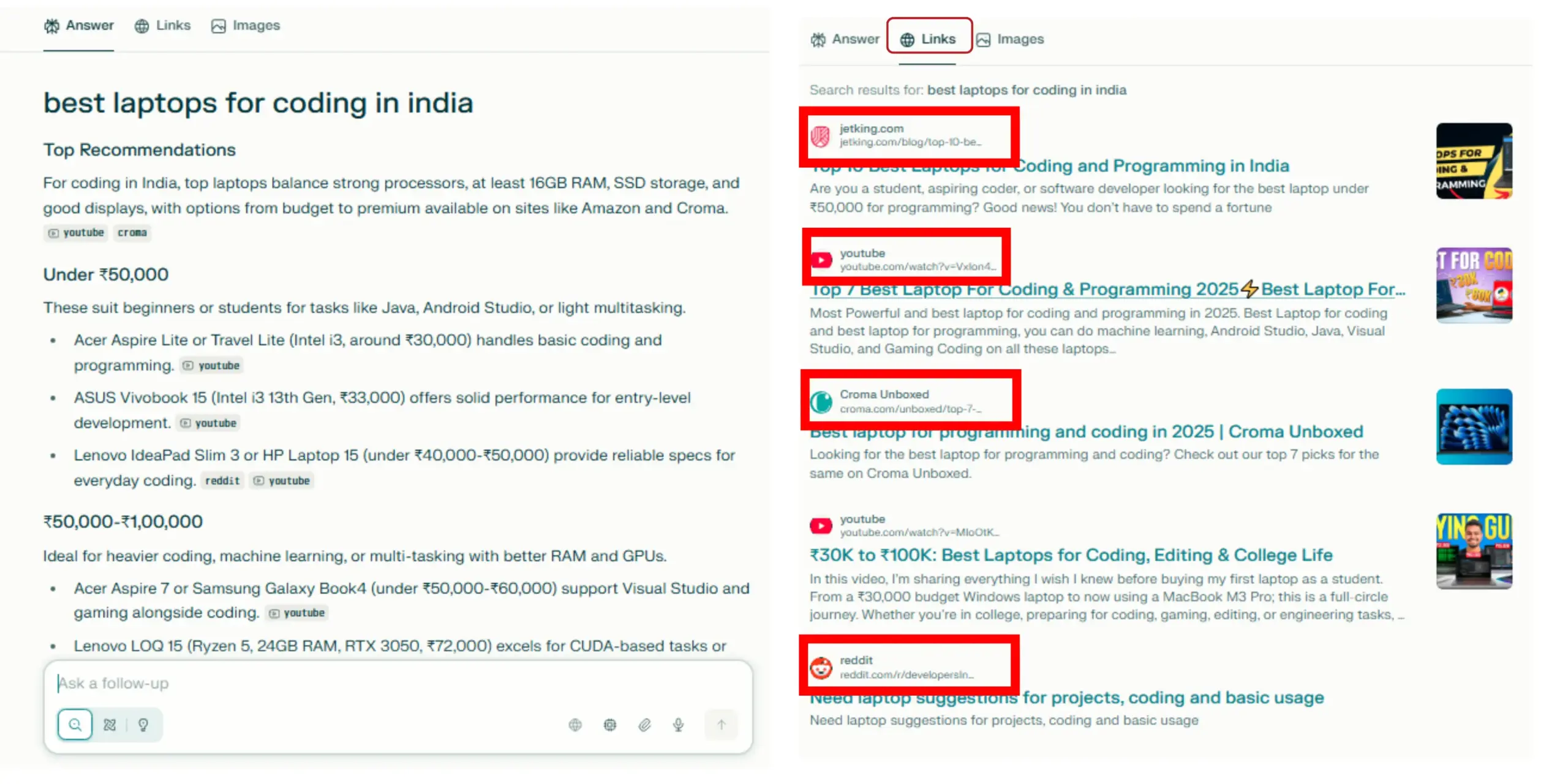
Instead, it mixed insights from:
- YouTube tech reviewers
- Reddit threads from real developers
- Croma product listings
- Niche tech blogs
- User discussions on forums and Quora-like platforms
This shows how Perplexity blends multiple micro-sources to build a well-rounded answer.
3. Improve Your H-E-E-A-T Signals ( Case Study: RK Web Solutions)
For AI search engines like Perplexity, H-E-E-A-T isn’t optional; it’s the foundation of visibility. Perplexity rewards content that is genuinely helpful, transparent, and backed by real-world expertise.
To show you how to apply this, here’s a “real example of how RK Web Solutions” strengthened the H-E-E-A-T signals on their “Local SEO Packages page”. After implementing these elements, their page started appearing in Perplexity results for “best local SEO services price in India.”
🔵 H — Helpfulness: Give Users Exactly What They Asked For
RK Web Solutions made their content extremely specific, answering the exact search intent of users looking for pricing, service details, and comparison.
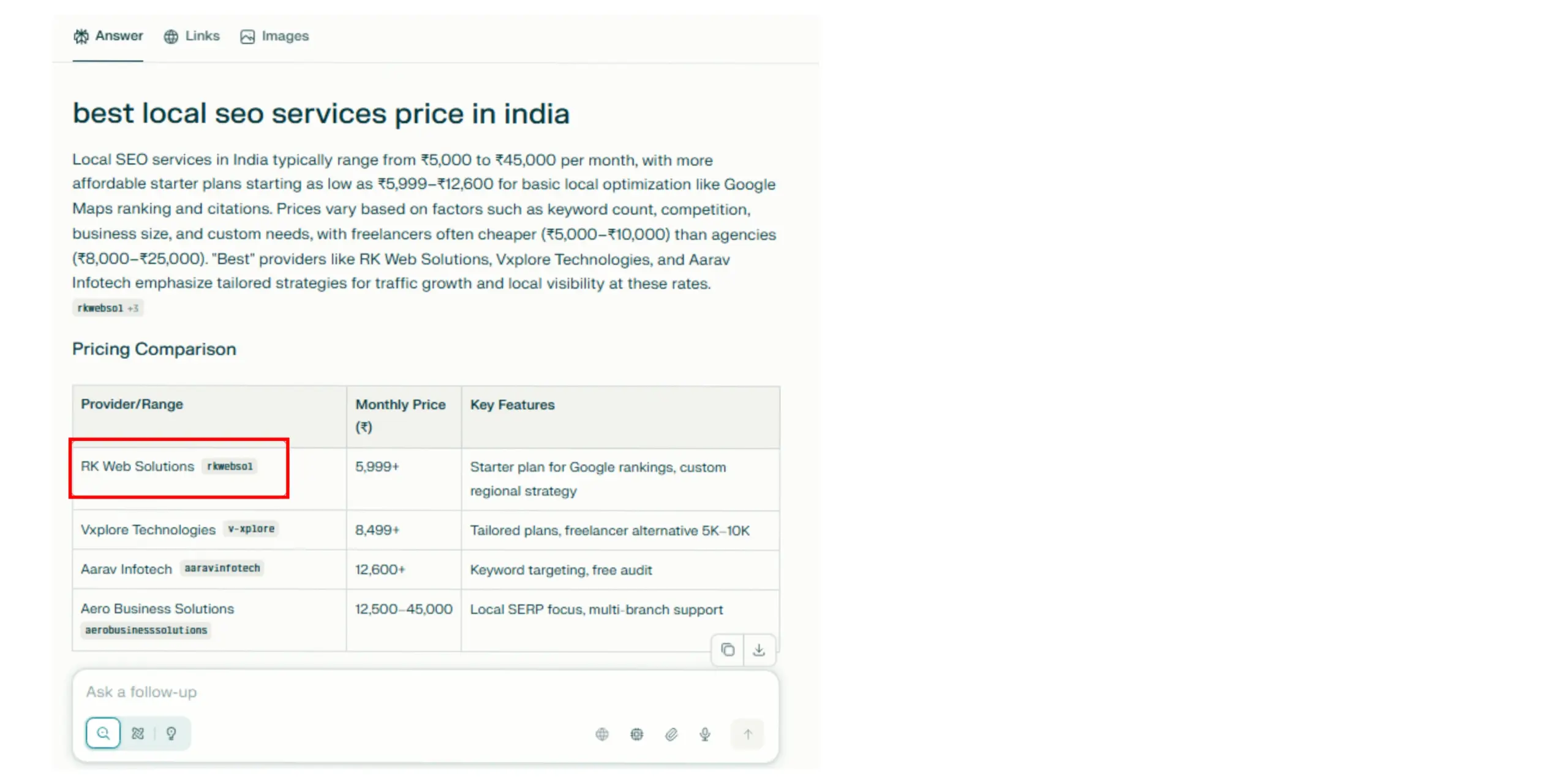
How They Improved Helpfulness:
- Clear monthly price ranges
- Easy-to-scan comparison tables
- Immediate answers without fluff
- Direct alignment with user queries (“local SEO price in India”, “affordable SEO services”)
🟢 E — Expertise: Demonstrate Professional SEO Knowledge
Expertise is shown when a company confidently shares its process, tools, and work methodology.
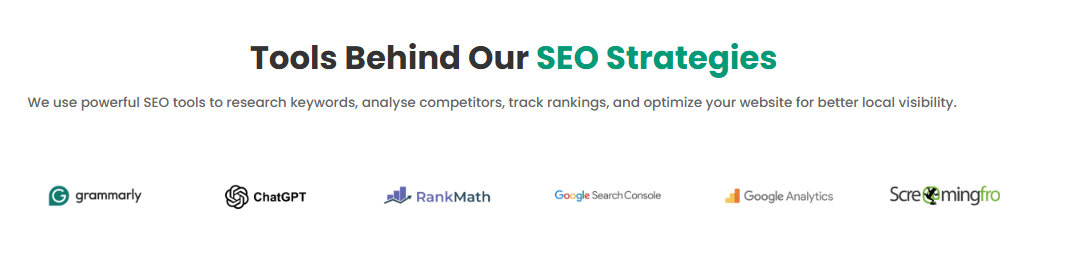
How RK Web Solutions Demonstrates Expertise:
- They list advanced tools used for optimization
- They outline their SEO strategy clearly.
- They provide actionable insights rather than vague promises.
This signals to Perplexity that the content is written by someone who genuinely performs SEO work.
🟡 E — Experience: Show Real-World Implementation & Results
Perplexity favors creators who aren’t just explaining — but doing. RK Web Solutions highlights years of execution, completed campaigns, and practical SEO experience.

How They Show Experience:
- Over 15 years of SEO practice
- Hundreds of successful campaigns
- Real case workflows displayed
- Clear value proposition backed by historical performance
This shows real involvement in SEO rather than theoretical claims.
🟣 A — Authoritativeness: Prove You’re a Recognized Source
Authority comes from recognition, comparisons, and mentioning what sets the business apart from other businesses.
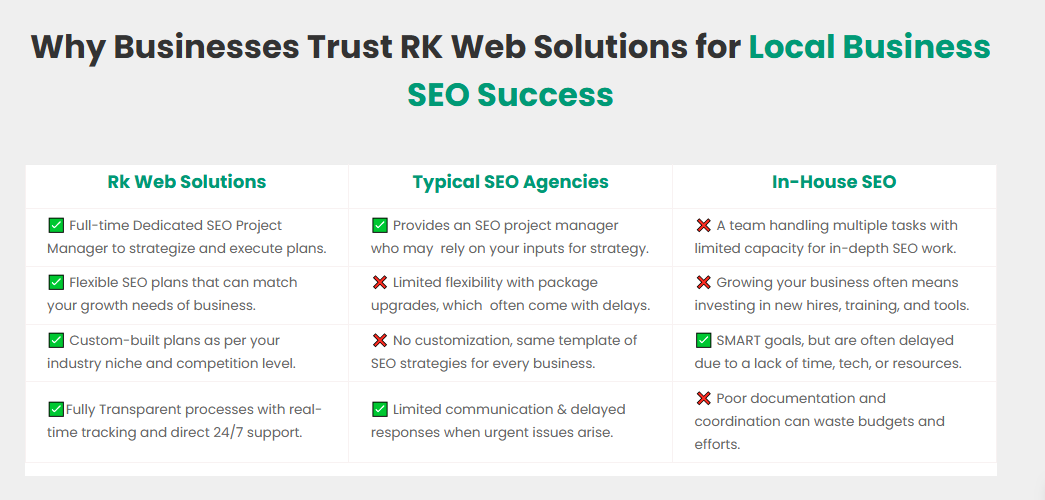
How Authority Was Built:
- Differentiation from “typical” SEO providers
- Unique selling propositions
- Proof of dedicated managers, customization, and transparency
- Strong positioning as an industry leader
Perplexity looks for these signals when deciding which sources are authoritative.
🔴 T — Trustworthiness: Be Transparent, Honest, and Verifiable
Trust signals help both users and AI confirm the credibility of your content.
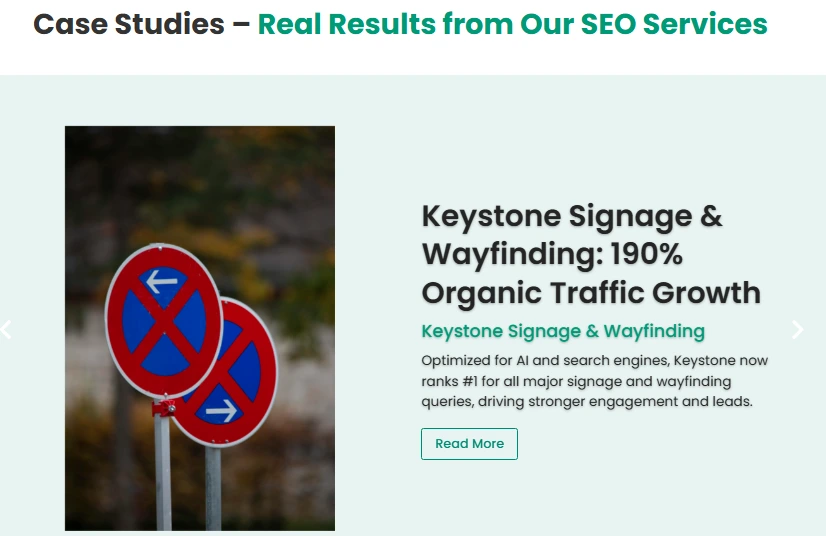
How RK Web Solutions Increased Trust:
- Real case studies
- Clear pricing models
- Transparent work processes
- Support availability
- Verified results are shown visually.
These signals strongly reinforce trust, a critical ranking factor for Perplexity.
Final Outcome: The Page Started Ranking on Perplexity
After RK Web Solutions added these H-E-E-A-T elements:
- Real case studies
- Transparent pricing
- Tools used
- Experience proof
- Unique strengths
Their Local SEO Packages page began appearing in Perplexity’s top results — proving that H-E-E-A-T directly affects AI search visibility.
How Can You Apply This To Your Own Website?
✔ Add real expertise (process, tools, frameworks)
✔ Show your experience through case studies or screenshots
✔ Be authoritative — highlight what makes you better
✔ Build trust with transparency, pricing, and proof
✔ Most importantly: answer user intent directly and completely
By integrating these improvements, your content becomes not only more trustworthy for users but also instantly favored by AI search engines.
4. Optimize for Conversational Queries
Perplexity doesn’t rank content based on keywords alone; it scans for content written the way humans naturally ask and answer questions.
This is why your formatting, headings, and sentence structure matter as much as your keywords.
Why Conversational Formatting Matters?
People don’t search like:
“perplexity seo optimization best guide”
They search like:
“How do I optimize my content for Perplexity?”
“What is Perplexity SEO?”
Perplexity wants to match this natural language, so if your content mirrors those question patterns, your chances of getting cited go up.
How to Format Your Content for Conversational Queries?
1. Turn Your H2s/H3s into Real Questions
Instead of:
❌ Perplexity SEO Overview
Write:
✅ H2: What Is Perplexity SEO?
Perplexity identifies question-formatted headers as “answer opportunities.”
2. Answer Immediately in a Clear, First Sentence
You must respond in the very first line (the “direct answer sentence”).
Example:
Perplexity SEO is the process of optimizing content so AI search engines can understand, cite, and rank your answers.
This helps Perplexity extract your answer as a featured “citation block.”
3. Add Follow-Up Details in Small, Skimmable Paragraphs
- Use 2–3 sentences max per block.
Break up your content using:
- bullet points
- mini paragraphs
- explanatory notes
This matches how Perplexity generates its own summarized responses.
5. Structure Content for Easy Extraction By AI Algorithms
AI models and search bots do not “read” content the way humans do; they parse and categorize information.
If your page is one giant wall of text, AI has to work harder to understand it. And when AI has to work harder, it’s less likely to cite you in places like Perplexity, Google AI Overviews, or ChatGPT answers.
So if you want AI to pull your content into its responses, you need to make your writing easy to extract and reuse. Think of it like giving the AI neatly labeled boxes instead of a messy storage room.
Below is exactly how to do that.
1. Start With a Short Summary or TL;DR
AI looks at the top of your page first. That’s where it expects the main answer.
What to do:
Right after your H1, add a quick 2–3 sentence summary that answers the main question your page is about.
Example:
“The best way to clean leather boots is to use a pH-balanced cleaner. This protects the leather while removing stains. Avoid harsh soap because it dries the material.”
This gives AI a clear, confident “starting point.”
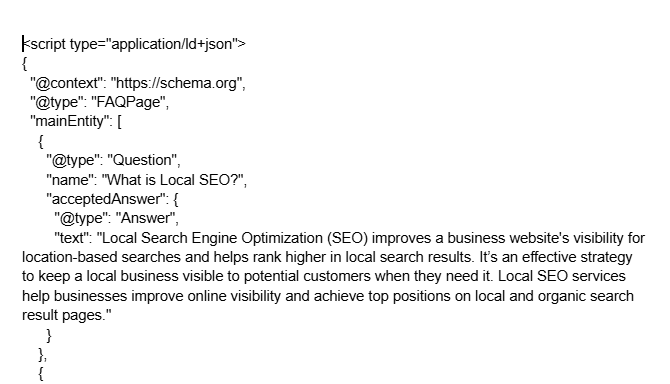
2. Add an FAQ Section (With FAQ Schema)
AI loves question-and-answer formats because that’s exactly how people search.
What to do:
Add a simple FAQ section at the bottom of your blog.
Use actual questions like “How long does local SEO take?”
Give short, direct answers.
If you wrap it in FAQ Schema, even better — it tells AI explicitly:
“This is the question. This is the answer.”
3. Use Bullet Points & Numbered Lists
Long paragraphs are difficult for AI to break apart. Lists, on the other hand, are like easy-scan “content chunks.”
What to do:
- Use numbered lists for steps or how-tos.
- Use bullet points to list features, benefits, pros/cons, examples, and other relevant details.
4. Add Clear Takeaways at the Top
Don’t hide the most important info at the end of your article. AI may not get that far — or worse, it might summarize your page incorrectly.
What to do:
Create a small “Key Takeaways” box near the top of the page.
This gives AI a clear snapshot of the most important ideas before it reads the rest.
5. Keep Paragraphs Short & Scannable
Google now ranks individual passages, not just whole pages. That means your content needs clean, focused little paragraphs that each explain one idea.
What to do:
- Keep paragraphs around 40–60 words.
- Make sure each paragraph covers one point.
- Avoid giant blocks of text.
Short = scannable = easier for AI to extract and cite.
6. Add a Variety of Media Elements
Modern AI models are “multimodal,” meaning they can perceive, analyze, and interpret images, audio, and video alongside text. Platforms like Perplexity, Google Gemini, and Bing Chat explicitly look for visual context to create rich, magazine-style answers.
When Perplexity generates a result, especially in the “Discover” tab, it frequently pulls images, diagrams, and even video previews to enrich the answer.
That means adding the right media doesn’t just make your content look good…
It increases your chances of being selected, cited, and showcased visually inside Perplexity’s results.
Rich media = richer context = higher visibility.
“ See how Perplexity’s discover tab displays articles with strong visual content.”

Why Media Helps With Perplexity Results:
Perplexity uses visuals for two purposes:
- Understanding — Images + alt text help the AI understand your page’s topic more accurately.
- Surfacing — AI highlights content with quality visuals because users find it easier to consume.
This is especially important for service pages, product comparisons, tutorials, and data-driven
Content — visuals make your expertise “AI-readable.”
Key Tips to Make Multi-Media Work for You:
- Add high-quality images and diagrams: Break complex ideas into simple visuals — AI loves digestible information.
- Include videos when helpful: Tutorials, product demos, or case study walkthroughs get more attention.
- Always write descriptive alt text: Alt text is how Perplexity understands your images. Example: “Local SEO pricing comparison chart for small businesses in India.”
- Use infographics or charts to support data: Perplexity frequently pulls charts into Discover Panel previews.
7. Add Depth to Your Content With Research
When Perplexity chooses what to cite, it isn’t just looking for “long content” — it’s looking for content that’s backed by evidence.
AI trusts pages that demonstrate real data, credible references, and factual accuracy.
Think of it this way:
If your page sounds like an opinion, Perplexity treats it as optional.
If your page sounds like research, Perplexity treats it as reliable.
Depth = credibility.
Credibility = citations.
Why Research Helps With Perplexity?
Perplexity evaluates not just what you say but how well-supported your claims are.
When your content includes data points, surveys, industry insights, or even your own internal findings, the AI has something concrete to latch onto.
This increases your chances of being cited — especially for comparison keywords, pricing pages, and “best X for Y” queries.
Key Tips for Research-Driven Content:
- Cite studies, research papers, surveys, or industry reports. This instantly boosts trust signals.
- Add your own data when possible.
Even small internal stats (conversion increases, cost savings, response rates) differentiate you from generic articles. - Use external sources to strengthen credibility.
When Perplexity sees you referencing trusted sites, it treats your page as a “verified” resource. - Avoid opinions without proof. AI prefers claims that can be validated, not personal assumptions.
8. Regularly Refresh Your Content
AI search engines like Perplexity, Bing Copilot, and Google Gemini differentiate themselves from standard LLMs (like the basic ChatGPT) by their ability to access the live web. Their primary selling point is real-time accuracy.
If your content bears a timestamp from three years ago, AI models view it as “stale data.” Even if the advice is still technically valid, the algorithm is programmed to prioritize sources that signal current relevance. To an AI, an outdated article is a hallucination risk. To stay cited, your content must remain living and breathing.
How to Stay Fresh
1. Update Content at Least Once a Year
Set a “content audit” schedule. For fast-moving industries (like tech, finance, or marketing), quarterly updates are ideal. For evergreen topics, an annual review is mandatory.
The Signal: When you update a page, search bots re-crawl it. If they see significant changes, they re-index the content with a fresh timestamp, moving you to the front of the line for current queries.
2. Refresh Stats, Screenshots, and Examples
Nothing kills credibility faster than a screenshot of an old interface or a statistic from 2019. AI can cross-reference data. If your article cites “Twitter” but the rest of the web calls it “X,” or if you quote 5-year-old market data, the AI may deem your entire article unreliable.
Action: Swap out old screenshots and find the most recent year’s data reports to cite.
3. Add visible “Last Updated” Dates
Don’t hide your publication dates. Display a “Last Updated” date prominently at the top of your post. More importantly, ensure your site’s schema markup (structured data) reflects the dateModified field.
Why it matters: This is a direct metadata signal to the AI that says, “This content has been vetted recently.”
4. Remove Outdated Advice (Pruning)
“Content Pruning” is essential for AI optimization. If a tool you recommended no longer exists, or a strategy you described has been banned, delete it.
The Risk: If an AI summarizes your article and includes a dead link or bad advice, users will downvote the answer, and the AI will learn to stop citing you.
5. Expand Sections with New Insights
Simply changing the date isn’t enough; you must add value. Add a “2025 Update” section or inject a paragraph about recent trends.
Action: Look at the “People Also Ask” questions for your topic today and add answers to those new questions in your existing content.
How to Measure Success in Perplexity & Other AI Answer Engines
Measuring success in the age of AI requires a shift in mindset. Unlike traditional Google Search, where success equals a “click,” AI Answer Engines often satisfy user intent directly in the chat interface. This means you might see fewer clicks but higher brand authority. However, traffic does happen, and measuring it requires looking at new metrics.
Here is how to track if your AI SEO strategy is working:
1. Monitor “Referral” Traffic in GA4
Perplexity and Bing Chat often appear as referral sources rather than organic search traffic in Google Analytics 4 (GA4).
What to look for: Filter your traffic reports for perplexity.ai. A rise in referrals from this domain is the clearest sign that you are being cited as a footnote source.
2. Track “Share of Model” (SoM)
“Share of Voice” is being replaced by “Share of Model.” This measures how often your brand is cited as the source for keywords relevant to your industry compared to your competitors.
How to do it: Perform manual queries or use emerging AI tracking tools to ask questions like, “What are the best tools for [Your Industry]?” or “How do I [Solve Problem X]?” Record how often your brand is the primary citation versus your competitors.
3. Watch for the “Impression-to-Click” Gap
In Google Search Console, if your impressions are skyrocketing for question-based keywords but clicks are stabilizing, you may be winning the “Zero-Click” war. This means Google’s AI Overview is using your content to answer the user instantly. While this doesn’t always drive clicks, it builds immense brand awareness and trust.
4. Check Perplexity’s “Discover” Feed
If your content is high-quality and visual, it may appear in Perplexity’s Discover feed (a curated news stream). Traffic spikes from this source are often sharp and significant.
Get Discovered in Perplexity with AI SEO
The shift from “Search Engines” to “Answer Engines” is not a fad; it is the evolution of the internet. Perplexity and other AI models are hungry for facts, data, and authoritative voices. They want to cite you, but they need you to speak their language.
By structuring your data, keeping your content fresh, and prioritizing clear, direct answers, you move from being just another search result to being the Source of Truth.
Don’t wait for your competitors to dominate the AI footnotes. The brands that optimize for AI today will define the answers of tomorrow.
Ready to Future-Proof Your Content?
Is your website ready for the AI era, or is it invisible to the algorithms?
Audit your Site for Perplexity SEO now
Is Your Brand Ready For the AI ERA?
Find out whether AI systems will cite or skip your content.
Get your AI Readiness Score in minutes.
FAQS
1. How can you improve your visibility in Perplexity’s results?
Focus on direct answers, structured data, and content freshness. To get cited, your content must be easily readable by Perplexity AI. Use specific headers (H2s/H3s) that match user questions, place the answer immediately after the header, use bullet points for lists, and ensure your site loads quickly. Regular updates are also crucial, as Perplexity prioritizes live, up-to-date data.
2. What exactly is Perplexity AI?
3. How does the Perplexity AI platform function?
4. In what ways might Perplexity AI influence modern SEO?
It shifts the goal from “earning clicks” to “earning citations.” Traditional SEO focuses on ranking #1 to get traffic. Perplexity SEO (or AEO – Answer Engine Optimization) focuses on being the “Source of Truth” so that the AI credits your brand. While this may result in fewer total clicks, the traffic generated is often higher intent, and the brand’s visibility builds significant trust.
5. Is it worthwhile to optimize content specifically for Perplexity?
6. How does Perplexity determine which sources or pages to cite?
7. Does SEO still play a role in how Perplexity selects content?
8. Can small websites or blogs appear in Perplexity’s answers?
9. Does domain authority impact how a site ranks within Perplexity?
10. How do I measure my "AI Readiness"?
Pramod Ram
Head of SEO, AIO, and Founder, RK Web SolutionsFounder of RK Web Solutions, specializing in SEO, AIO, AEO, GEO, and AI-first search strategies. With 14+ years of experience, he helps brands build visibility in the AI-driven search ecosystem.
Explore Related Blog Posts
Why Some Brands Don’t Appear in “Top 10 Lists” but Still Win in AI-Driven Search
TL;DR Not appearing in “Top 10” lists does not mean a brand lacks visibility in AI-driven search. AI systems do not rank companies based on curated lists or popularity. They select sources based on clarity, consistency, and how well content explains a topic. Brands...
The Future of GEO: How AI Changes Brand Discovery in 2026 & Beyond
The Future of GEO: How AI Changes Brand Discovery in 2026 & BeyondWe have now officially entered the AI Discovery Era, a world where people no longer “search” with keywords. They simply ask AI questions in natural language. Instead of showing a list of links, AI...
Ranking Factors for AI Search Engines (2025 Study)
Ranking Factors for AI Search Engines (2025 Study)AI search engines are transforming the way content is searched, evaluated, and cited. AI search changes how information is consumed, but it still relies on the foundations of traditional SEO. While core SEO signals...