
How GEO vs SEO Defines Winning Strategies for AI Search in 2026

What You Will Learn in This Guide:
This guide gives you a complete blueprint to win with GEO and SEO in the AI search era.
The Battle for the Future of Search
By 2026, 50% of your current organic traffic may disappear. Why? Because users aren’t clicking links, they’re reading AI answers.
Search is undergoing its biggest shift since Google launched. The rise of AI search engines, LLMs, and answer-generation tools has changed how people discover information and how businesses get visibility.
The competition is no longer just about winning Google rankings through SEO. It’s now about getting referenced inside AI-synthesized answers, where users make decisions instantly. This is where the real GEO vs. SEO battle begins.
What Are SEO and GEO?
- SEO (Search Engine Optimization) focuses on ranking webpages on Google using keywords, technical SEO, backlinks, and content depth.
- GEO (Generative Engine Optimization) focuses on earning visibility inside answers generated by ChatGPT, Gemini, Perplexity, Claude, and AI Overviews.
In short:
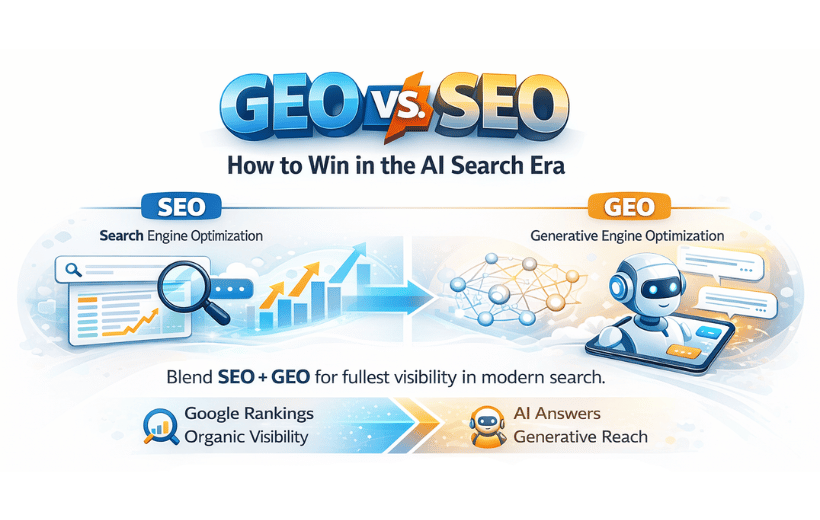
If SEO helps you rank on Google, GEO helps you rank inside AI answers.
Why This Debate Matters for Business Growth in 2026
By 2026, most online users will get answers directly from AI systems without clicking websites. That means:
- AI Overviews will replace many organic clicks
- LLMs will reference only a few trusted brands
- GEO signals will influence what AI chooses to cite
- Businesses practicing GEO will dominate discovery
Relying only on traditional SEO is no longer enough. To grow, brands must appear where customers actually get answers: inside AI-generated responses.
How Has Search Shifted From 10 Blue Links to AI-Generated Answers?
Search has transformed dramatically. In the old model, Google displayed a list of 10 blue links, users clicked through, and rankings directly determined traffic.
Today, AI systems generate a single, synthesized answer often citing only a small handful of sources. As a result, overall visibility is shrinking.
- Search is moving from link-based to answer-based
- AI models decide which brands to include
- GEO is becoming as crucial as SEO
To win the future of search, businesses must optimize for both traditional SEO for Google visibility and GEO for AI visibility.
GEO Vs. SEO Explains How To Win In The AI Search Era
How Do SEO Crawlers and AI LLMs Differ? (Round 1: Core Technology)
The SEO vs. GEO debate begins with how search technology actually works. Traditional search engines depend on crawlers and PageRank to rank pages, while AI-driven search relies on Large Language Models (LLMs) and Retrieval-Augmented Generation (RAG). This shift explains why the rules of visibility are changing so quickly.
How Does SEO Work Behind the Scenes With Spiders, Indexing, and PageRank?
To understand the move from SEO to GEO, you need to look under the hood. Search is shifting from a retrieval-based model (finding links) to a generative model (creating answers).
Traditional SEO works like a digital filing system. Web crawlers (or spiders) scan the internet, index pages based on keywords, metadata, and structure, and use algorithms like PageRank to measure authority through backlinks.
Rankings are determined mathematically: stronger technical SEO, better keyword alignment, and higher-quality links lead to higher positions.
This model is linear, predictable, and optimization-focused. If your signals outperform competitors, you win visibility.
Key difference: In SEO, you optimize to be found. In GEO, you optimize to be cited.
What Is GEO and How Do LLMs Use Retrieval-Augmented Generation (RAG)?
Generative Engine Optimization (GEO) works very differently. Instead of simply fetching pages, AI systems read, evaluate, and summarize content.
AI search engines use LLMs combined with RAG to generate answers. Rather than storing the entire web, RAG allows the model to pull fresh, trusted information in real time and synthesize it into a single response.
The key difference is simple but powerful:
In SEO, you optimize to be found. In GEO, you optimize to be cited.
SEO vs GEO: How the Evaluation Model Has Changed
The rules of engagement have shifted.
- SEO (The Crawler Model): Focuses on keyword matching and link signals. If your H1s, metadata, and backlinks align well, search engines assume relevance.
- GEO (The RAG Model): Focuses on semantic clarity and information gain. LLMs evaluate whether your content explains a topic more clearly, accurately, and efficiently than other sources.
AI prefers content that is easy to extract facts from, not content padded for word count.
Expert Pointer: Stop writing for length. AI models reward information density. Explaining a concept clearly in 100 words often beats a 1,000-word article filled with fluff.
Does Technical Schema Still Matter for AI Search Optimization?
Short Answer: Yes, more than ever, but for a new reason.
Schema markup and structured data are not obsolete. They now act as translation layers for AI systems. Clean HTML and structured data reduce the effort required for LLMs to understand your content, increasing the likelihood of being selected as a trusted grounding source.
- Old Role: Helped trigger rich snippets in Google Search
- New Role: Helps RAG systems map entities, facts, and brand authority, improving AI trust.
Technical SEO still matters, but today it supports meaning and clarity, not just rankings.
How SEO and GEO Content Strategies Differ (Round 2: Content Strategy)
If Round 1 was about the engine, Round 2 is about the fuel.
For the last two decades, content strategy was a game of matching. If a user searched for “best running shoes,” and you had those words in your H1, URL, and density mix, you had a shot at ranking.
GEO changes the game from matching to understanding. LLMs (Large Language Models) don’t just scan for strings of text; they map relationships between concepts. To survive the shift to AI Search, you must stop optimizing for keywords and start optimizing for entities.
How Does SEO Use Keywords, Search Volume, and LSI for Ranking?
Traditional SEO is quantitative. It relies on measurable metrics to predict success. It treats Google like a database that needs precise labels to file content correctly.
- Search Volume: Creating content based on what people are already asking.
- Keyword Density: Ensuring the topic is mentioned enough times to signal relevance without triggering spam filters.
- LSI (Latent Semantic Indexing): A dated but functional concept of using synonyms to help crawlers understand broad context.
The Limitation: You can have perfect keyword density and still say nothing of value. Traditional SEO rewards relevance signals, even if the content is shallow.
How Does GEO Use Entity Authority, Semantic Fluency, and Citations?
GEO is qualitative. It treats the search engine like a reader, not an organizer.
AI models use Vector Space, a mathematical way of understanding how words relate to each other. They look for Information Gain (new, unique value) rather than just keyword repetition.
- Entity Authority: This is the new “ranking factor.” Does the AI understand that “Nike” (Brand Entity) is related to “Running Shoes” (Product Entity) and “Marathon Training” (Concept Entity) within your content? The clearer these connections, the more likely the AI cites you.
- Semantic Fluency: This refers to how logically your content flows. If your writing is unconnected or stuffed with keywords, the AI loses the thread of context and will ignore you.
- Citations as Currency: In the LLM world, a backlink is good, but a citation is better. Being referenced as a source of truth by other high-authority entities signals the AI to trust your data.
Expert Pointer: Use the “N-E-E-A-T” approach for GEO. New info, Experience, Expertise, Authoritativeness, Trustworthiness. If you aren’t adding new information, the AI has no reason to retrieve you.
Why Does Answer Engine Optimization Prefer Concise, No-Fluff Content?
Here is the hardest pill for content marketers to swallow: The 2,000-word blog post is often a liability in AI Search.
“Answer Engine Optimization” (AEO) demands Bottom Line Up Front writing.
- SEO loved long intros to keep users on the page.
- GEO/AEO hates them. If an AI has to parse 500 words of fluff to find the definition of a term, it will bypass your site for a competitor who defined it in the first sentence.
The Strategy:
Define it immediately: Give the direct answer in the first 60 words.
Expand contextually: Use the rest of the content to provide depth, nuance, and examples.
SEO Backlinks vs GEO Citations for Building Authority (Round 3: Authority Signals)
In the traditional search wars, he with the most backlinks usually won. In the age of AI, she with the most verified citations wins.
While both SEO and GEO demand authority, the mechanism of measurement has fundamentally changed. We are moving from a Link Graph (who links to whom) to a Knowledge Graph (who is related to what).
How Does Traditional Link Building Work With Domain Authority and Dofollow Links?
Traditional SEO operates on a voting system. Google’s PageRank algorithm treats a hyperlink as a vote of confidence.
- The Metric: Link Equity (often measured by SEOs as Domain Authority or DA).
- The Logic: If a high-authority site links to you, some of its authority “passes” to your site.
- The Tactic: You optimize Anchor Text (the clickable words) to tell the crawler what your page is about.
In this model, you can technically “game” the system. If you get enough dofollow links from strong domains, you can rank poorly written content simply because the “votes” say you are important.
What Is the New Trust Economy in AI Responses and “Share of Model”?
AI models (LLMs) do not count votes; they verify facts.
GEO relies on Coincidence and Topic Visibility. The AI scans the web to see how often your Brand Entity appears alongside specific keywords (e.g., “CRM software” or “Sustainable Coffee”) on trusted platforms.
- Implied Links > Hyperlinks: A mention of your brand in a New York Times article teaches the AI that you are authoritative, even if there is no blue clickable link.
- Citation Confidence: If an LLM is 99% sure a fact is true because it appears on 50 trusted sites, it will cite that fact. If it’s only on your site, it frames it as a claim (or ignores it).
Expert Pointer:
This shifts the focus from “Link Building” to “Digital PR.” You need to be where the AI is learning, such as news sites, industry journals, and expert forums.
How Do SEO and GEO Differ in User Impact and Visibility?
The ultimate difference lies in the user experience of the result.
- SEO Goal (The SERP): You want to occupy a specific pixel position on a screen (Rank #1). The user still has to click to see your value.
- GEO Goal (The Chat): You want to be “hard-coded” into the answer. The user reads your brand name as part of the solution without ever leaving the interface.
The Reality Check:
SEO gets you traffic. GEO gets you brand awareness. To survive in 2026, you cannot rely on one. You need the technical foundation to rank in Google (SEO) and the brand saturation to be cited by ChatGPT (GEO).
How User Intent Impacts SEO and GEO Success (Round 4: User Experience & Intent)
Understanding User Intent is no longer just a buzzword; it is the dividing line between where SEO survives and where GEO takes over. We are witnessing a bifurcation of search behavior.
Why SEO Wins for Local and Transactional Search (Navigational Intent)?
Traditional SEO remains the undisputed king of Transactional and Navigational intent.
When a user’s intent is specific and action-oriented, buying a product, finding a local address, or logging into a portal, they do not want a conversation with a chatbot. They want a direct path to the destination.
- The Scenario: A user searches “Emergency plumber near me” or “Buy Nike Air Max size 10.”
- The Winner: SEO. An AI summary here is an obstruction. The user wants a phone number, a map, or an “Add to Cart” button.
- The Tactic: Double down on Local SEO (Google Business Profiles), schema for products (Price/In-Stock status), and conversion-optimized landing pages.
Why GEO Wins for Research and Discovery (Informational Intent)?
GEO dominates the Informational and Commercial Investigation intent.
When a user is in the research phase, the “10 blue links” model is inefficient. Users are tired of clicking five different tabs to piece together an answer. They prefer the AI to synthesize the data for them.
- The Scenario: A user searches “Best CRM for small real estate agencies” or “How does RAG technology work?”
- The Winner: The AI reads the top results and presents a synthesized answer (The Zero-Click result).
- The Tactic: Focus on “Answer-Ready Content.” You aren’t trying to get them to click immediately; you are trying to be the brand the AI recommends as the solution.
Expert Pointer:
Don’t fight the Zero-Click trend. If your content is purely informational (e.g., “What is a mortgage rate?”), accept that traffic will drop, but aim for Brand Impression share. If the AI answers the question and cites your brand as the source, you win, even without the click.
What Is the “Zero-Click” Reality of AI Overviews?
The “Zero-Click” era doesn’t mean SEO is dead; it means vanity metrics are dead.
- Old World: You measured success by pageviews.
- New World: You measure success by qualified conversions..
- The Shift: You will see less traffic from informational queries because the AI answers them directly.
However, the traffic that does click through will have higher intent; they have read the summary and now want the deep dive.
The Hybrid Strategy:
Use SEO to capture the bottom of the funnel.
Use GEO to capture the top of the funnel.
How to Measure SEO vs GEO Performance (Round 5: Measuring Success)
The most dangerous trap in 2026 is judging a GEO strategy by an SEO dashboard.
For two decades, we have worshipped at the platform of Google Analytics. If the line went up, we were winning. But as search moves to AI-generated answers, traffic is separating from influence. You can now be the market leader without ever getting the click.
What Metrics Do Traditional SEO Scorecards Use? (Organic Sessions, CTR, Bounce Rate)
Traditional SEO is comfortable because it is transparent. It fits neatly into a performance marketing spreadsheet.
- The Currency: Sessions & CTR. We track users entering the store
- The Engagement: Bounce Rate & Dwell Time. We track if they liked what they saw.
- The Result: Direct Conversion. The user clicked, saw the button, and bought the thing.
The Limitation: This only measures captured demand. It ignores the people who found the answer on Google and left satisfied without visiting your site.
How Does GEO Measure Zero-Click Answers and AI Summaries?
GEO introduces a “blind spot” in analytics. When an AI summarizes your blog post perfectly, the user doesn’t need to click.
- The Currency: Citation Frequency. How often is your brand listed as a source in the AI Overview?
- The Engagement: Sentiment Analysis. When the AI talks about you, is it positive? Does it associate you with “Premium” or “Budget”?
- The Result: Share of Model (SoM). This is the new “Market Share.” It measures your dominance in the AI’s training data.
Expert Pointer: Stop looking for “GEO Traffic” in GA4. Look for Branded Search Lift.
If users read about you in an AI answer, they often come back later and search for your brand name directly. That is your GEO conversion.
Which Approach Drives More Conversions and Brand Trust?
- SEO Success: You rank #1, get 1,000 visits, and sell 10 products
- GEO Success: You are cited in the AI answer. 10,000 people see your brand as the expert. 0 people click immediately. 50 people search for your brand three days later.
The Verdict:
If you only optimize for traffic (SEO), you lose brand awareness.
If you only optimize for answers (GEO), you lose direct sales.
You must optimize for the hybrid: The “Click-Through” for the buyer, and the “Read-Through” for the learner.
SEO or GEO: Which Strategy Leads in 2026?
After five rounds of analyzing technology, content, authority, intent, and metrics, one thing is clear: The era of “SEO or GEO” is a false choice.
Asking which one wins is like asking a retail store if they prefer foot traffic or brand reputation. You go out of business without both.
- SEO is your sales floor. It captures high-intent users ready to buy, book, or visit.
- GEO is your billboard. It builds the reputation and answers the questions that happen before the decision is made.
The Division of Territory
To dominate the search landscape of 2026, you must stop treating search as a pillar. Divide your strategy based on the job the user is trying to do.
Where SEO Remains the Undisputed Champion (E-Commerce & Local Brands)
Robots are still better than LLMs at logistics. When a user needs specific data points or immediate physical utility, traditional SEO wins every time.
- E-Commerce & Inventory: AI can suggest a shoe, but it cannot display live inventory, size guides, or “add to cart” functionality.
- Local Search: “Plumber near me” is a spatial query, not a creative writing prompt. Google Maps and Local Pack optimization remain king.
- Transactional Queries: When the credit card is out, users want a website, not a summary.
Where GEO Is Taking Over (Top-of-Funnel Education)
When the user is learning, comparing, or troubleshooting, the “10 blue links” are obsolete.
- Research & Education: “How to fix a leaking tap” or “History of the Roman Empire.” AI synthesizes this better than a blog post.
- Brand Evaluation: Users ask AI, “What are the pros and cons of Brand X?” Your visibility here depends on entity authority, not backlinks.
Comparative Table: SEO vs GEO
Why the Hybrid Strategy (AIO + SEO) Is the Real Winner
The brands that survive the next decade will adopt Answer Engine Optimization.
This is the hybrid model. It means building a website that is technically perfect for crawlers (SEO) while filling it with high-density, fact-checked content that feeds LLMs (GEO).
The Bottom Line:
- If you ignore SEO, you lose the sale today.
- If you ignore GEO, you lose the customer of tomorrow.
Your 2026 SEO + GEO Optimization Playbook
To survive the transition to AI-first discovery, you cannot simply “do more SEO.” You must evolve your infrastructure to feed two different masters:
- The Crawler (Googlebot)
- The Neural Network (LLMs).
5 Steps to Future-Proof Your Website for AI Search for 2026
1. The “Barbell” Content Strategy
Stop writing “middle-of-the-road” content. Move to the edges.
- For SEO (The Left Weight): Create highly specific, transactional pages targeted at short-tail keywords (e.g., product pages, service listings). Optimize these for speed and conversion.
- For GEO (The Right Weight): Create comprehensive “Entity Hubs.” These are deep-dive resources that cover a topic so thoroughly that an AI model views your site as the primary definition of that concept.
2. Weaponize Your Schema
Structured data is no longer just for rich snippets; it is the translation layer for AI.
- Go beyond basic Article schema. Implement sameAs tags to link your brand to its social profiles, Wikipedia entries, and Knowledge Graph nodes.
- Use FAQPage and HowTo schema to feed direct answers to RAG (Retrieval-Augmented Generation) systems.
3. Diversify Authority Signals
You need “votes” for the crawler and “validation” for the AI.
- Build dofollow backlinks from relevant domains to pass PageRank.
- Execute Digital PR campaigns to get unlinked brand mentions in high-trust news outlets and industry journals. The AI reads these as “training data” that confirms your expertise.
4. Intent Mapping: The “Click” vs. The “Answer.”
Audit your existing content map.
- If the user intent is “Do” (Buy, Book, Login) → Optimize for SEO. Remove friction.
- If the user intent is “Know” (Learn, Compare, Fix) → Optimize for GEO. Provide the direct answer in the first paragraph to capture the AI summary (Zero-Click).
5. Evolve Your Dashboard
You cannot manage what you do not measure.
- Old Metric: “How many people visited my site?” (Organic Sessions).
- New Metric: “How often is my brand the answer?” (Share of Model).
- The Fix: Start tracking Branded Search Volume. If your GEO strategy is working, users will read about you in an AI answer and then search for your brand specifically
Why Businesses Need Both GEO and SEO
The market has split. Choosing one approach is choosing to ignore half your audience.
- SEO protects your revenue. It captures the bottom of the funnel where money changes hands.
- GEO protects your relevance. It captures the top of the funnel where opinions are formed.
The Winning Formula:
SEO (Infrastructure) + GEO (Authority) = Total Search Dominance.
Businesses that adopt this dual strategy today will not just survive the AI shift; they will define it.
Is your brand invisible to AI?
Don’t wait further to find out. Contact RK Web Solution today for a comprehensive GEO Audit and future-proof your traffic.
FAQs
Are SEO and GEO (Generative Engine Optimization) the same?
No. SEO improves keyword rankings and organic traffic, while GEO ensures content is understood, trusted, and cited by generative AI platforms. SEO brings users to your website; GEO positions your brand as a source within AI answers. Both work together, but serve different roles in AI-first search.
GEO vs SEO: What’s the difference? Is there one?
SEO focuses on optimizing content for traditional search engine rankings like Google’s blue links. GEO (Generative Engine Optimization) optimizes content for AI-driven search systems that generate answers, summaries, and recommendations. In 2026, SEO drives discovery, while GEO ensures visibility inside AI-generated responses.
GEO vs AEO vs AI: Which is shaping the real future of SEO?
AI is the foundation; AEO structures content for direct answers, and GEO optimizes content for visibility in generative AI. The future of SEO in 2026 lies in combining all three using AI-driven insights, AEO-friendly formats, and GEO strategies to stay visible across search engines and AI platforms.
What is AI Search, and how does it work in 2026?
AI Search uses large language models to understand intent, synthesize information, and generate direct answers instead of listing links. In 2026, AI search evaluates content quality, structure, authority, and clarity to decide which brands are referenced inside AI-generated responses.
Why is traditional SEO alone not enough in 2026?
Traditional SEO focuses on rankings and traffic, but AI search prioritizes answer relevance and trust. Without GEO and AEO, content may rank but remain invisible in AI-generated summaries. Modern SEO requires optimization for humans, search engines, and generative AI systems.
How does AEO support AI and GEO strategies?
AEO (Answer Engine Optimization) structures content in a question–answer format that AI systems prefer. Clear FAQs, concise responses, and schema markup help AI extract accurate answers, making AEO a foundational layer for effective GEO and AI search visibility.
How does internal linking impact AI and GEO performance?
Internal linking helps AI models understand content relationships and topical authority. Linking related pages strengthens context, improves discoverability, and increases the likelihood that AI systems reference your content when generating comprehensive answers.
What industries benefit most from GEO and AI SEO?
SaaS, healthcare, travel, legal, B2B services, and eCommerce benefit the most due to high informational intent. Any industry relying on expertise, trust, and discovery can gain a competitive edge by adopting GEO and AI-first SEO strategies.
How can RKweb help businesses win AI search in 2026?
RKweb combines SEO, AEO, and GEO strategies to improve visibility across search engines and AI platforms. By focusing on intent-driven content, structured answers, and AI-friendly optimization, RKweb helps brands stay discoverable in the evolving AI search landscape.
Pramod Ram
Head of SEO, AIO, and Founder, RK Web SolutionsFounder of RK Web Solutions, specializing in SEO, AIO, AEO, GEO, and AI-first search strategies. With 14+ years of experience, he helps brands build visibility in the AI-driven search ecosystem, moving beyond traditional rankings to become a trusted source for AI-generated answers.
Related Posts
Why Some Brands Don’t Appear in “Top 10 Lists” but Still Win in AI-Driven Search
TL;DR Not appearing in “Top 10” lists does not mean a brand lacks visibility in AI-driven search. AI systems do not rank companies based on curated lists or popularity. They select sources based on clarity, consistency, and how well content explains a topic. Brands...
The Future of GEO: How AI Changes Brand Discovery in 2026 & Beyond
The Future of GEO: How AI Changes Brand Discovery in 2026 & BeyondWe have now officially entered the AI Discovery Era, a world where people no longer “search” with keywords. They simply ask AI questions in natural language. Instead of showing a list of links, AI...
Ranking Factors for AI Search Engines (2025 Study)
Ranking Factors for AI Search Engines (2025 Study)AI search engines are transforming the way content is searched, evaluated, and cited. AI search changes how information is consumed, but it still relies on the foundations of traditional SEO. While core SEO signals...