
From SEO to GEO – Making Your Brand Appear in AI Search

Search is no longer just about ranking on page #1. In 2026, it’s about being mentioned, summarized, and cited inside AI-generated answers.
If your brand is not part of those answers, it risks becoming invisible to a growing share of users.
For years, businesses relied on SEO, which simply meant improving a website to rank higher in search results and attract organic traffic.
Now, alongside SEO, a newer layer is emerging in which content needs to be structured so AI systems can understand, extract, and confidently reference it in their responses.
That shift is what we now call GEO.
SEO helped brands get discovered. GEO helps brands get included in AI-generated answers.
TL;DR
- Ranking at number 1 position is no longer enough if AI doesn’t cite your brand.
- Visibility now depends on being mentioned, summarized, and trusted inside AI responses.
- SEO helps you get discovered. GEO helps you get included.
- GEO Framework structures your content so AI systems can confidently reference it.
- In 2026, competitive advantage belongs to brands that optimize for citation, not just clicks.
Why the Search Landscape Has Changed in 2026
Shifts in how users discover information online
Discovery used to be link-led. Users searched, compared multiple pages, and formed their own conclusions.
Today, discovery is answer-led. Users expect:
- One clear response
- Immediate clarity
- Conversational explanations tailored to their context
The question has shifted from “What exists?” to “What applies to me?”
The role of AI in generating direct search responses
AI systems now generate synthesized answers at the top of search results. Instead of acting as directories, they interpret content and present a structured response.
If your content clearly explains a topic, it may be included. If it relies only on keywords without clarity, it is likely ignored.
Search has moved from navigation to interpretation.
What is Generative Engine Optimization (GEO)?
Generative Engine Optimization (GEO) is the practice of structuring content so AI systems can easily understand, extract, and reference it. It focuses on clarity, authority, and structured answers rather than only keyword rankings.
GEO builds on traditional SEO but adapts it for AI-driven search environments.
SEO focuses heavily on rankings. GEO focuses on citation and visibility inside AI answers.
How GEO aligns with AI-driven search engines
AI engines don’t just “rank” your page; they “read” it. They use Large Language Models (LLMs) to see if your content follows a logical flow and avoids confusing language.
When your content is easy for a machine to interpret, the AI is more likely to use your information to answer a user’s question.
Why GEO matters now
GEO is the “new SEO” for the AI era. It’s about making sure your expertise is easy for AI systems to find, trust, and repeat to users.
How Do AI Engines Decide Which Brands to Cite?
AI engines follow consistent patterns to choose their sources. They aren’t looking for the “most popular” link; they are looking for the most “reliable” and “clear” answer.
What signals make content citation-worthy for AI systems?
To be cited by an AI, your content needs to send the right signals:
- Semantic Density & Information Gain: AI favors content that delivers complete answers without filler.
- LLM Readability & Structural Clarity: Logical headings and a clear flow make it easy for AI to extract info.
- Entity Presence & Contextual Authority: Clearly defining your brand, products, or concepts reduces ambiguity.
- Structured Data & Machine Interpretability: Elements like schema and tables help AI extract and reuse info.
- User Experience (UX): Clear layouts and easy navigation make the page more suitable for citation.
AI engines prioritize content that provides unique value, is organized for machines to read, and is structured to reduce any confusion about what the brand does.
In our ranking factors research, we tested these elements to understand how they affect search performance.
The “GEO Strategy” Framework: How to Optimize Your Content
At RK Web Solutions, our GEO Framework was not created in theory. It evolved from a real shift we observed while managing high-performing SEO campaigns.
We have successfully implemented AI SEO strategies for many brands. Through structured optimization, technical improvements, and focused keyword targeting, the brands reached the number one position on SERPs for their primary commercial keywords.
From a traditional SEO perspective, the SEO campaign was a success.
But something unexpected happened.
Despite ranking at the top, inquiries began to soften. Qualified leads were not increasing in proportion to visibility. When we investigated further, we noticed a pattern.
Users were no longer clicking through as frequently. Instead, they were reading AI-generated summaries for relevant queries. In several cases, those summaries cited competitors rather than the brand that ranked first.
The issue was no longer about ranking.
It was about citation.
That realization led to the development and implementation of our GEO framework.
The Strategic Pivot: Implementing GEO
Rather than replacing SEO, we enhanced it.
We focused on structuring content for AI interpretation, not just keyword performance. This included:
- Implementing Answer-First content architecture
- Reducing long introductory sections
- Improving semantic density
- Adding a clear entity schema
- Reinforcing service definitions for machine readability
- Semantic Internal Linking
Answer-First writing became central to this shift. Instead of leading with extended explanations, we placed the core answer at the beginning of each section, followed by supporting details. This made the content easier for AI systems to extract and reference confidently.
Evidence in Action
For a Mumbai-based consultancy, we observed that although the brand ranked #1 for “Signage and Wayfinding Consultants,” it was absent from AI-generated summaries for related commercial queries.
After restructuring the pages using Answer-First formatting and implementing the entity schema, the brand began appearing within AI Overviews and conversational AI responses, including ChatGPT and Perplexity.
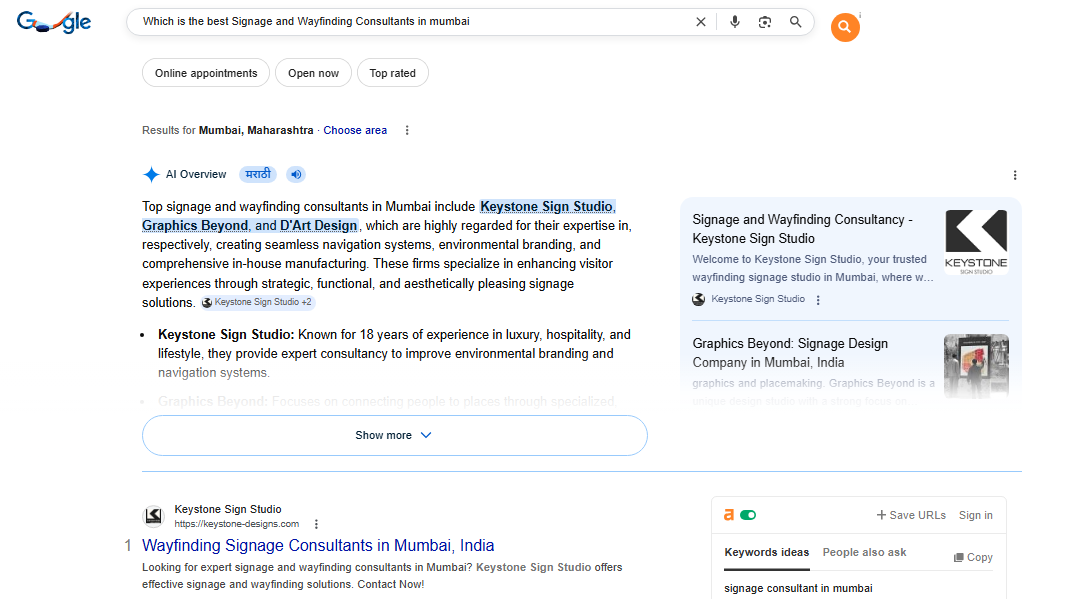
(AI-generated overview after implementing Answer-First structuring and entity schema, showing brand inclusion in summary responses.)
This transition demonstrated a critical insight:
- Ranking secured visibility in traditional search.
- Structured authority secured visibility in AI-generated answers.
This approach was not limited to a single engagement.
After implementing the GEO framework across multiple client accounts, we consistently observed improved AI visibility and stronger citation presence.
The pattern reinforced a clear conclusion: when expertise is structured for machine interpretation, AI systems are more likely to reference it.
What These GEO Outcomes Suggest About the Future of Search
Search is no longer about winning a keyword. It is about becoming a trusted source that AI systems confidently summarize and cite.
Authority is becoming platform-agnostic. Whether a user searches on Google, uses conversational AI tools, or uses voice assistants, visibility now depends on clarity, structure, and machine-readable expertise.
The future of search is shifting from finding links to trusting sources. Brands that adapt their content for AI interpretation will not just rank — they will be referenced.
Conclusion
Search is becoming an interpretation layer, not just a discovery channel. AI systems now shape how expertise is surfaced, compared, and trusted.
Brands that structure their knowledge clearly will influence how markets understand their category. Those that don’t may still exist online, but they won’t shape the narrative.
The opportunity ahead isn’t just visibility. It’s authority at the point of explanation.
Generative Engine Optimization is how brands participate in that shift.
Want to know if your brand appears in AI-generated answers?
Frequently Asked Questions (FAQs)
Is GEO better than SEO?
What is Answer-First content architecture?
This improves clarity for users and makes content easier for AI systems to extract and reference.
How can I tell if my brand appears in AI-generated answers?
If your brand isn’t mentioned while competitors are, you likely lack AI visibility
How do I know if my website needs geo-optimization?
Pramod Ram
Head of SEO, AIO, and Founder, RK Web SolutionsFounder of RK Web Solutions, specializing in SEO, AIO, AEO, GEO, and AI-first search strategies. With 14+ years of experience, he helps brands build visibility in the AI-driven search ecosystem, moving beyond traditional rankings to become a trusted source for AI-generated answers.
Related Posts
Why Some Brands Don’t Appear in “Top 10 Lists” but Still Win in AI-Driven Search
TL;DR Not appearing in “Top 10” lists does not mean a brand lacks visibility in AI-driven search. AI systems do not rank companies based on curated lists or popularity. They select sources based on clarity, consistency, and how well content explains a topic. Brands...
The Future of GEO: How AI Changes Brand Discovery in 2026 & Beyond
The Future of GEO: How AI Changes Brand Discovery in 2026 & BeyondWe have now officially entered the AI Discovery Era, a world where people no longer “search” with keywords. They simply ask AI questions in natural language. Instead of showing a list of links, AI...
Ranking Factors for AI Search Engines (2025 Study)
Ranking Factors for AI Search Engines (2025 Study)AI search engines are transforming the way content is searched, evaluated, and cited. AI search changes how information is consumed, but it still relies on the foundations of traditional SEO. While core SEO signals...